 Whalesbook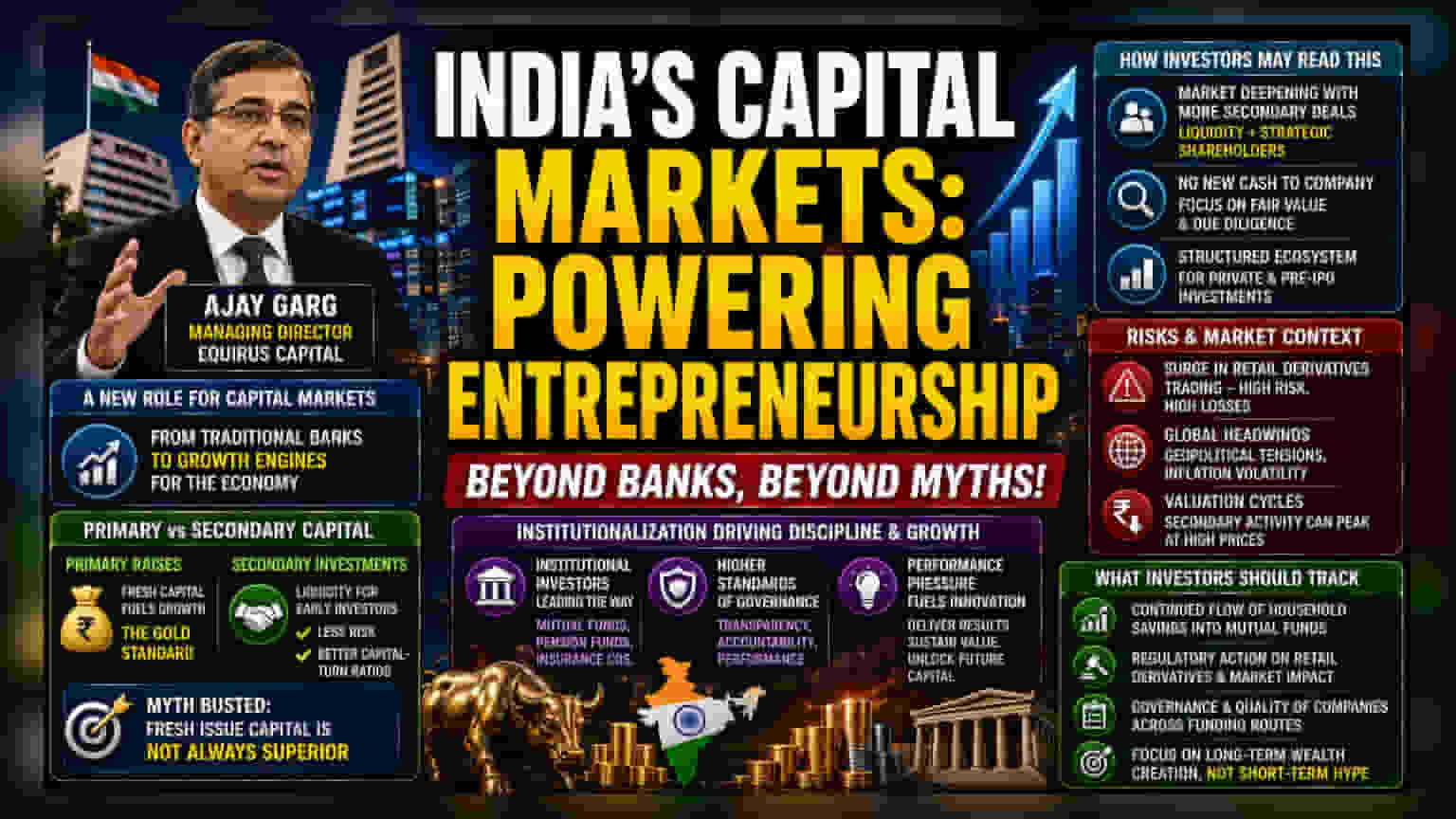


Ajay Garg of Equirus Capital explains why India’s maturing capital markets are shifting focus beyond traditional IPOs, highlighting the risk-adjusted value in secondary investments.
What Happened
Ajay Garg, Managing Director of Equirus Capital, has emphasized the evolving role of India’s capital markets in supporting entrepreneurship. During recent discussions, he highlighted that capital markets are increasingly becoming a vital engine for economic progress, moving beyond the traditional role of banks. Garg pointed out that while primary capital raises—such as Initial Public Offerings (IPOs)—are often viewed as the gold standard for growth, secondary investments (purchasing existing shares from earlier investors) offer unique advantages. He argues that these secondary opportunities can often carry less risk and provide better capital-turn ratios, challenging the common market myth that fresh issue capital is always superior.
The Shift in Market Strategy
For years, investors have often prioritized primary markets, where money goes directly into the company’s treasury to fuel expansion. However, the market is undergoing a structural change. As India’s corporate ecosystem matures, secondary deals—where private equity funds or early investors exit their positions to new institutional buyers—are gaining mainstream attention. This shift provides liquidity to early investors and allows companies to bring in new institutional shareholders who can offer fresh strategic guidance without the immediate pressure of a new capital injection.
Institutionalization and Discipline
The Indian capital market has seen a rapid increase in professional oversight. With domestic mutual funds, pension funds, and insurance companies playing a larger role, the market now enforces stricter discipline on promoters and entrepreneurs. This institutionalization means companies are held to higher standards of transparency, governance, and operational efficiency. Garg notes that this performance pressure, while demanding, ultimately fosters a culture of innovation, as companies must consistently deliver on promises to maintain their valuation and access to future capital.
How Investors May Read This
Investors often fixate on the excitement of IPOs, but the increasing prevalence of secondary market transactions suggests that the market is deepening. For individual investors, this means the ecosystem for buying and selling private or pre-IPO companies is becoming more structured. However, it is essential to understand that secondary investments do not provide the company with new cash for operations; they are essentially a transfer of ownership. This requires investors to conduct deeper due diligence on the fair value of the shares rather than focusing solely on the growth story of the company’s future expansion.
Risks and Market Context
While the market sentiment remains positive, investors should be aware of the challenges currently facing the broader financial system. There is growing regulatory concern regarding the dominance of speculative trading in equity derivatives, where retail investor participation has surged, often resulting in significant net losses. Additionally, while the Indian economy shows resilience, global headwinds—including geopolitical tensions and fluctuating inflation—continue to pose risks to market stability. Investors must also be cautious about valuation cycles, as secondary market activity can sometimes peak when prices are high, potentially exposing late entrants to corrections if market sentiment shifts.
What Investors Should Track
Moving forward, the key monitorables include the continued formalization of household savings into market-linked instruments like mutual funds, which supports liquidity. Investors should also watch for regulatory actions regarding retail derivatives, as these could influence short-term market volatility. Furthermore, observing the quality and governance standards of companies entering the market through various fundraising routes remains essential for long-term wealth creation, rather than just chasing the latest primary market offering.