

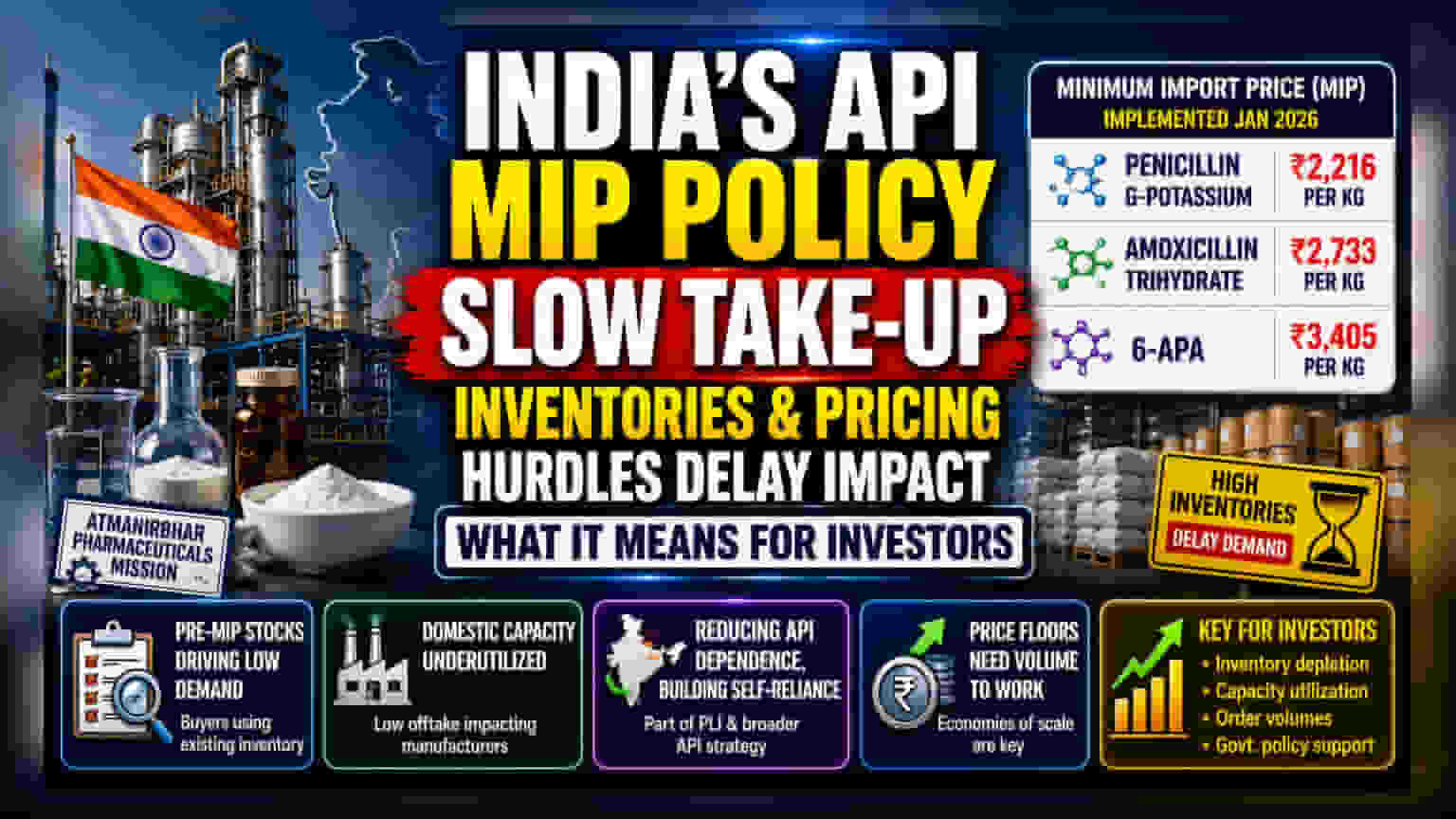
India's Minimum Import Price (MIP) policy for key antibiotic raw materials like Penicillin G and Amoxicillin has not yet boosted local manufacturing. Despite government efforts to curb low-cost imports, industry demand remains weak, leaving significant domestic production capacity underutilized as buyers work through existing inventories.
What Happened
The Indian government’s move to support local Active Pharmaceutical Ingredient (API) manufacturers through a Minimum Import Price (MIP) framework is facing a slow uptake. Implemented in January 2026, the policy set price floors for importing critical raw materials to make them less attractive than domestic alternatives. Specifically, the Directorate General of Foreign Trade (DGFT) fixed the MIP for Penicillin G-potassium at ₹2,216 per kg, Amoxicillin Trihydrate at ₹2,733 per kg, and 6-APA at ₹3,405 per kg. However, months later, industry executives report that demand for domestically produced inputs has not picked up, leading to underutilized manufacturing capacity across the sector.
Why The Policy Is Facing Hurdles
The government's intent was to strengthen India’s self-reliance by making it harder for cheap, imported raw materials—mostly from China—to undercut domestic producers. Despite this, pharmaceutical companies and traders have been slow to shift their sourcing to local suppliers. Industry participants note that buyers often prefer to stick with established supply chains unless there is a clear, immediate cost or availability advantage. Because the price floor is a regulatory measure rather than a fundamental shift in production costs, the expected migration to local sourcing has been sluggish.
The Inventory Factor
Many in the industry believe the current low uptake is a temporary phase. Executives point out that buyers had anticipated the policy change and stockpiled significant quantities of raw materials before the MIP went into effect. As long as these pre-MIP inventories remain, demand for fresh material from domestic manufacturers is unlikely to rise sharply. The expectation is that once these existing stockpiles are fully consumed, pharmaceutical companies will be forced to turn to domestic sources at the new price benchmarks, which could finally lead to higher capacity utilization.
The Broader API Strategy
India has been attempting to reduce its heavy dependence on foreign APIs, with China historically supplying a large share of the country’s raw material needs. The MIP is part of a broader government strategy, including the Production Linked Incentive (PLI) scheme, designed to build an independent and resilient domestic API ecosystem. However, the sector still faces a structural challenge: while India has built significant manufacturing capacity, it often struggles to compete with the economies of scale and integrated supply chains found in other markets. For many domestic manufacturers, the current challenge is not just about competing on price, but about ensuring that their plants can operate at efficient levels to justify the high fixed costs of production.
What Investors Should Track
For investors following the pharmaceutical and API manufacturing sector, the next few quarters will be critical. The key monitorable is the depletion of high-cost inventory stockpiles, which should eventually force a return to fresh buying. Investors may track commentary from management teams in the bulk drug sector regarding capacity utilization rates and whether the government provides any further support to help domestic units become more cost-competitive. Any material improvement in order volumes for Indian API manufacturers would be a primary indicator that the MIP policy is beginning to deliver its intended benefits.