

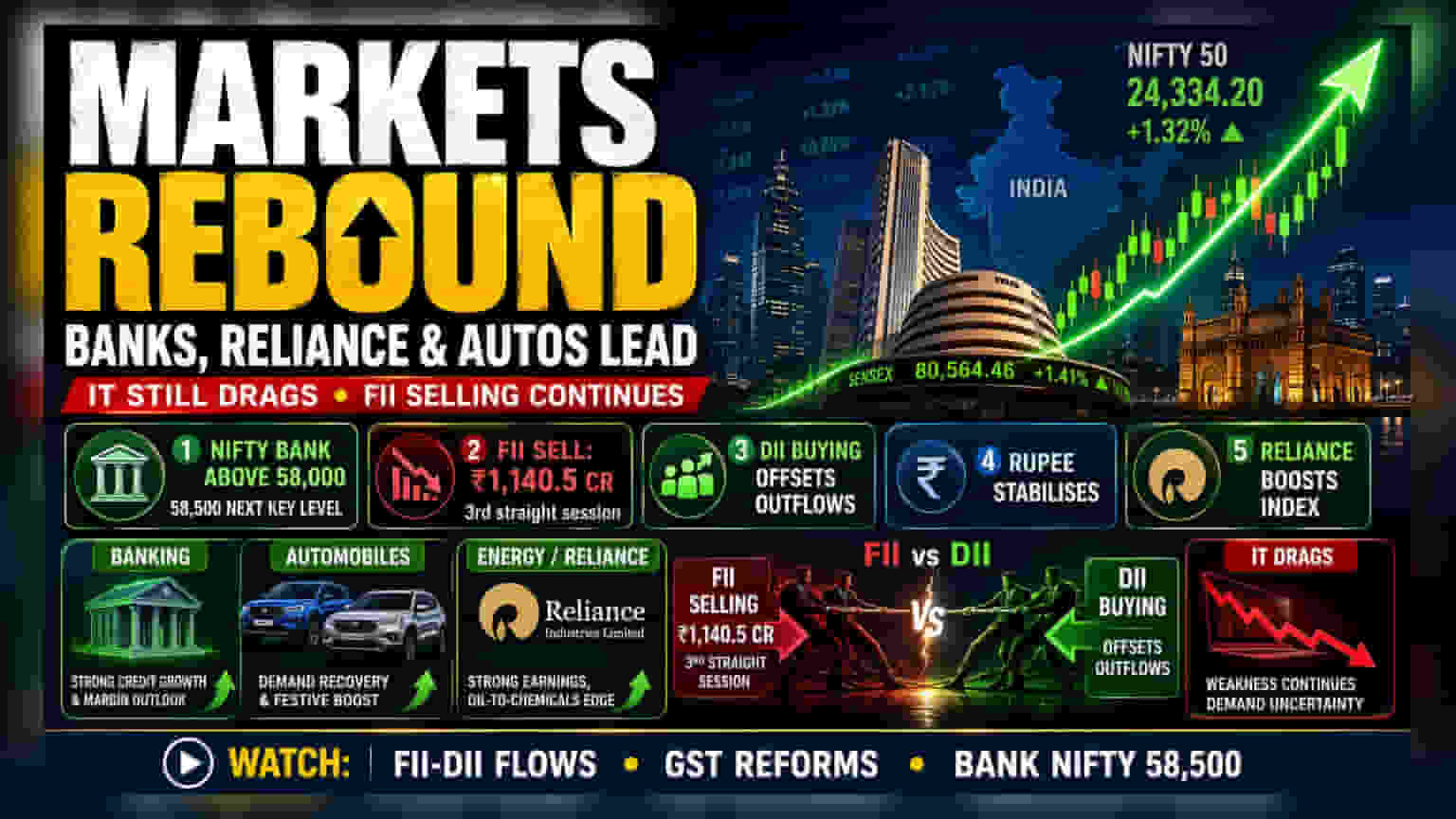
Indian benchmarks snapped a two-day losing streak on Wednesday, supported by gains in financial and auto stocks. Despite persistent selling by foreign investors, strong domestic institutional buying and relief in the rupee helped sustain the positive momentum.
What Happened
Indian equity markets staged a recovery on Wednesday, ending a two-day decline. The rebound was primarily driven by heavy buying in financial services, Reliance Industries, and the automobile sector. These gains helped offset the ongoing pressure within the information technology (IT) sector, which remained a drag on the broader market performance. Improving macroeconomic indicators and a slight stabilization in the rupee provided further confidence to market participants.
Financials and Reliance Power the Move
Financial stocks emerged as the clear leaders of the session. The Nifty Bank index performed particularly well, crossing the 58,000 mark. Analysts are now watching 58,500 as the next key resistance level—a point where supply could potentially increase. Reliance Industries also contributed significantly to the index gains, providing the necessary weight to pull the benchmark higher despite the underperformance in IT shares.
The FII-DII Tug-of-War
Foreign Institutional Investors (FIIs) remained net sellers for the third consecutive session, offloading equities worth approximately ₹1,140.50 crore on Wednesday. Over the last three days, foreign investors have pulled out more than ₹5,000 crore from the Indian equity market. However, domestic institutional investors (DIIs) have been actively buying, acting as a buffer against this outflow. This ongoing dynamic between foreign selling and domestic buying remains a critical factor for market volatility.
Policy and Corporate Updates
Outside of the core index moves, there were notable developments in the corporate and policy space. Nayara Energy caught the market's attention by announcing a reduction in petrol prices by ₹5 per litre and diesel by ₹3 per litre. Such reductions are often monitored by investors for their potential impact on transport costs and inflation. Additionally, there is renewed discussion regarding the next phase of GST reforms. Policymakers and experts are debating changes to simplify the tax structure, reduce litigation, and correct the inverted duty structure, which could have long-term implications for corporate margins.
Sector Trends to Monitor
Investors are also analyzing the June auto sales data, with reports from majors like Maruti Suzuki and Hyundai offering a look into consumer demand patterns. Meanwhile, the global environment remains complex. International headlines, such as significant income reports from cryptocurrency ventures linked to family offices and US judicial rulings on citizenship, are being digested by global markets, keeping investors cautious.
What Investors Should Track
Moving forward, the primary monitorable will be whether Wednesday’s gains can be sustained in the Thursday trading session. Key indicators to watch include the daily flow of FII versus DII money, the stability of the rupee, and any further updates on GST reform proposals. With the Bank Nifty testing technical resistance at 58,500, trading volume and price action near these levels will be crucial for determining the short-term market trend.