

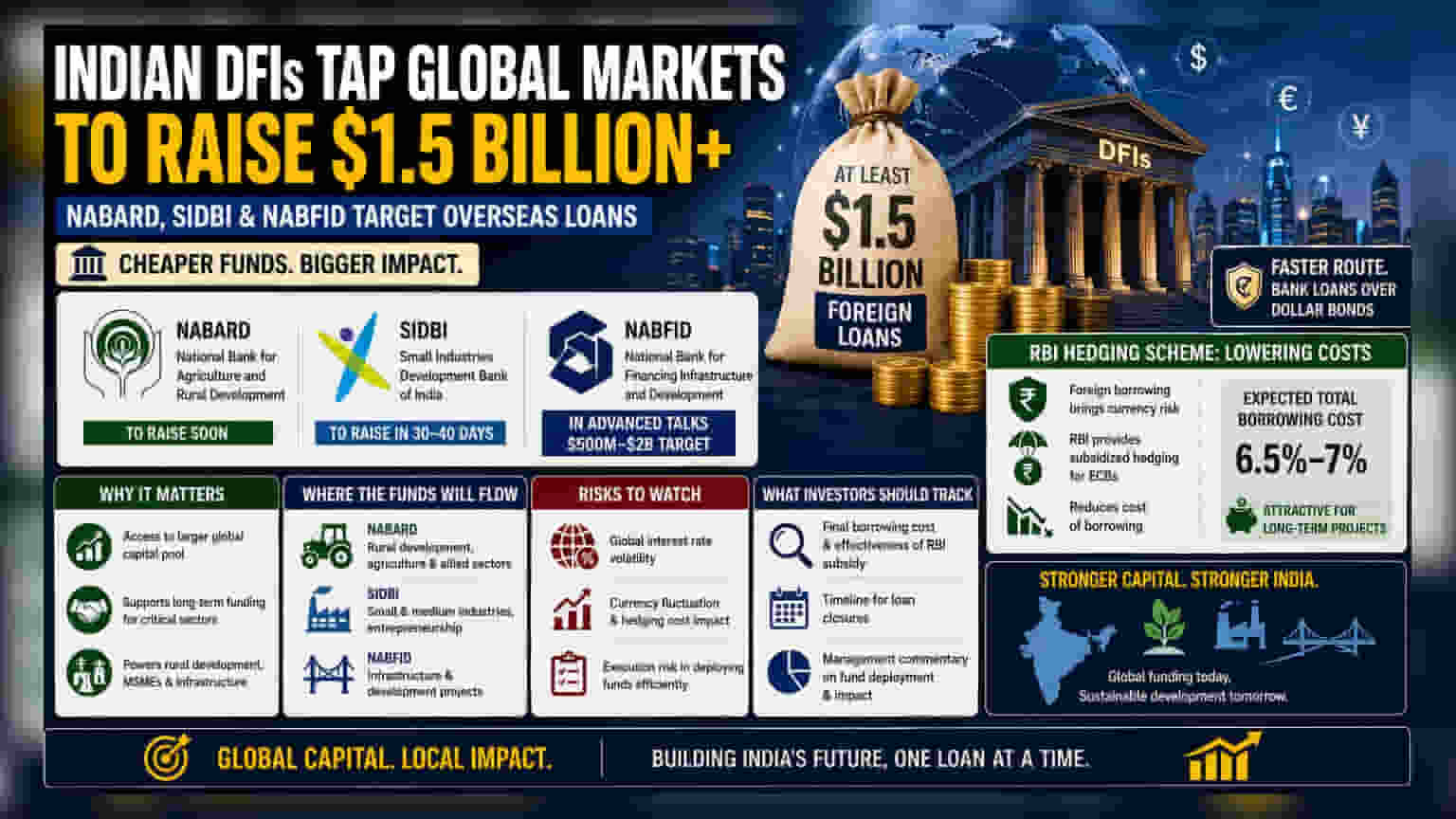
Three major Indian development finance institutions—NaBFID, Nabard, and Sidbi—are planning to raise at least $1.5 billion through foreign-currency loans. By utilizing an RBI-supported hedging scheme, these institutions aim to lower their borrowing costs compared to issuing dollar bonds. This move is designed to support long-term funding for infrastructure and development projects while helping manage currency fluctuation risks.
What Happened
Three key development finance institutions (DFIs) in India—the National Bank for Agriculture and Rural Development (Nabard), the Small Industries Development Bank of India (Sidbi), and the National Bank for Financing Infrastructure and Development (NaBFID)—are moving to tap international markets. They plan to raise a combined total of at least $1.5 billion through foreign-currency loans.
NaBFID is leading this effort and is in advanced talks with potential lenders. It aims to secure between $500 million and $2 billion in the current financial year. Meanwhile, Nabard and Sidbi are expected to begin their fund-raising efforts within the next 30 to 40 days. Unlike dollar bonds, which require a more complex and time-consuming process, these institutions are opting for bank loans for a faster execution.
The Role of the RBI Hedging Scheme
The core of this strategy involves an incentive provided by the Reserve Bank of India (RBI). Borrowing in foreign currency, such as the US Dollar, typically exposes Indian lenders to currency risk—the possibility that the rupee might lose value against the dollar, making repayment more expensive.
The RBI has introduced a scheme that offers subsidized hedging for external commercial borrowings (ECBs). Hedging acts like an insurance policy against currency movement. By subsidizing this cost, the RBI is effectively lowering the total expense for these institutions. NaBFID expects its total borrowing cost to land between 6.5% and 7%, which the institution finds attractive for its capital needs.
Why This Matters for Development Finance
These DFIs play a specific role in the Indian economy. Nabard focuses on rural development, Sidbi supports small and medium-sized industries, and NaBFID is dedicated to financing long-term infrastructure projects. Because these projects require massive, long-term capital, these institutions need access to diverse funding sources. Raising debt in foreign markets allows them to access a larger pool of capital than what might be available solely through domestic sources.
Understanding the Risks
While the RBI's hedging scheme reduces the immediate cost of currency protection, investors should understand that foreign borrowing carries inherent risks. Even with hedging, the cost of borrowing is influenced by global interest rates and market sentiment. If global rates rise or if liquidity in foreign markets tightens, future borrowing costs could increase. Additionally, while these institutions are backed by state mandates, their ability to manage foreign debt depends on their internal ability to deploy these funds efficiently into profitable or developmental projects that can generate the cash flow needed for repayment.
What Investors Should Track
For those tracking the broader financial sector, the key monitorable will be the actual execution of these loans. Investors should watch for:
- The final cost at which these institutions are able to raise the money, as this indicates how effective the RBI's subsidy is.
- The timeline for when these loans are finalized, which will suggest the level of appetite global lenders have for Indian DFI debt.
- Any management commentary regarding the deployment of these funds, which will clarify how these billions are being used to support infrastructure and rural development.