

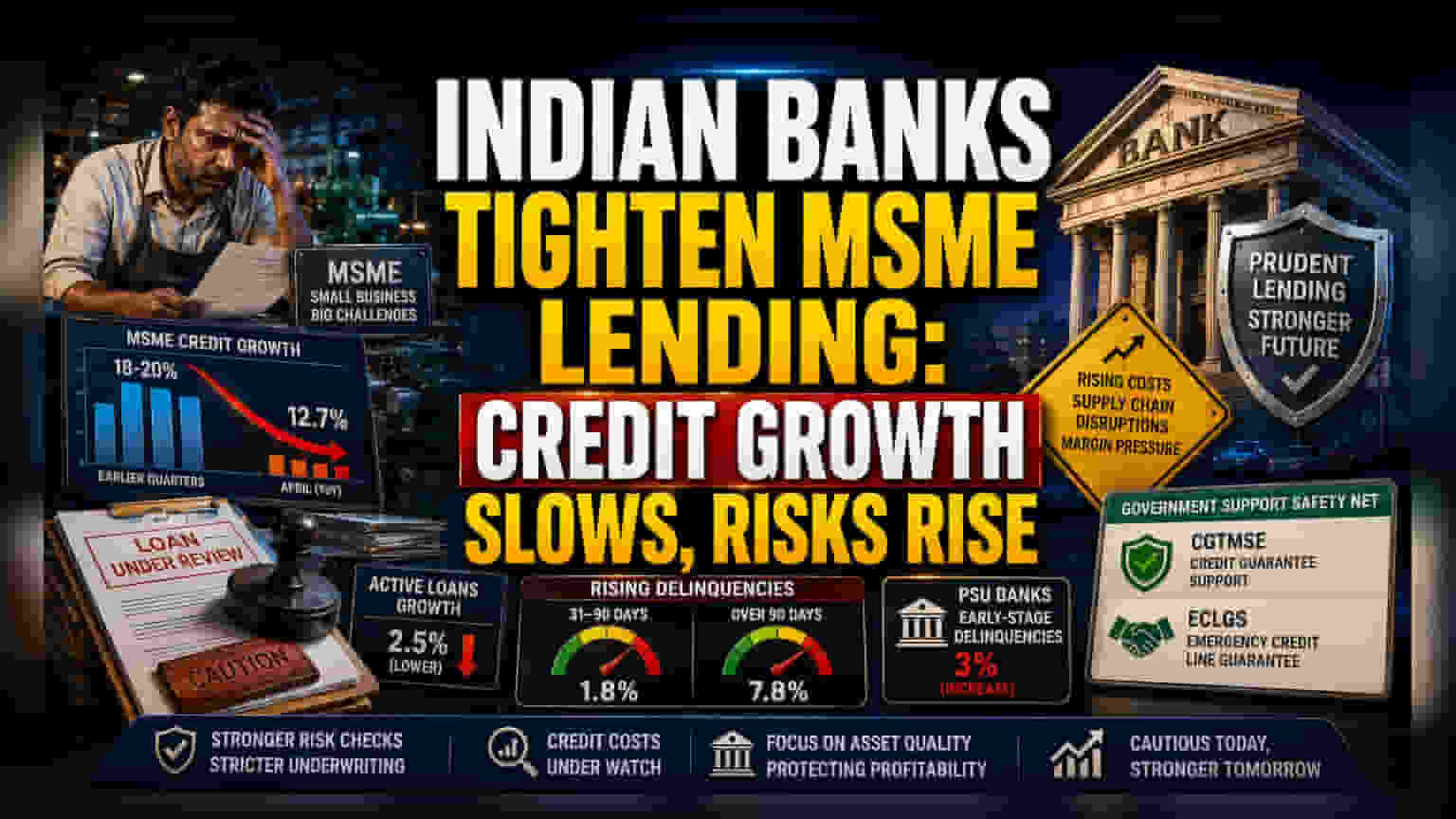
Indian banks are becoming more cautious with lending to micro, small, and medium enterprises (MSMEs) as credit growth slows to 12.7% and repayment delays rise. Rising delinquency rates, particularly among public sector banks, have led to stricter approval standards. Investors should note how this shift, driven by higher input costs and global supply chain issues, could impact future bank profitability and credit costs.
What Happened
Indian banks are adopting a more conservative stance toward lending to micro, small, and medium enterprises (MSMEs). Recent data from April shows that credit growth for this segment has slowed to 12.7% year-on-year, a significant drop from the 18% to 20% expansion seen in previous quarters. The slowdown is even more evident in the number of active loans, which grew by only 2.5% compared to earlier periods of faster expansion.
Reserve Bank of India (RBI) data indicates that total MSME lending has remained largely stagnant at ₹14.49 lakh crore, slipping from ₹15 lakh crore recorded in March. Lenders are responding to these signals by strengthening their internal checks and applying stricter standards before approving new loans.
Why Asset Quality Matters for Banks
Banks are seeing an early rise in delinquency rates, which refers to the number of loans where borrowers have delayed payments. Data indicates that loans with 31 to 90 days of delay have risen to 1.8%, while loans with over 90 days of delay have climbed to 7.8%.
This shift is not uniform across the banking sector. Public sector banks are experiencing a more noticeable increase in stress compared to private sector peers, with early-stage delinquencies in this segment rising to 3%. This is a critical monitorable for investors, as higher credit costs—the money banks must set aside for potential loan losses—can directly reduce a bank’s profitability and return on assets.
Factors Driving the Stress
External factors are placing pressure on the repayment capacity of smaller businesses. Disruptions in global supply chains and rising input costs, partly linked to the ongoing conflict in West Asia, are affecting margins for smaller firms. Businesses in sectors such as textiles, chemicals, and auto components appear to be more sensitive to these cost pressures. Banks are now watching these industries closely to see if the current stress is a temporary bump or a sign of a deeper cycle of defaults.
The Role of Government Support
While banks are cautious, there are support mechanisms in place. Government-backed programs like the Credit Guarantee Fund Trust for Micro and Small Enterprises (CGTMSE) and the Emergency Credit Line Guarantee Scheme (ECLGS) continue to act as a buffer. These schemes provide lenders with a safety net, helping to manage risks. However, the fact that some firms are accessing these facilities as a precaution highlights the general climate of uncertainty in the small business sector.
What Investors Should Track Next
For investors, the key monitorable will be the quarterly financial results of banks with high exposure to the MSME segment. Specifically, look for updates on credit costs and asset quality trends in earnings calls. If delinquencies continue to rise, banks may maintain their cautious lending approach, which could limit growth in their loan books for the coming quarters. Monitoring whether private or public sector banks manage to control these credit costs effectively will be important for assessing future performance.