 Whalesbook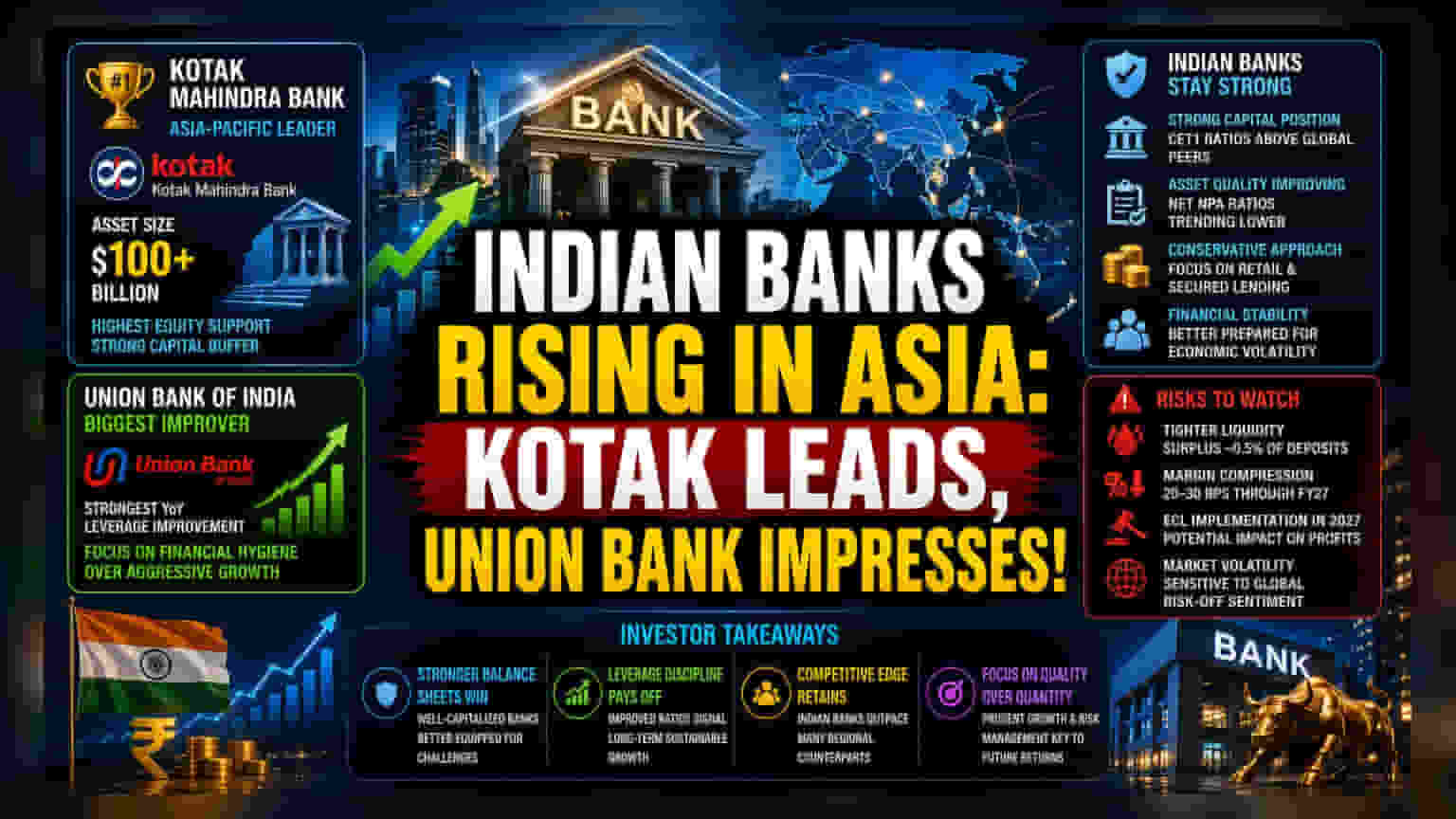


Regional Financial Positioning
The Indian banking sector is currently reasserting its presence in the Asia-Pacific theater, with recent data highlighting a focus on capital structure and leverage management. Kotak Mahindra Bank, with its substantial asset base exceeding $100 billion, leads the ranking for large-scale institutions. This positioning reflects the bank's ability to maintain high equity support relative to assets, providing a buffer against the volatile economic environment that has hampered regional peers in the first half of 2026.
The Growth Versus Stability Trade-off
While Kotak Mahindra Bank anchors the top of the league tables, Union Bank of India has secured the most significant year-on-year improvement in leverage ratios. This pivot is notable for a public-sector lender, signaling an emphasis on financial hygiene over raw credit expansion. Data from the current fiscal year suggests that such improvements are not merely statistical artifacts but the result of institutional efforts to harden balance sheets against potential liquidity constraints and inflationary pressures. For investors, this shift is critical; as deposit costs rise and credit growth moderates, banks with superior capital management are better positioned to sustain margins compared to those relying on aggressive, high-risk leverage.
Competitive Context and Sectoral Risks
Indian lenders currently navigate a complex environment characterized by tighter liquidity surplus—which has dipped to approximately 0.5% of deposits—and persistent external economic uncertainties. Unlike some regional counterparts in Southeast Asia that have shifted loan portfolios toward vulnerable micro and small enterprise segments, Indian banks have generally maintained more conservative asset quality, with net non-performing asset ratios trending lower. However, the sector is not immune to risk. Analysts note that while capital buffers remain strong—with CET1 ratios significantly higher than those of major U.S. or European peers—the expected implementation of expected credit loss (ECL) frameworks in 2027 and potential margin compression of 20–30 basis points through FY27 pose tangible threats to near-term profitability.
The Bear Case: Hidden Vulnerabilities
Despite the positive headlines surrounding leverage metrics, institutional skeptics point toward the untested nature of these reforms in a sustained down-cycle. A primary concern is the narrowing flexibility of the Reserve Bank of India to provide liquidity, which could force banks to compete more aggressively for retail funds, thereby squeezing net interest margins. Furthermore, historical volatility in the Nifty Bank index throughout Q1 2026 serves as a reminder that Indian banking valuations remain sensitive to global risk-off sentiment. For lenders like Union Bank, the path forward requires maintaining this improved leverage profile while simultaneously managing the transition toward a more digital-heavy, potentially higher-cost funding structure.