 Whalesbook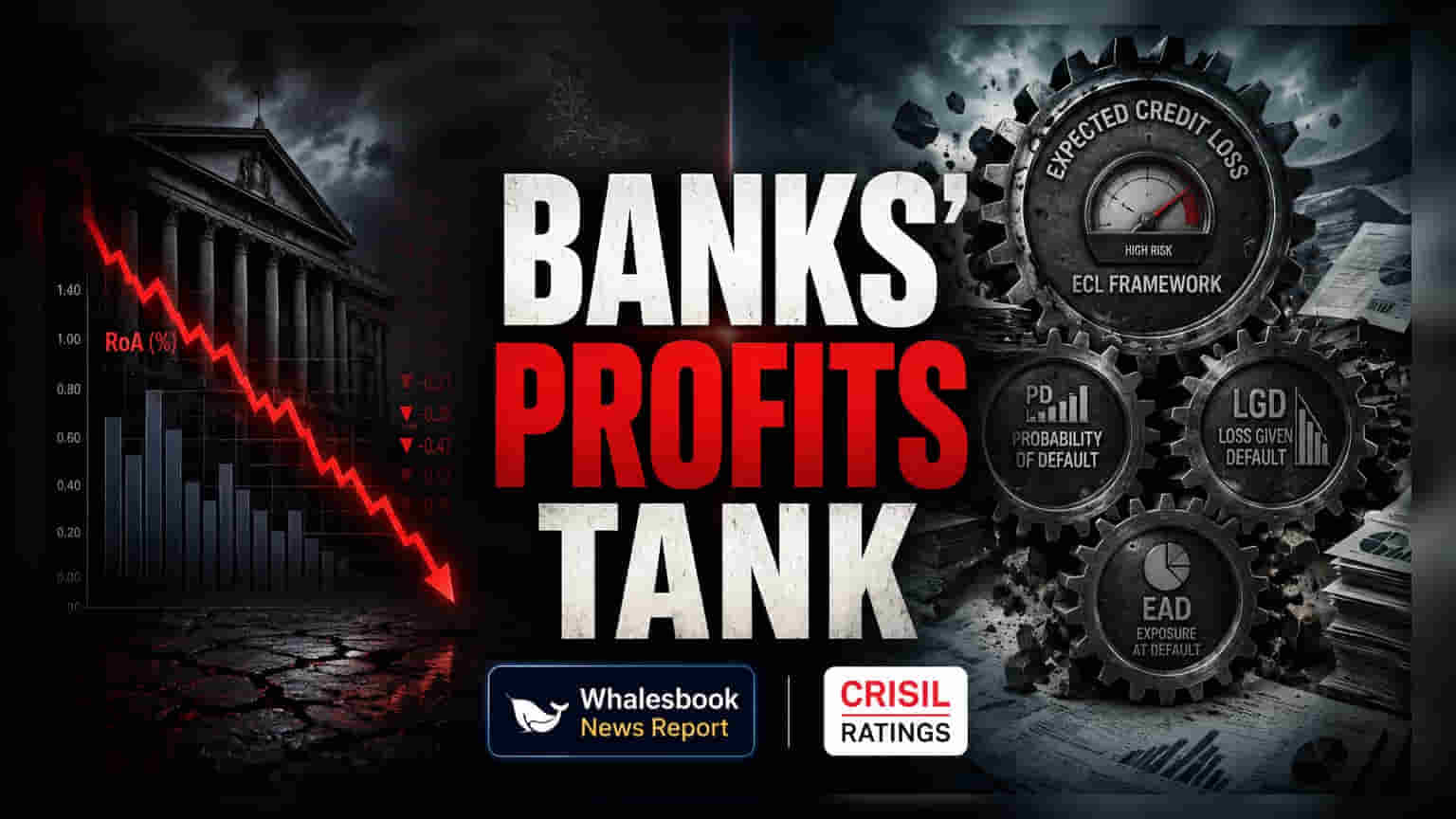


The Margin Normalization Phase
The Indian banking sector is pivoting toward a period of disciplined moderation after a banner fiscal year 2026, during which listed banks collectively breached the ₹4 lakh crore profit threshold for the first time. Current projections suggest a softening of return on assets (RoA) to the 1.15-1.2% range for FY2027. This cooling is not a reflection of fundamental asset quality decay, but rather a deliberate recalibration of bank balance sheets in response to shifting macroeconomic signals and stringent upcoming regulatory requirements.
Treasury Gains and the ECL Shift
The primary engine of the expected RoA contraction is the normalization of treasury income. Last year’s fiscal performance was bolstered by opportunistic mark-to-market gains as bond yields fluctuated. With the benchmark 10-year government bond yield now tethered in a tighter, elevated range—driven by persistent global geopolitical tensions and oil price sensitivities—the scope for similar trading windfalls has evaporated.
Simultaneously, banks are proactively fortifying their capital buffers ahead of the Reserve Bank of India’s (RBI) new Expected Credit Loss (ECL) framework. Effective April 1, 2027, this mandate marks a significant shift from reactive, incurred-loss provisioning to a forward-looking, probability-weighted model. Although the transition is widely viewed as a long-term structural positive that aligns India with global standards, it necessitates an immediate increase in provision coverage. By front-loading these expenses, institutions are effectively trading short-term profit volatility for future institutional resilience.
The Structural Funding Gap
While operating margins are being managed, the sector faces a lingering liquidity challenge. Credit growth continues to outpace deposit mobilization, with the credit-to-deposit (CD) ratio remaining near historic highs. This divergence is forcing banks to rely more heavily on expensive funding instruments, such as certificates of deposit (CDs), which reached record issuance levels in the final quarter of FY2026. This heightened competition for retail and bulk deposits is likely to keep the cost of funds elevated, placing a natural ceiling on net interest margins (NIMs) throughout the fiscal year.
The Forensic Bear Case: Risks to the Outlook
Despite the prevailing optimism regarding the sector's capital adequacy, institutional risks remain. The banking system’s reliance on short-term market funding to bridge the credit-deposit gap is a potential stress point if liquidity conditions tighten further. Furthermore, while the RBI has provided a four-year glide path for ECL implementation, the specific impact on Common Equity Tier 1 (CET1) ratios will vary significantly across lenders. Banks with weaker initial provision buffers or higher exposure to retail segments—such as gold or unsecured personal loans—may face disproportionate pressure on their capital profiles. Finally, any escalation in geopolitical conflict or a spike in crude oil prices beyond $110 per barrel would likely force the RBI to maintain a restrictive stance, further suppressing bond prices and dragging down the treasury income segment more severely than current estimates anticipate.