

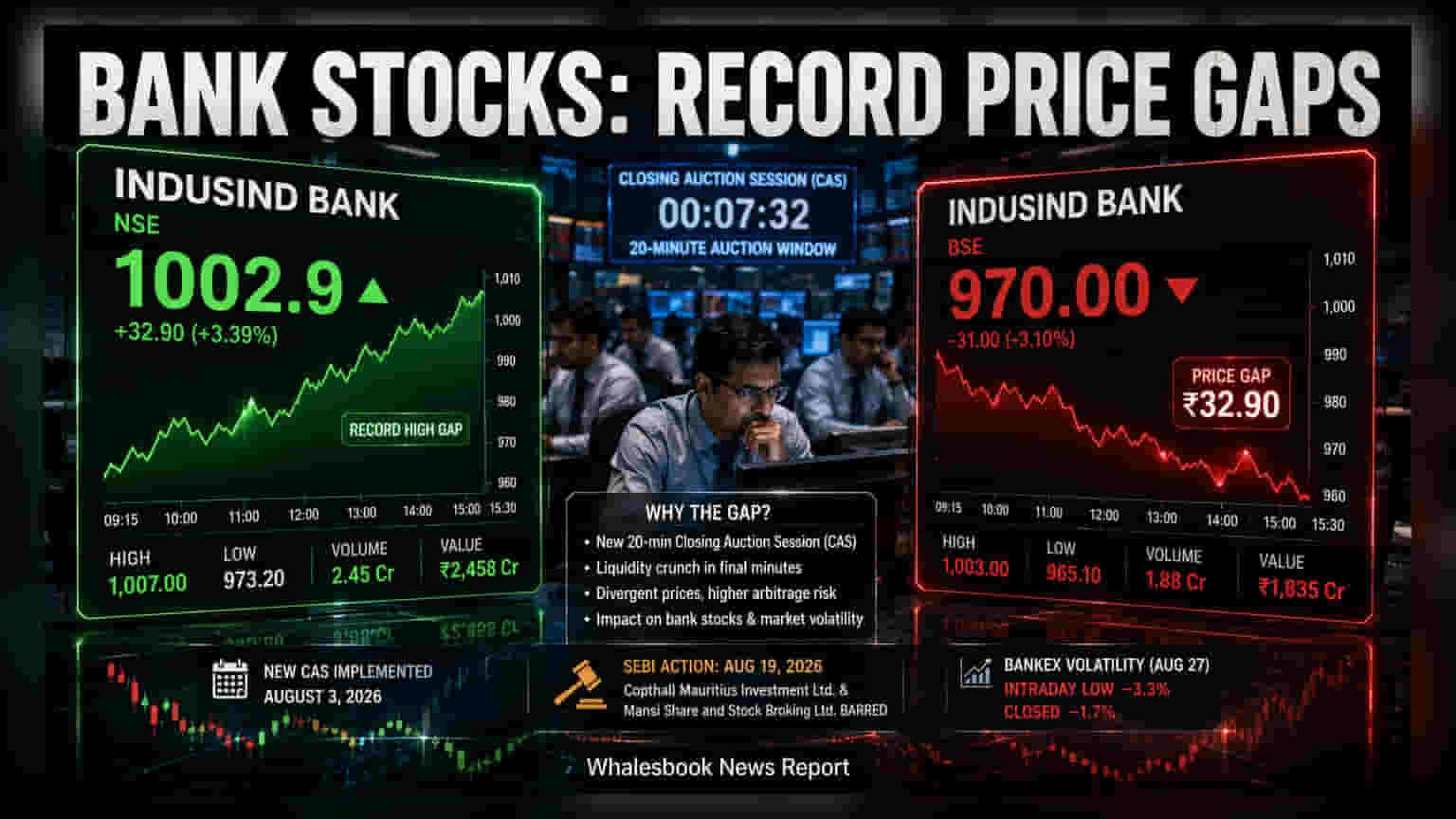
Indian banking stocks are seeing record price differences between the NSE and BSE following the new closing auction system launched on August 3. The wide gaps, highlighted by IndusInd Bank’s recent ₹33 price spread, are disrupting arbitrage and raising concerns about market liquidity. With SEBI investigating alleged manipulation, investors are watching for regulatory updates to improve price stability.
A significant change in how Indian stock markets determine closing prices is causing unexpected friction for banking stocks. Since the implementation of the new Closing Auction Session (CAS) on August 3, 2026, investors have observed unusually wide price gaps between the National Stock Exchange (NSE) and the BSE. On Thursday, August 27, this issue reached a two-decade high for several lenders, including IndusInd Bank, AU Small Finance Bank, IDFC First Bank, and Federal Bank.
For example, IndusInd Bank saw a notable price discrepancy on August 27, closing at ₹1,002.9 on the NSE while falling to ₹970 on the BSE. A gap of nearly ₹33 for a single stock is rare and indicates that the price discovery mechanism is struggling to synchronize across the two exchanges during the new 20-minute auction window.
The core of the problem lies in the design of the new auction session, which was intended to replace the previous weighted average price method. Market participants, including institutional traders, have noted that the 20-minute window often lacks the deep liquidity required to bridge pricing differences between the two exchanges. This has effectively made traditional arbitrage—the strategy of buying on one exchange and selling on another to profit from price differences—highly risky. When prices move in opposite directions or fail to align during the final minutes of the day, investors and traders can face unintended losses.
The volatility has also impacted broader market indices. The BSE Bankex gauge, which tracks 14 major banking stocks, experienced sharp fluctuations on August 27, dropping by 3.3% at one point during the auction period before eventually closing 1.7% lower. This erratic movement has raised concerns that the new system may be amplifying volatility rather than reducing it, especially during busy trading periods like the monthly derivatives expiry.
Regulatory authorities are now heavily involved. On August 19, 2026, the Securities and Exchange Board of India (SEBI) issued an interim order barring a unit of JPMorgan Chase & Co. (Copthall Mauritius Investment Ltd.) and Mansi Share and Stock Broking Ltd. from the market. The regulator alleged that these entities were involved in price manipulation during the closing auction on August 13.
This regulatory crackdown has added a layer of caution to the market, as institutional and retail investors alike try to navigate the challenges of the new system. For investors, the most critical monitorable in the coming weeks will be how regulators and exchange operators respond to these complaints. Market participants are waiting to see if there will be adjustments to the auction window or new guidelines to improve liquidity and prevent similar price distortions. Until the system stabilizes, the risk of sudden, large price movements during the closing period remains a factor for traders to manage.