

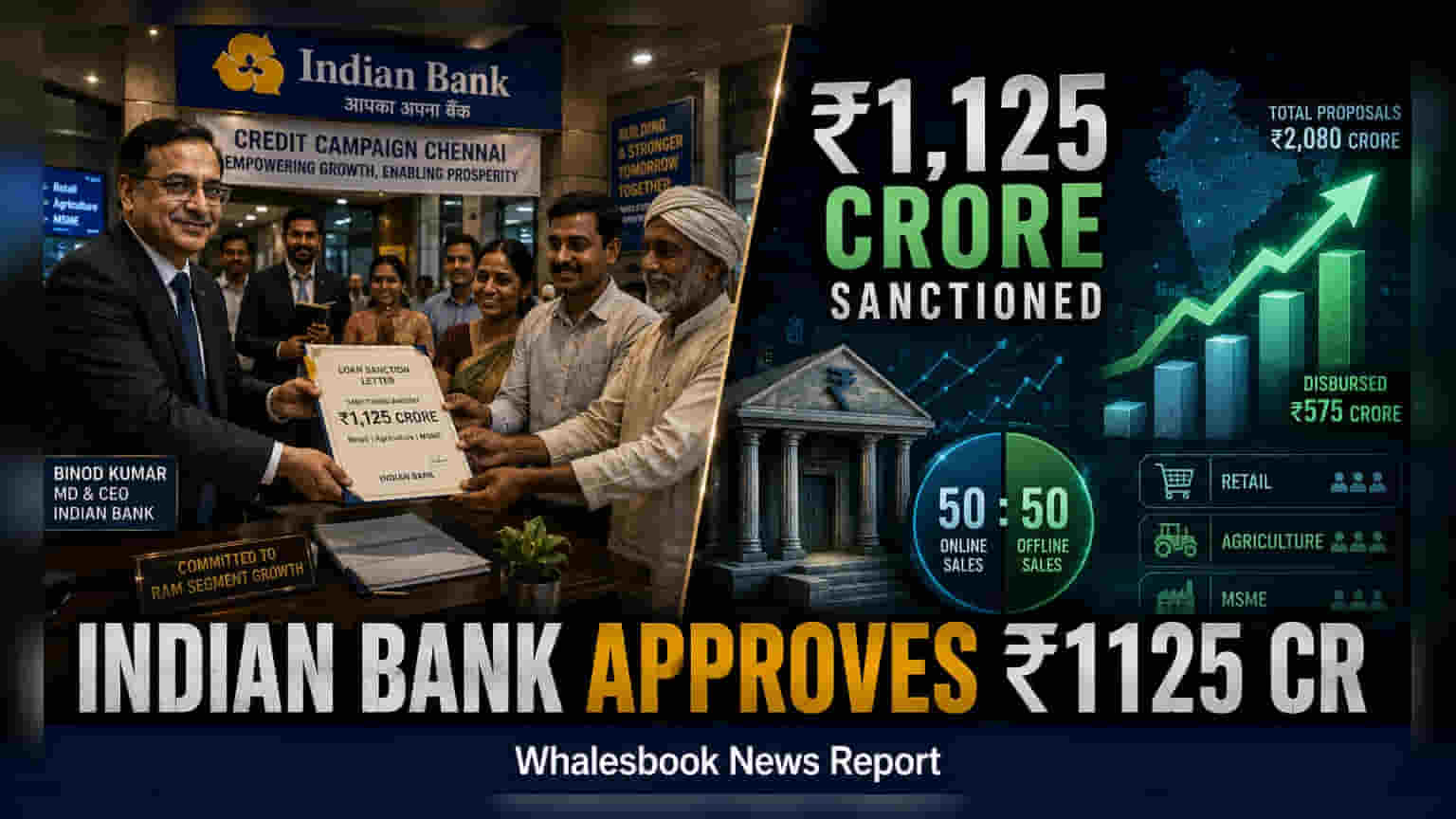
Indian Bank has sanctioned ₹1,125 crore during a major credit drive in Chennai, with ₹575 crore already disbursed to the retail, agriculture, and MSME sectors. The initiative highlights the bank's strategy to grow its core loan book. Investors are now tracking how this expansion balances with the bank's ongoing efforts to maintain asset quality and manage provisioning against broader economic risks.
Indian Bank recently concluded a large-scale credit campaign through its Field General Manager’s Office in Chennai, where it sanctioned loans worth ₹1,125 crore. The initiative saw significant participation, with total loan proposals amounting to ₹2,080 crore. Out of the sanctioned amount, the bank has already disbursed ₹575 crore to borrowers in the retail, agriculture, and MSME (Micro, Small, and Medium Enterprises) sectors, demonstrating a push for quick capital deployment.
This credit drive aligns with the bank's broader strategy to prioritize the 'RAM' segment—Retail, Agriculture, and MSME. For public sector banks, focusing on these areas is a strategic move to diversify loan portfolios and reduce reliance on large, cyclical corporate accounts. By increasing its reach in these sectors, the bank aims to build a more granular and potentially stable revenue stream.
Investors looking at the bank's financial health will note its recent performance. In the quarter ending June 2026, Indian Bank reported a net profit of ₹3,273 crore, marking a 10.09% increase compared to the same period last year. Its asset quality has also remained resilient, with a Gross NPA (Non-Performing Asset) ratio of 1.86% as of June 30, 2026. This data suggests that while the bank is aggressively pursuing growth in credit, it has been effective in keeping bad loans in check.
However, the path forward involves balancing this growth with risk management. The bank has indicated that it is setting aside precautionary provisions, partly due to geopolitical tensions in regions like West Asia. Such provisions are essential buffers that ensure the bank remains stable if global or local economic conditions become uncertain. While the RAM segment is generally safer than large corporate lending, it is not immune to risks. MSMEs and agricultural borrowers can be sensitive to economic fluctuations, such as changes in raw material costs or seasonal conditions, which may impact repayment capacity.
The key monitorable for shareholders will be the sustainability of this loan growth. Investors should watch future quarterly updates to see if the bank can maintain this pace of lending without causing pressure on its net interest margins or asset quality. Management commentary on credit costs and the health of the retail and MSME loan books will provide further clarity on how the bank plans to navigate the coming quarters.