

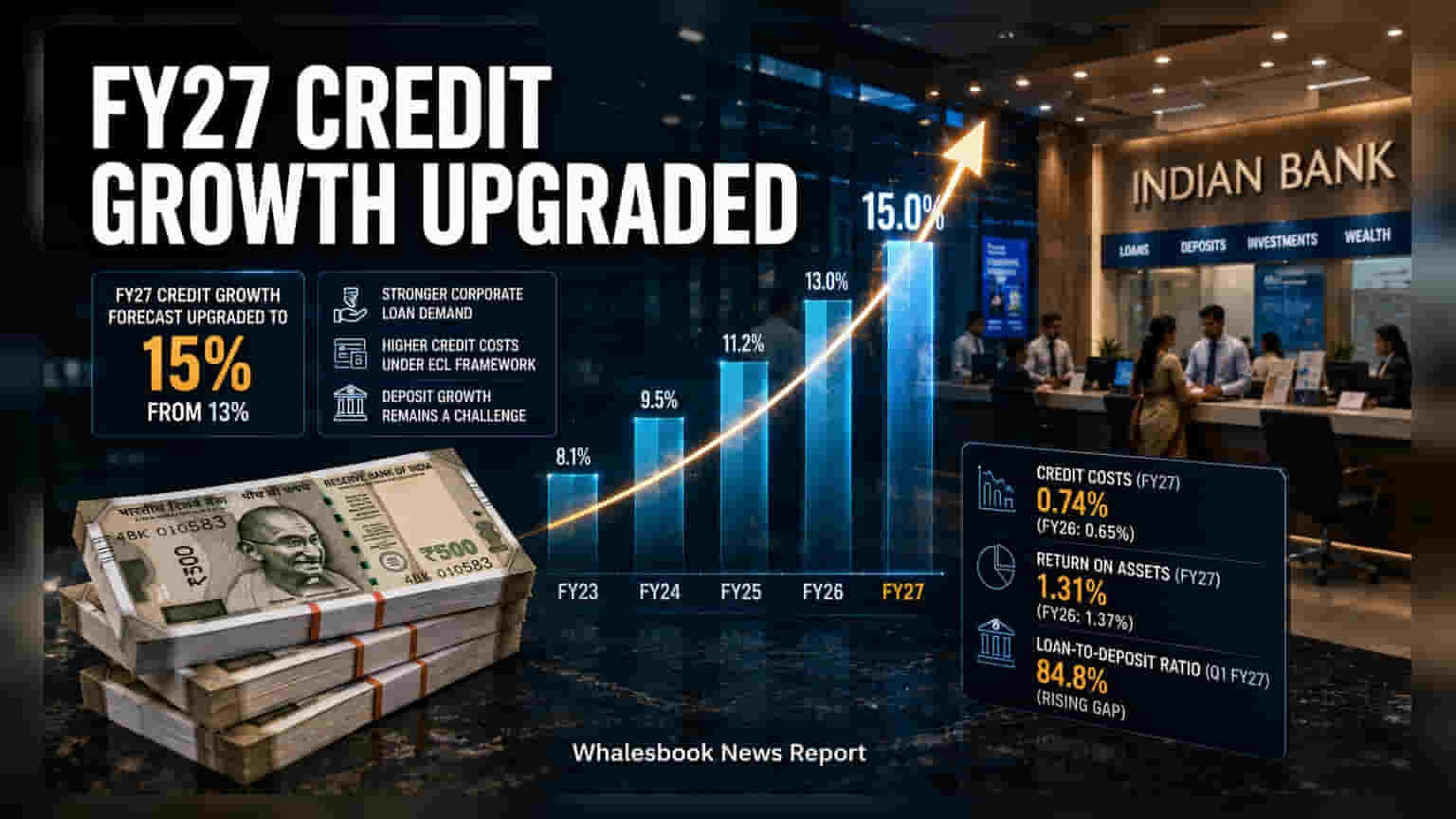
India Ratings has upgraded its bank credit growth forecast for fiscal year 2027 to 15 percent, driven by strong corporate demand. However, the agency warns that new accounting rules for loan provisions may pressure bank profitability. Investors should monitor how lenders balance this loan growth with the challenge of gathering enough deposits.
India Ratings and Research has revised its credit growth forecast for the Indian banking sector for fiscal year 2027, lifting the expectation to 15 percent from its previous estimate of 13 percent. This upgrade reflects an increase in corporate lending, as businesses ramp up demand for working capital and expansion projects. While the increase signals a more active economy, the rating agency has cautioned that this growth comes with notable challenges for bank profitability.
The core of the agency’s caution lies in the transition to the Expected Credit Loss (ECL) provisioning framework. Under these new guidelines, banks are required to set aside more money as a buffer against potential future loan losses. This regulatory shift is expected to push credit costs—the amount banks charge against their profits to cover bad loans—to 0.74 percent for fiscal year 2027, up from 0.65 percent in the previous year. As a result, the overall system-wide return on assets, a key metric used to measure how effectively a bank uses its money to generate profit, is projected to dip by 0.06 percent to 1.31 percent.
Public sector banks are expected to feel this impact more acutely than their private sector counterparts. This is largely because private lenders often maintain stronger provisioning buffers—essentially, they have already set aside more money for rainy days. For public sector banks, the transition to the new accounting norms may create a larger one-time drag on their balance sheets.
Beyond profitability concerns, there is a structural challenge in how banks fund their loans. The gap between credit growth and deposit growth has become a focal point, with the loan-to-deposit ratio climbing to 84.8 percent in the first quarter of fiscal 2027. This ratio indicates that banks are lending money at a pace that is outpacing their ability to collect deposits. While regulatory measures, such as those targeting specific foreign currency deposits, aim to ease this pressure, the deposit-mobilization challenge remains a critical hurdle for sustained credit expansion.
Meanwhile, Non-banking finance companies (NBFCs) are taking a more cautious approach. Rather than chasing aggressive growth, many are pivoting their strategies toward improving asset quality and ensuring stable loan collection. These companies are navigating a complex environment where inflationary pressures and changing weather patterns can impact the ability of borrowers to repay their loans.
For investors, the key area to monitor will be how banks manage the delicate balance between capturing the current credit demand and maintaining deposit growth. As banks adjust to the new provisioning standards, the ability to protect profit margins while expanding the loan book will be the most important trend to watch in upcoming quarterly results.