

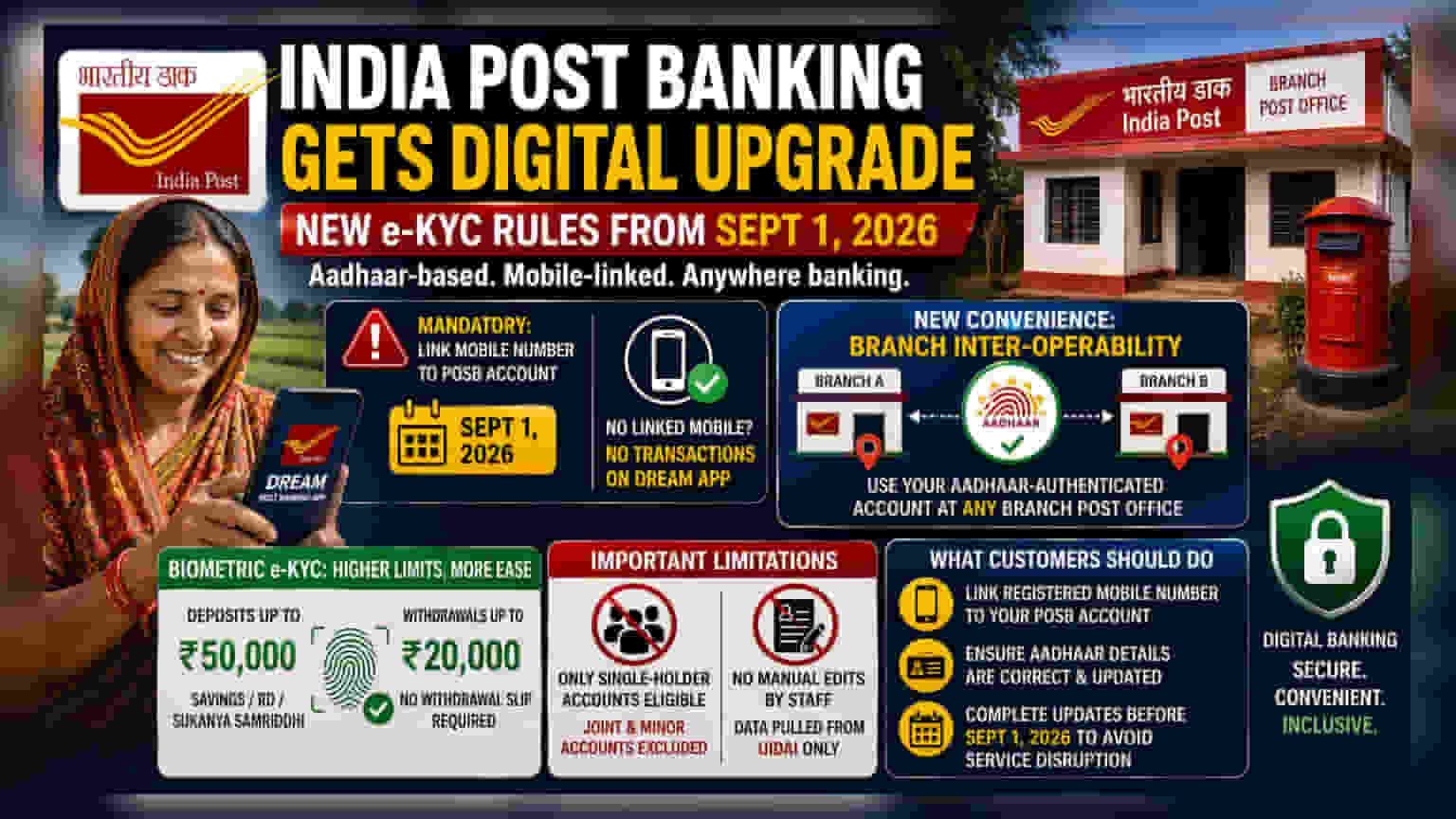
Starting September 1, India Post customers must link their mobile numbers to Post Office Savings Bank accounts to use the DREAM app for transactions. This move pushes Aadhaar-based e-KYC for rural banking, aiming to improve security and enable cross-branch service access.
What Happened
The Department of Posts has introduced a new mandate to overhaul its rural banking operations by prioritizing Aadhaar-based e-KYC. Starting September 1, customers who have not linked their registered mobile numbers to their Post Office Savings Bank (POSB) accounts will be unable to perform transactions using the DREAM mobile application. This change is part of a broader push to increase digital security and streamline financial verification in rural communities where post offices often serve as the primary banking point.
The Mobile Number Requirement
The new directive effectively restricts digital transaction access for non-compliant accounts. After the September 1 deadline, activities such as Aadhaar-authenticated deposits and withdrawals through the DREAM app will be blocked for any account lacking a registered mobile number. This move forces customers to update their contact information to maintain access to app-based banking features, which is critical for transaction alerts and fraud prevention.
New Convenience: Branch Interoperability
In a significant shift for rural banking, India Post is introducing 'BO inter-operability.' Historically, customers were restricted to transacting only at the specific Branch Post Office where their account was opened. With the new system, eligible customers can use their Aadhaar-authenticated profiles to conduct banking services at any Branch Post Office within the network. This provides much-needed flexibility for migrant workers and government scheme beneficiaries who may be located far from their home branch.
Transaction Limits and Aadhaar Integration
The new e-KYC framework relies on biometric authentication, reducing the reliance on traditional paper-based methods. Customers can now complete savings, recurring deposit (RD), and Sukanya Samriddhi account deposits up to ₹50,000 using biometric verification. Additionally, savings account withdrawals up to ₹20,000 are permitted without the need for withdrawal slips.
However, there are specific limitations to the new system. Currently, these digital features are available only for single-holder accounts, meaning joint and minor accounts are excluded from this framework. Furthermore, the system is designed to pull customer data directly from the UIDAI database. Postal staff will not be permitted to manually edit details such as name or date of birth. If the data retrieved from the Aadhaar system does not match existing account records, the e-KYC conversion will be stalled until the records are corrected, forcing those customers to rely on traditional paper methods.
What Investors and Customers Should Track
As the September 1 deadline approaches, the primary monitorable is the pace of adoption and the effectiveness of the technical transition. Customers should ensure their Aadhaar data and registered mobile numbers are up to date to avoid service disruptions. From an operational perspective, the success of this move will depend on how efficiently the department handles potential data mismatches and whether the system can scale to include joint and minor accounts in the future.