

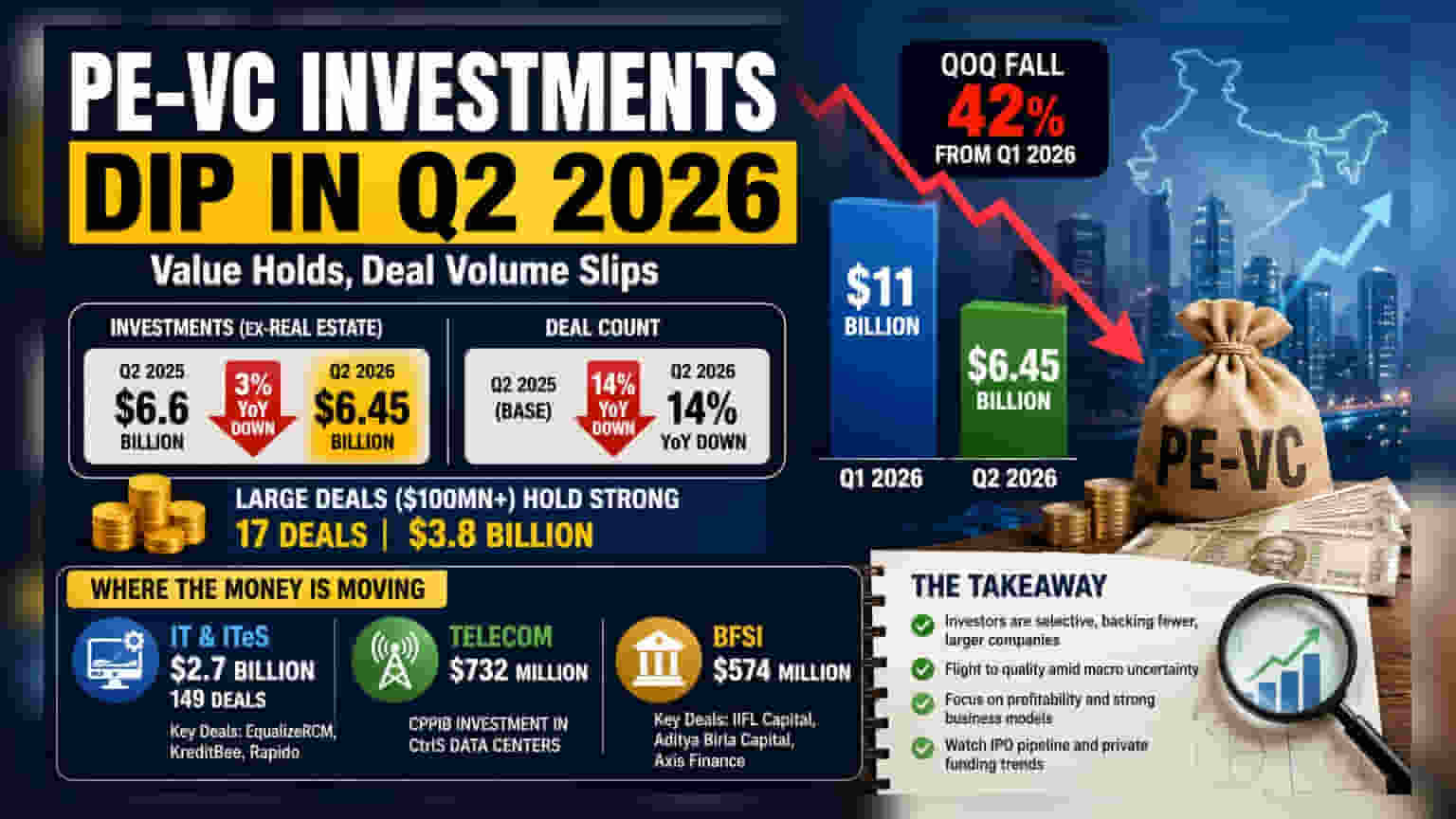
Private equity and venture capital investments in India, excluding real estate, fell 3% year-on-year to $6.45 billion in the second quarter of 2026. While large-ticket transactions remained steady, the significant drop in overall deal volumes points to a more cautious investment environment. This trend is a key monitorable for investors as it can influence the future IPO pipeline and liquidity in the public markets.
What Happened
Private equity and venture capital (PE-VC) investments in Indian companies witnessed a slight decline in the second quarter of 2026. Data shows that total investments, excluding the real estate sector, stood at $6.45 billion, marking a 3% decrease compared to the $6.6 billion recorded in the same period of 2025. The decline was more pronounced when looking at the immediate previous quarter, with investments falling 42% from the $11 billion seen in the first quarter of 2026.
While the total value of investments showed resilience, the volume of deals saw a sharper pullback. Deal counts dropped by 14% year-on-year and 29% quarter-on-quarter. However, larger deals—those valued at $100 million or more—held ground, with 17 such transactions totaling $3.8 billion during the quarter.
Why Investors Should Care About Funding Trends
For stock market investors, PE-VC investment trends serve as a leading indicator of sentiment in the broader economy. A slowdown in deal volume, even if the total investment value remains stable, often suggests that investors are becoming more selective. They are likely prioritizing established, larger companies over earlier-stage startups.
This trend matters because private funding acts as a feeder for the public markets. A robust private investment cycle typically builds a healthy pipeline for future Initial Public Offerings (IPOs). If deal-making activity slows significantly over a sustained period, it could eventually impact the supply of new companies entering the public market, affecting investor options and market liquidity in the long run.
Where The Money Is Moving
The IT and ITeS sector continued to be the primary magnet for capital, securing $2.7 billion across 149 deals. This highlights the ongoing investor focus on technology-driven growth and digitization. Notable transactions included Carlyle’s $300 million investment in EqualizeRCM, a $280 million round for KreditBee led by Advent International, and a $240 million investment in Rapido.
The telecom industry also captured significant attention, largely driven by infrastructure needs. A major highlight was CPPIB’s $732 million investment in CtrlS Data Centers, reflecting strong institutional interest in India’s growing data infrastructure.
Meanwhile, the Banking, Financial Services, and Insurance (BFSI) sector attracted roughly $574 million. Key moves here included Fairfax Holdings acquiring a controlling stake in IIFL Capital Services for $384 million, alongside investments in Aditya Birla Capital and Axis Finance.
The Meaning Behind The Slowdown
The gap between the total investment value and the falling deal volume suggests a "flight to quality." Investors are concentrating their capital in fewer, larger companies rather than spreading bets across a wider range of businesses. This cautious approach is often a response to valuation concerns and global macroeconomic uncertainties, which can make investors more demanding regarding profitability and cash flow, even in private firms.
What Investors Should Track Next
Investors may want to monitor how this funding environment influences corporate behavior. If private funding remains tight or selective, companies may focus more on improving their operational efficiency and profit margins rather than aggressive cash-burning expansion.
Additionally, keeping an eye on the IPO pipeline in the coming quarters will be useful. A continued reliance on a few large deals rather than a broad base of smaller investments might signal that the market is prioritizing stable, mature business models, which can provide clues about the types of companies likely to attract investor interest if they decide to go public.