

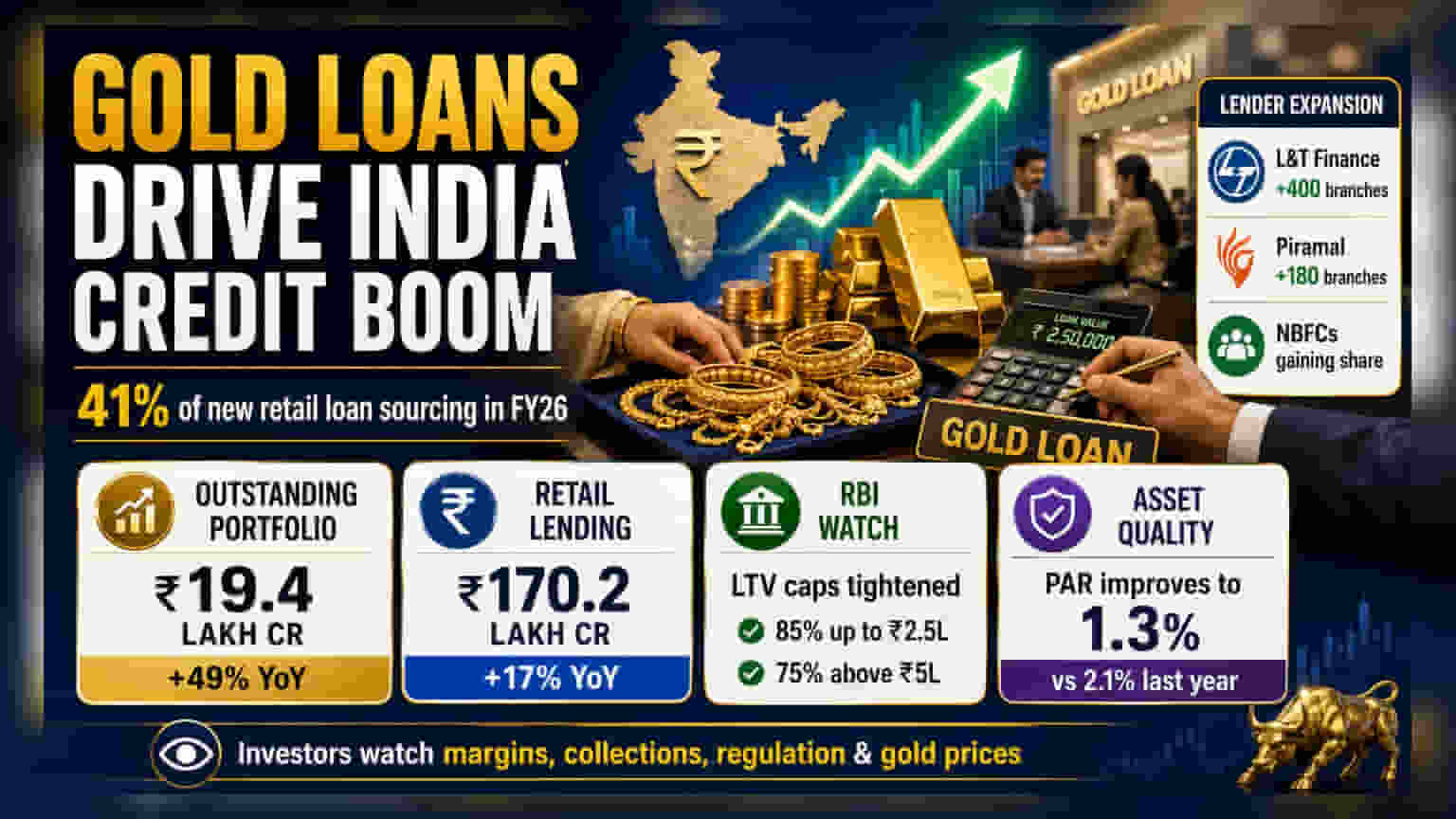
Gold loans now make up 41% of new retail credit in India, with the market reaching ₹19.4 lakh crore in FY26. While lenders are rapidly expanding their networks to capture this demand, investors should watch how recent Reserve Bank of India (RBI) regulatory guidelines on loan-to-value ratios impact future profitability and risk.
What Happened
Gold loans have become a major driver of credit growth in India, significantly outpacing the broader retail lending market. In the fiscal year 2026, gold loans accounted for 41% of all new retail loan sourcing, a sharp jump from 20% in FY24. The total outstanding portfolio for this segment grew by 49% compared to the previous year, reaching ₹19.4 lakh crore. In comparison, the overall retail lending market saw a growth of 17%, reaching ₹170.2 lakh crore. This trend indicates that households are increasingly using gold as a primary financial asset to unlock liquidity, rather than just as a last-resort option during financial stress.
Strategic Shifts by Lenders
Financial companies are aggressively expanding their physical presence to tap into this demand. L&T Finance has announced plans to open 400 new gold loan branches in FY27 to increase its reach. Bajaj Finance is also aiming to grow its gold loan portfolio, targeting a contribution of over 5% to its total assets under management, up from 3.5%. Similarly, Piramal Finance plans to add 180 branches in the coming year. A notable shift in the market is that non-banking financial companies (NBFCs) are steadily winning market share from public sector banks, driven by faster processing and wider reach.
The Regulatory Environment
While the growth is high, the regulator is keeping a close watch. The Reserve Bank of India introduced stricter guidelines in June 2025 to manage risks as the sector scales. These norms include caps on loan-to-value (LTV) ratios—the percentage of the gold's value that a lender can give as a loan. Specifically, the limit is set at 85% for loans up to ₹2.5 lakh and 75% for loans exceeding ₹5 lakh. These rules are designed to ensure that lenders remain protected even if gold prices fluctuate. The RBI has also tightened rules regarding bullet repayment loans, where the principal and interest are paid at the end of the term.
Risk and Asset Quality
Despite the rapid expansion, asset quality in the gold loan segment remains stable. Data shows that the PAR (31-180), which tracks the quality of loans, improved to 1.3% in April 2026, down from 2.1% in April 2025. The resilience of this segment is helped by rising gold prices, which provide lenders with safer collateral. However, as lenders expand their portfolios, maintaining this quality will be a key challenge. The average size of a gold loan has also climbed to ₹1.96 lakh in FY26 from ₹98,000 in FY23, reflecting both higher gold values and a shift in borrowing behavior.
What Investors Should Track
Investors should monitor how individual lenders balance this high-growth opportunity with regulatory compliance. Key monitorables include the ability of companies to maintain healthy profit margins despite the LTV caps, the effectiveness of their collection strategies, and their success in expanding beyond the traditional markets in southern India. Any changes in gold price trends or further regulatory updates from the RBI regarding borrower leverage will also be critical factors for the sector's long-term performance.