

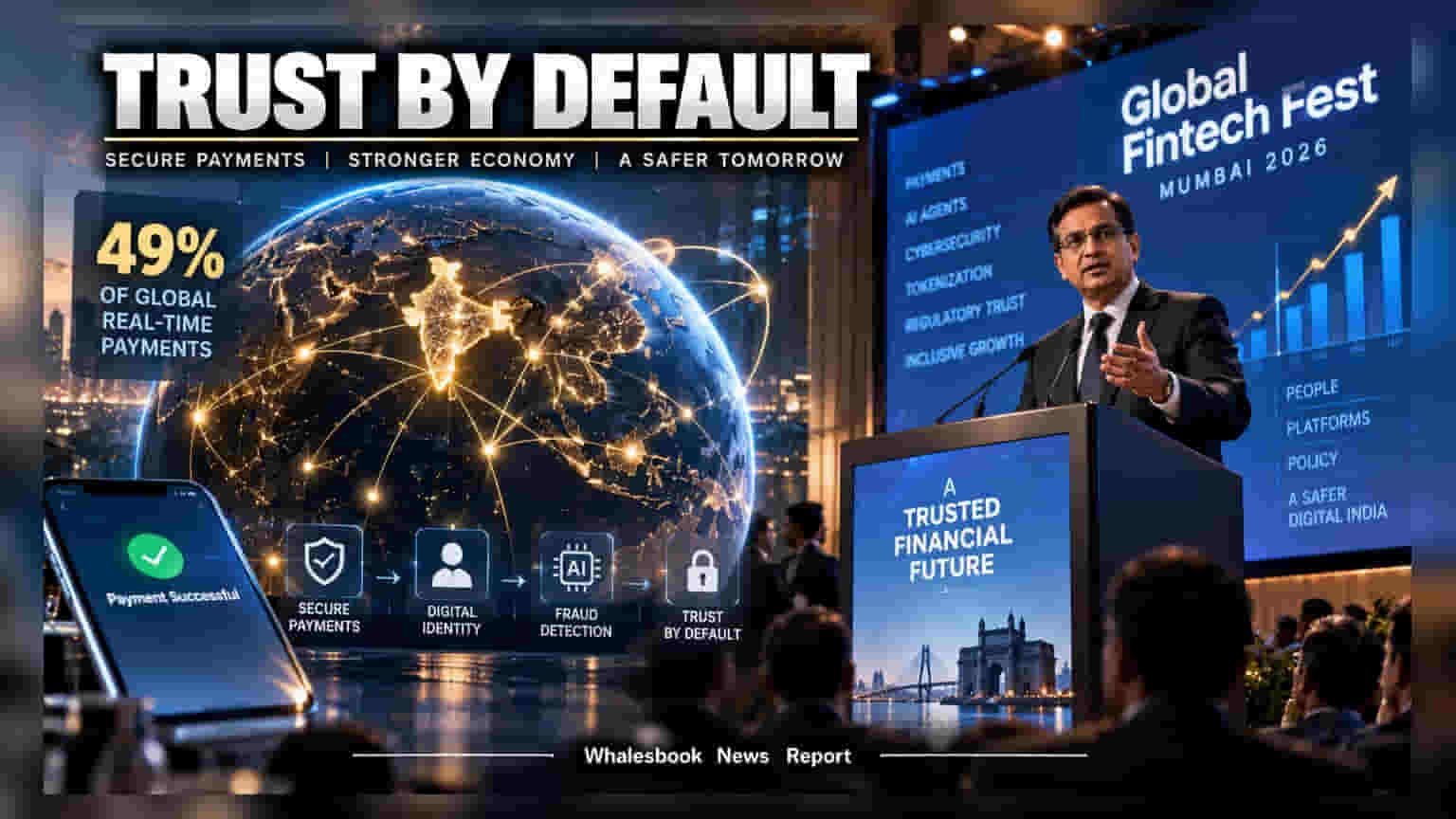
As India handles 49% of global real-time digital transactions, the industry is shifting from scaling volume to building 'trust by default.' The Global Fintech Fest in Mumbai this week highlights the need for advanced security to counter AI-driven fraud. For investors, this signals a potential rise in technology and security spending for banks and fintech companies, which may impact operating margins.
India’s financial sector is entering a new phase of evolution. With the country now accounting for 49% of the world’s real-time digital payment volume, the focus at the Global Fintech Fest, currently underway in Mumbai from September 8 to September 11, 2026, has shifted. The industry is moving away from the goal of simple expansion toward a new standard known as 'trust by default.'
This concept aims to build security, identity verification, and fraud detection directly into the foundation of the digital payment architecture, rather than treating security as an add-on feature. As financial transactions become increasingly complex due to the rise of autonomous AI agents—software that can search for products and execute payments without constant human input—the potential for fraud and unauthorized access has risen. Industry participants are now highlighting that static security measures are no longer adequate.
The Business and Financial Impact
For companies operating in the digital payments space, this shift toward 'trust by default' has direct implications. It necessitates higher spending on advanced cybersecurity tools, tokenization technologies, and artificial intelligence-driven risk intelligence systems. Banks, payment gateways, and fintech platforms will likely need to allocate more capital toward these security upgrades to remain compliant with evolving regulatory expectations from bodies like the Reserve Bank of India and the NPCI.
While these investments are critical for system resilience, they do create a cost burden. Investors may monitor whether this increase in technology and security spending exerts pressure on the operating margins of fintech firms and banks. Furthermore, building these systems can create a competitive divide; companies that can afford to implement robust 'trust by default' frameworks may find it easier to operate, while smaller players with limited budgets for high-end security infrastructure might face operational challenges or higher compliance hurdles.
Risks and Market Observations
It is important for market participants to understand that this technological evolution is not without risk. Beyond the direct cost of implementation, there is the risk of user friction. If security protocols become too complex, they may discourage adoption, a trend that some recent data has hinted at as certain consumer segments re-engage with physical, non-digital channels. Additionally, navigating the increasingly stringent regulatory environment requires constant, costly updates to internal systems.
Ultimately, the success of this shift will depend on how efficiently companies can balance high-level security with a smooth user experience. Investors should watch for upcoming regulatory directives that may mandate these 'trust' standards across the industry. The next important update for shareholders will be the management commentary from listed banks and fintech players regarding their capital spending plans on cybersecurity and its expected impact on profitability in the coming quarters.