

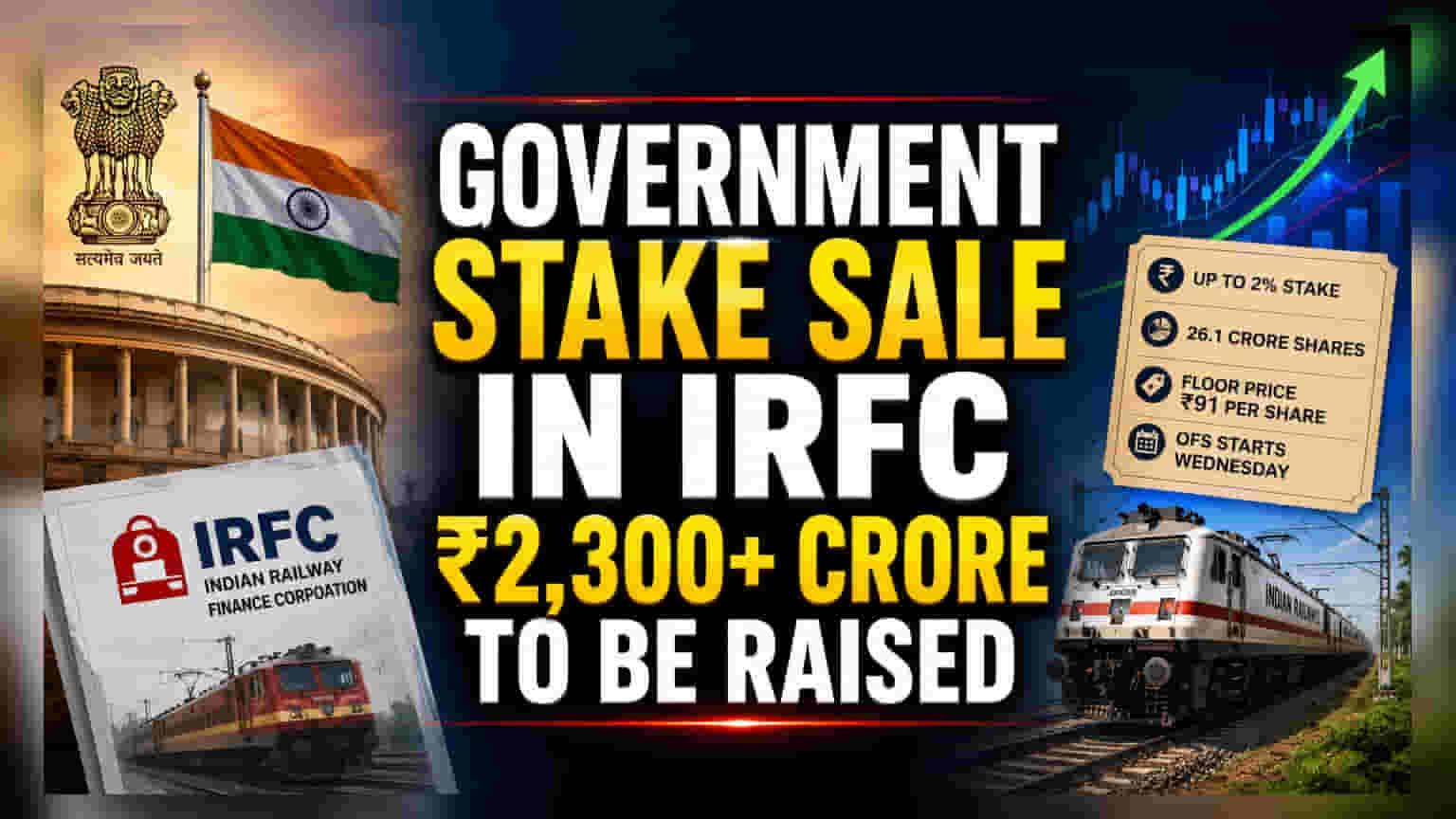
The Indian government has launched an Offer for Sale (OFS) to sell a 2% stake in the Indian Railway Finance Corporation (IRFC). Priced at a floor of ₹91 per share, the sale aims to raise over ₹2,300 crore. This secondary market sale increases the share supply, which often leads to short-term trading volatility for retail and institutional investors.
What Happened
The Indian government has initiated a stake sale in the Indian Railway Finance Corporation (IRFC) through an Offer for Sale (OFS) mechanism. The government plans to offload up to 2% of its shareholding in the company, which amounts to approximately 26.1 crore shares. The floor price for this transaction has been set at ₹91 per share, aiming to raise more than ₹2,300 crore. The sale is scheduled to take place over two days starting Wednesday.
The OFS Mechanics
An Offer for Sale is a method used by promoters—in this case, the government—to sell their shares directly on the stock exchange. This process is typically faster than a Follow-on Public Offer (FPO) and is often used by the government to meet its annual divestment targets. When an OFS is announced at a discount to the current market price, it creates an arbitrage opportunity for some investors but often puts short-term pressure on the stock price as the market aligns with the floor price.
Why The Government Is Selling
Divestment is a standard exercise for the government to generate non-tax revenue and reduce its fiscal deficit. By selling portions of its stake in profitable Public Sector Undertakings (PSUs) like IRFC, the government manages its balance sheet while simultaneously increasing public float—the number of shares available for trading by the public. For investors, this increased liquidity can be a long-term positive, although it often leads to temporary price corrections when the government acts as a large seller in the market.
Business Context and Sector Reality
IRFC is a specialized financial institution that acts as the dedicated financing arm of the Indian Railways. Its primary business involves borrowing funds from the market to finance the acquisition of rolling stock (trains, wagons, locomotives) and other railway infrastructure. Because it is a government-backed entity with a mandate to support critical infrastructure, it operates with a specific risk profile. Its profit margins are heavily dependent on the credit spread it earns over its borrowing costs. Investors typically monitor the company’s ability to manage interest rate risks and its ongoing expansion plans in line with the railway ministry's capital expenditure requirements.
Understanding The Price Gap
The floor price of ₹91 serves as the minimum bid price for the OFS. Historically, when the floor price is set at a significant discount to the prevailing market price, the stock tends to see increased trading volumes as traders and institutions look to participate in the sale. Investors should note that while a discount can look attractive, the market price of the stock often gravitates toward the floor price during the two-day window.
What Investors Should Track Next
The key monitorables for this OFS include the subscription data, specifically the interest shown by institutional investors versus retail participants. A high subscription rate from institutional investors often signals confidence in the long-term value of the stock, despite the government's selling pressure. After the OFS concludes, the focus will shift back to the company’s quarterly earnings, dividend consistency, and any new updates regarding the railway ministry’s future borrowing requirements.