

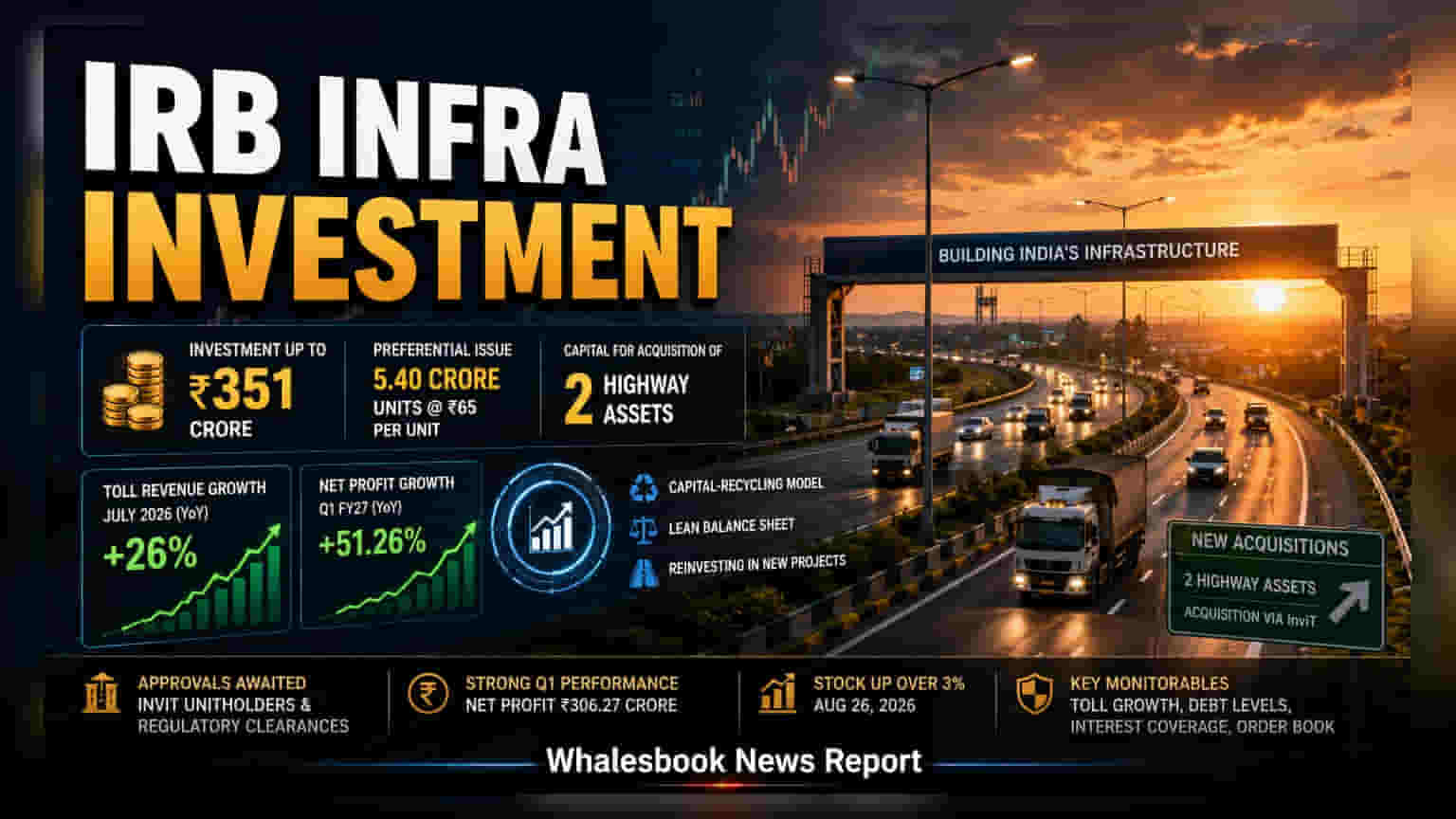
IRB Infrastructure Developers has committed ₹351 crore to the IRB InvIT Fund to support the acquisition of two new highway projects. The move aligns with the company’s strategy of recycling capital to grow its infrastructure portfolio. The investment remains subject to unitholder and regulatory approvals.
IRB Infrastructure Developers announced on Wednesday that its board of directors has approved a plan to invest up to ₹351 crore in the IRB InvIT Fund. This investment will be executed through a preferential issue of 5.40 crore units at a price of ₹65 per unit. The funds are earmarked to provide the infrastructure investment trust with the capital needed to acquire two new highway assets.
The investment is a part of the company's established capital-recycling model. By transferring operational assets to the InvIT, IRB Infrastructure aims to free up capital that can be reinvested into developing new projects. This cycle allows the company to maintain a leaner balance sheet while continuing to expand its highway footprint across the country.
The company’s operational performance has shown positive trends recently, bolstered by healthy traffic growth. In July 2026, the company reported a 26% year-on-year increase in toll revenue. Furthermore, in the first quarter of the 2027 fiscal year, the company posted a net profit of ₹306.27 crore, which represents a 51.26% increase compared to the same period last year. Following the announcement of the investment, the stock price reacted positively, recording a gain of over 3% during the trading session on August 26, 2026.
While the company continues to focus on asset growth, there are several areas investors typically monitor. The sector remains sensitive to interest rate fluctuations and general economic conditions, which can influence toll collections and construction costs. Like many companies in the road infrastructure space, IRB Infrastructure carries debt, and the company has historically shown a lower interest coverage ratio, which measures its ability to pay interest on borrowings. Additionally, the company relies on its capital-recycling model to fuel expansion, meaning its ability to sell assets and raise funds through the InvIT is critical for future project funding.
The transaction is not yet finalized. It must still receive approval from the unitholders of the IRB InvIT Fund and other mandatory regulatory clearances. The successful completion of these approvals and the subsequent integration of the two new highway assets will be the next key milestone for shareholders to track. Investors may also continue to monitor the company’s toll revenue data and the progress of its existing order book to gauge operational efficiency in the coming quarters.