

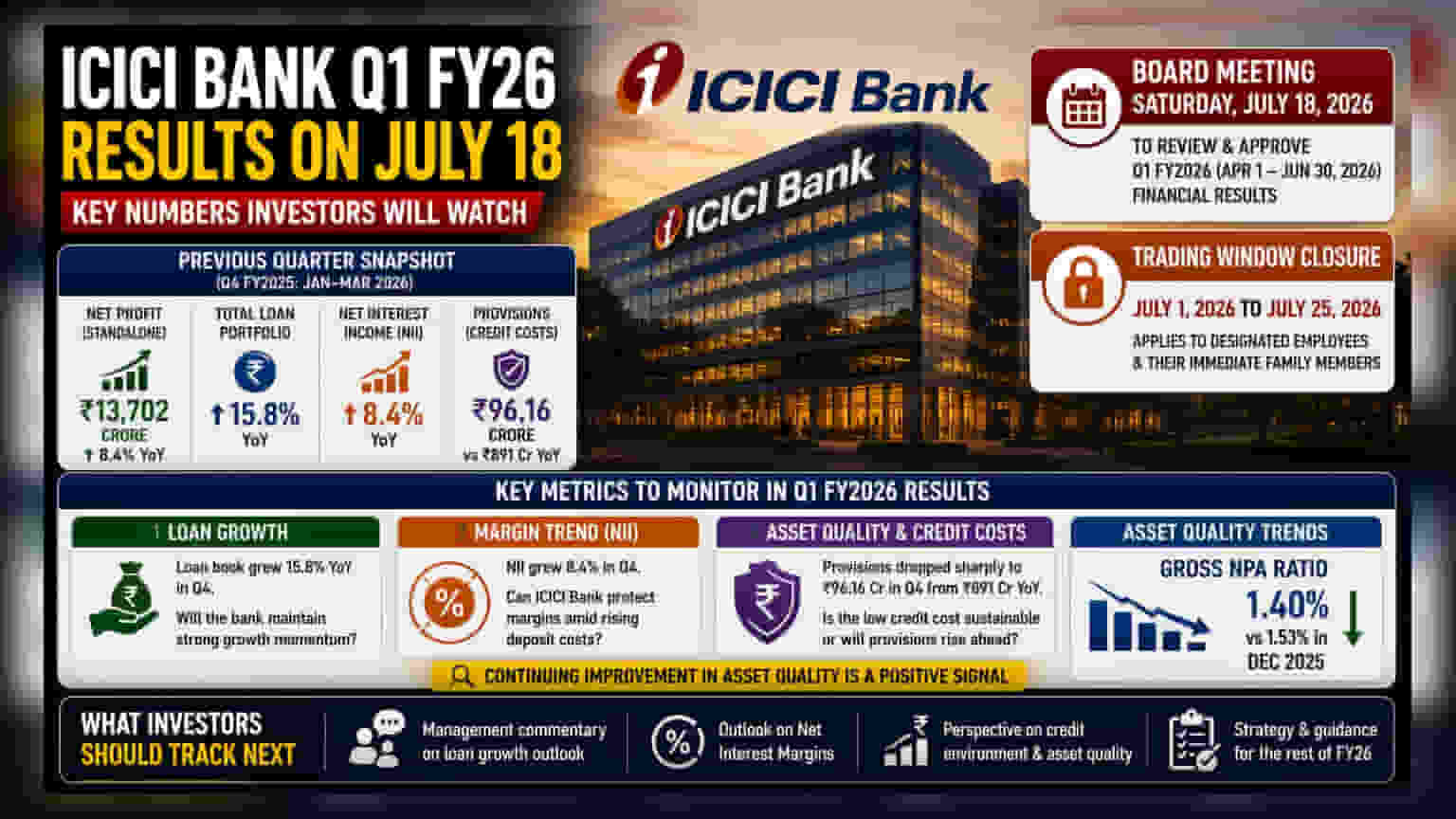
ICICI Bank has scheduled its board meeting for July 18, 2026, to review financial results for the quarter ending June 30, 2026. The trading window for designated employees will remain closed from July 1 to July 25. Investors will be keen to see if the bank can maintain its loan growth and stable asset quality metrics from the previous quarter.
What Happened
ICICI Bank has officially scheduled a meeting of its Board of Directors for Saturday, July 18, 2026. The main agenda for this meeting is to review and approve the bank’s financial performance for the first quarter of the 2026-27 fiscal year, covering the period from April 1, 2026, to June 30, 2026.
As part of standard corporate governance and regulatory compliance, the bank will implement a trading window closure for its shares. This restriction applies to designated employees and their immediate family members from July 1, 2026, until July 25, 2026. This process is designed to prevent trading when sensitive financial information is being finalized.
Why Investors Watch These Earnings
For shareholders, quarterly result days are important checkpoints to assess the health of the business. In the previous quarter (January-March 2026), ICICI Bank delivered a standalone net profit of Rs 13,702 crore, which was an 8.4% increase compared to the same period in the prior year. Investors will be looking to see if the bank can replicate this growth in the current, more challenging macroeconomic environment.
Key Metrics To Monitor
When the results are released on July 18, market participants will likely focus on three core areas that define banking performance.
First is loan growth. In the March quarter, the bank saw a 15.8% year-on-year increase in its total loan portfolio. Maintaining or growing this momentum depends on demand from retail and corporate borrowers. Investors will watch if the bank is still lending at the same pace or if it is being more cautious.
Second is the margin trend. Net interest income, which is the money earned from loans minus the money paid on deposits, grew by 8.4% last quarter. Rising deposit costs across the banking sector often put pressure on these margins. Investors will analyze whether the bank can protect its profitability despite these rising costs.
Third is asset quality and credit costs. The bank reported a significant drop in provisions to Rs 96.16 crore in the March quarter compared to Rs 891 crore in the year-ago period. A very low provision number often helps profit growth, but investors will look to see if this is sustainable or if the bank needs to increase its safety buffers in the coming quarters.
Asset Quality Trends
In the previous quarter, the bank’s gross non-performing assets ratio—a measure of bad loans as a percentage of total loans—fell to 1.40% from 1.53% in December 2025. This downward trend in bad loans has been a positive signal for shareholders. The market will monitor if this improvement continues or if higher interest rates across the economy start to stress the repayment ability of some borrowers.
What Investors Should Track Next
Beyond the headline profit and revenue figures, the management commentary during the post-earnings investor call will be crucial. Investors will likely watch for updates on loan growth guidance, the outlook on net interest margins, and the bank’s perspective on the overall credit environment. These details often provide the best clues about the bank’s strategy for the rest of the financial year.