

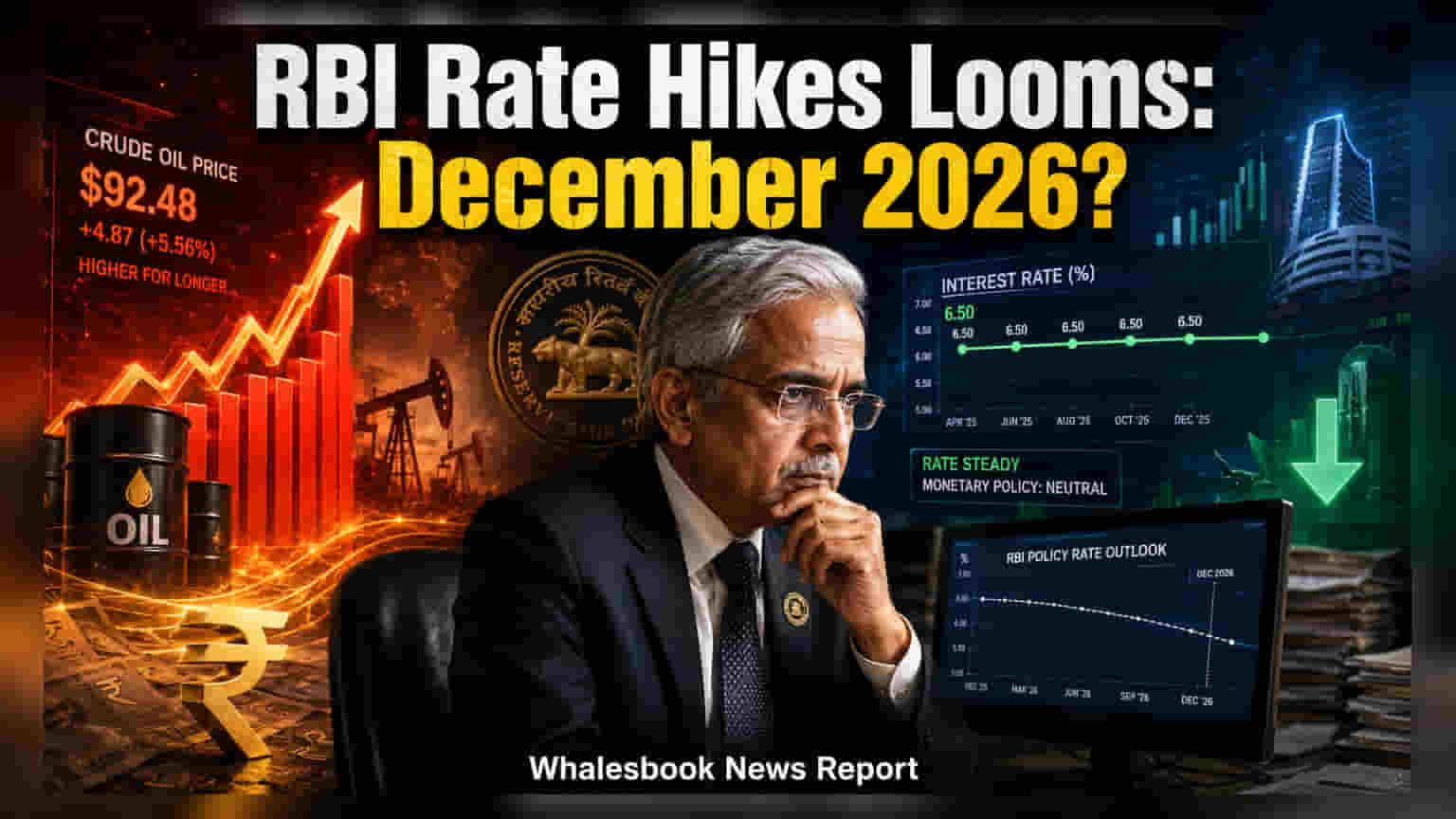
ICICI Bank's independent analysts expect the Reserve Bank of India may raise interest rates by 50 basis points starting December 2026 if crude oil prices remain elevated. This forecast follows the central bank's August 2026 decision to hold the repo rate at 5.25%. The potential rate cycle timeline remains sensitive to inflation trends and global energy costs.
The Reserve Bank of India (RBI) maintained the benchmark repo rate at 5.25% during its August 2026 monetary policy meeting, keeping the policy stance neutral. Following this decision, analysts at ICICI Bank released an independent assessment suggesting that the central bank might initiate a 50-basis-point interest rate hike cycle starting in December 2026, provided that crude oil prices stay high.
The bank’s projection highlights two potential scenarios for future monetary policy. In the first scenario, where crude oil prices remain elevated, the rate-hike cycle could commence in December 2026. Alternatively, if global oil prices trend downward, the bank anticipates that this tightening phase could be pushed back to April 2027, with the latter currently viewed as the more probable outcome.
Economic Growth and Inflation Outlook
The RBI recently updated its economic projections for the 2026-27 financial year, raising its real GDP growth forecast to 6.7% while lowering its retail inflation expectation to 5.0%. ICICI Bank’s internal research presents a slightly more optimistic outlook for India’s economy, forecasting growth at 6.9% for FY27 and accelerating to approximately 7.2% for FY28. Despite this robust growth forecast, the bank noted that expansion in the second half of the fiscal year could be slower than in the first, partly due to the high base effect from the previous year.
Data indicates that domestic demand remains strong, with high-frequency indicators showing healthy momentum throughout the first quarter and into the second. While current inflation projections have been lowered by the central bank, core inflation, excluding gold, continues to be a factor that analysts are monitoring closely. Should strong domestic consumption persist into FY28, it could eventually influence the need for higher policy rates to manage inflationary pressures.
Key Risks to the Monetary Path
Several factors outside of central bank control remain important for the future trajectory of interest rates. Volatile global crude oil prices act as a primary determinant for inflation and, consequently, the timeline for potential rate adjustments. Furthermore, geopolitical tensions continue to present uncertainty for the global and domestic economic outlook.
Domestically, the agricultural sector faces risks from inconsistent monsoon patterns, which could affect rural demand and food inflation. Additionally, banking sector liquidity is a monitorable area, as high credit-deposit ratios may put upward pressure on deposit rates even before any official repo rate changes occur. Investors may track upcoming RBI policy announcements, monthly inflation data, and global oil price fluctuations as key indicators for how the interest rate cycle may unfold in the coming quarters.