 Whalesbook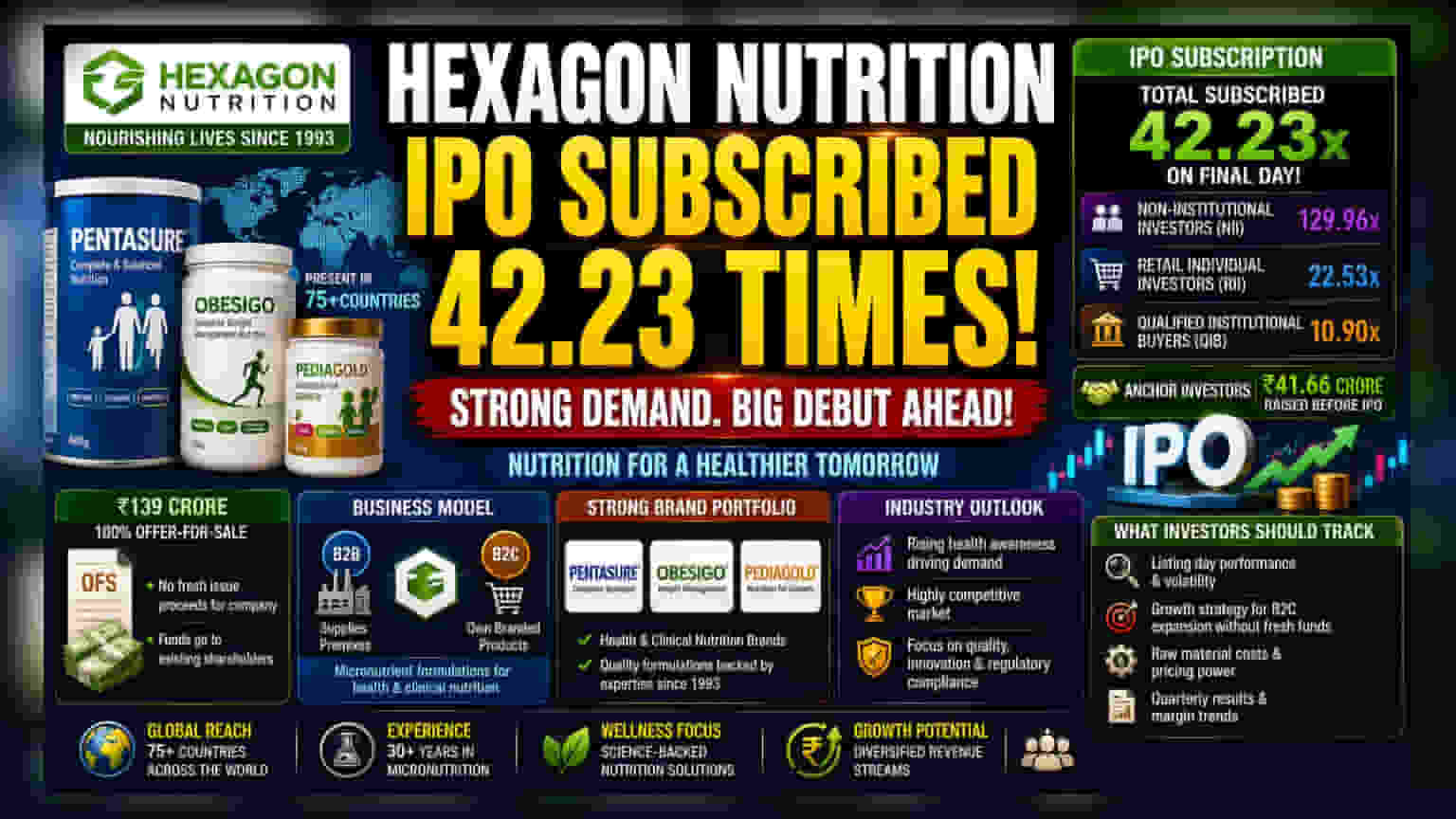


What Happened
Hexagon Nutrition's initial public offering (IPO) finished its final day of bidding with high investor interest. The total issue was subscribed 42.23 times, showing significant market appetite for the micronutrient company. The non-institutional investor category led the demand, subscribing their portion 129.96 times. Retail investors also participated actively, booking their quota 22.53 times, while qualified institutional buyers subscribed 10.90 times the shares on offer. The company raised Rs 41.66 crore from anchor investors before the IPO opened to the public.
Understanding the Offer-for-Sale Structure
It is important for investors to note that this Rs 139-crore issue is structured entirely as an offer-for-sale (OFS). In an OFS, existing shareholders, such as promoters, sell their stake to the public. This means the money raised from this IPO goes directly to the selling shareholders and not to Hexagon Nutrition’s own bank account. Unlike a 'fresh issue,' where companies raise money to pay off debt or fund new factories, this listing does not provide additional capital for the company's own expansion or business operations. Investors often monitor whether the company's internal cash flow is sufficient to support its growth plans without new IPO proceeds.
The Business Model
Hexagon Nutrition has been in the business of micronutrient formulations since 1993. The company operates across two main areas: a business-to-business (B2B) model where it supplies premixes, and a business-to-consumer (B2C) model where it sells its own branded products. Its product range includes well-known health and clinical nutrition brands like Pentasure, Obesigo, and Pediagold. By maintaining a presence in both the supply of raw micronutrients and finished clinical nutrition products, the company aims to diversify its revenue streams. Its operations currently span over 75 countries, which indicates a global reach for its formulations.
Sector Context and Competitive Landscape
The nutrition and health supplement industry in India is highly competitive. While growing awareness about wellness and clinical nutrition supports demand, the company faces pressure from large domestic and international FMCG players who have established distribution networks. Success in this sector often depends on strong brand recognition, product quality, and the ability to navigate regulatory standards set by agencies like the FSSAI. Investors often track how companies in this space manage raw material costs and maintain profit margins in a crowded market.
What Investors Should Track
As the company moves toward its listing, there are several factors to watch. The first is how the stock performs once it starts trading, as high oversubscription sometimes leads to listing day volatility. Second, investors will look for updates on the company’s future growth strategy, specifically how it plans to expand its B2C brand footprint without the fresh capital injection from this IPO. Third, monitoring management's commentary on raw material sourcing and pricing power is crucial, as any change in these costs can directly impact the company's profit margins. Finally, tracking the company's quarterly results will reveal whether it can maintain its historical growth in a competitive environment.