

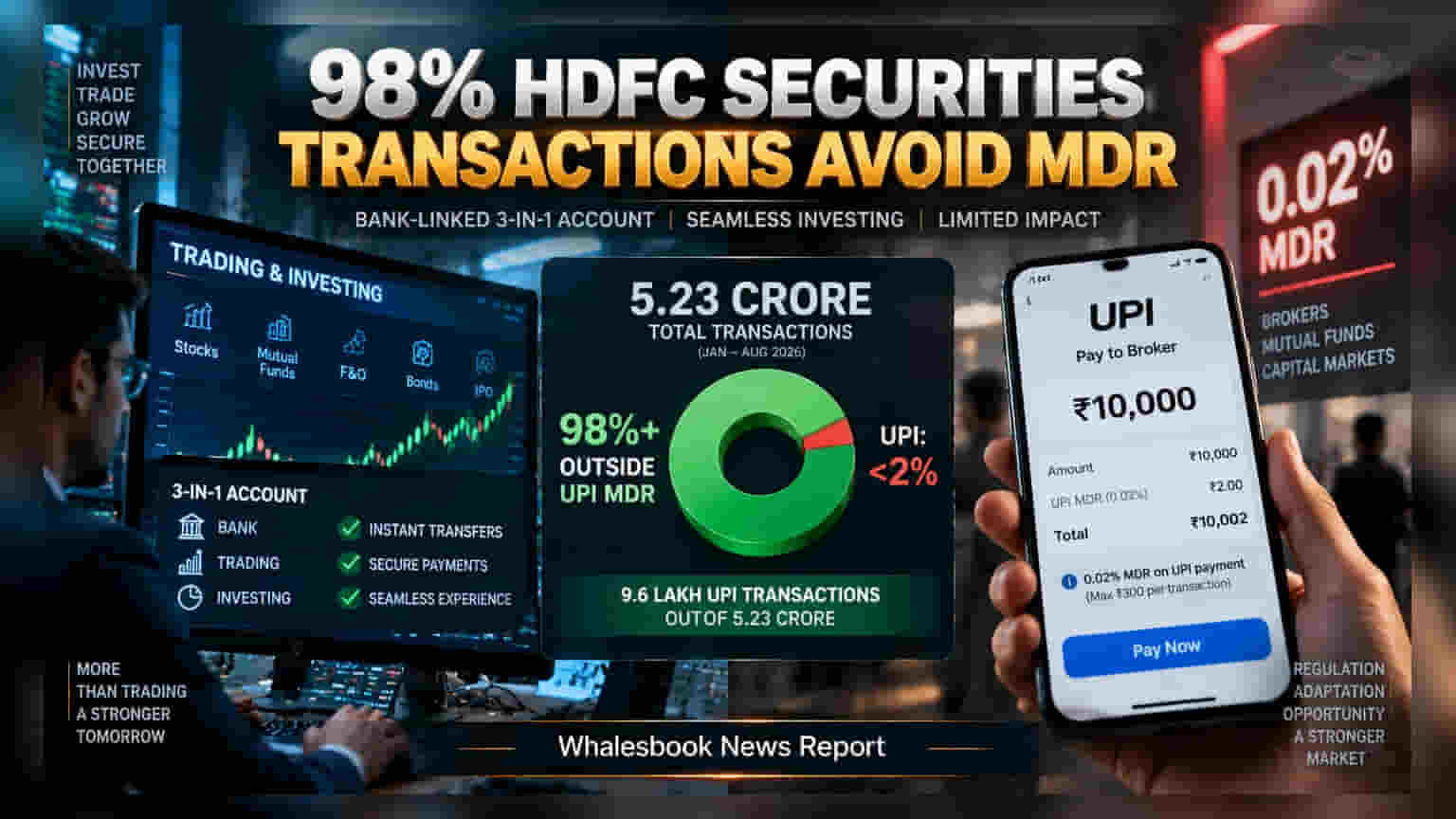
HDFC Securities stated that nearly 98% of its transactions will remain outside the new 0.02% UPI fee framework starting October 15, 2026. Because most clients use bank-linked accounts instead of UPI, the firm expects minimal cost impact. This stands in contrast to many discount brokers, which rely heavily on UPI for payments and may face tighter profit margins due to the new rule.
HDFC Securities has clarified that its business model offers a layer of protection against the new merchant discount rate (MDR) on UPI transactions. The brokerage reported that out of 5.23 crore transactions processed between January and August 2026, only about 9.6 lakh were made using UPI. This means more than 98% of its transaction volume is not subject to the new fee structure that takes effect from October 15.
The regulatory update introduces a 0.02% charge on UPI transactions within the capital markets segment, capped at ₹300 per transaction. This affects payments made to stockbrokers, mutual funds, and other securities dealers. While the fee aims to regulate digital payments in the market, it creates a new cost for brokers. HDFC Securities, which operates as part of the broader banking ecosystem, relies heavily on its 3-in-1 account structure. This linked-account system facilitates direct fund transfers that do not classify as UPI payments, thus bypassing the new levy.
The financial impact of this new fee varies widely across the brokerage industry. Many discount brokers, which have gained popularity for their low-cost trading, depend heavily on UPI for customer fund transfers. Industry estimates suggest that some platforms process nearly two-thirds of their incoming funds via UPI. For these firms, the 0.02% charge is a direct operational cost. This creates a difficult scenario, as brokers may have to pay this fee even when a customer adds funds to a trading account but chooses not to execute a trade, thereby resulting in no brokerage revenue to offset the payment cost.
Regulators are aware of these industry concerns. SEBI Chairman Tuhin Kanta Pandey has indicated that the regulator is reviewing the issues raised by broker associations. The industry is now waiting to see if there will be any adjustments to the framework or if brokers will have to absorb the costs, change their payment systems, or pass the fees on to customers. For HDFC Securities, the existing payment mix means it enters this transition with a distinct advantage compared to peers with higher UPI dependency. The key monitorable for investors across the sector will be how individual firms choose to handle these costs and whether the regulatory stance shifts before the October 15 implementation date.