
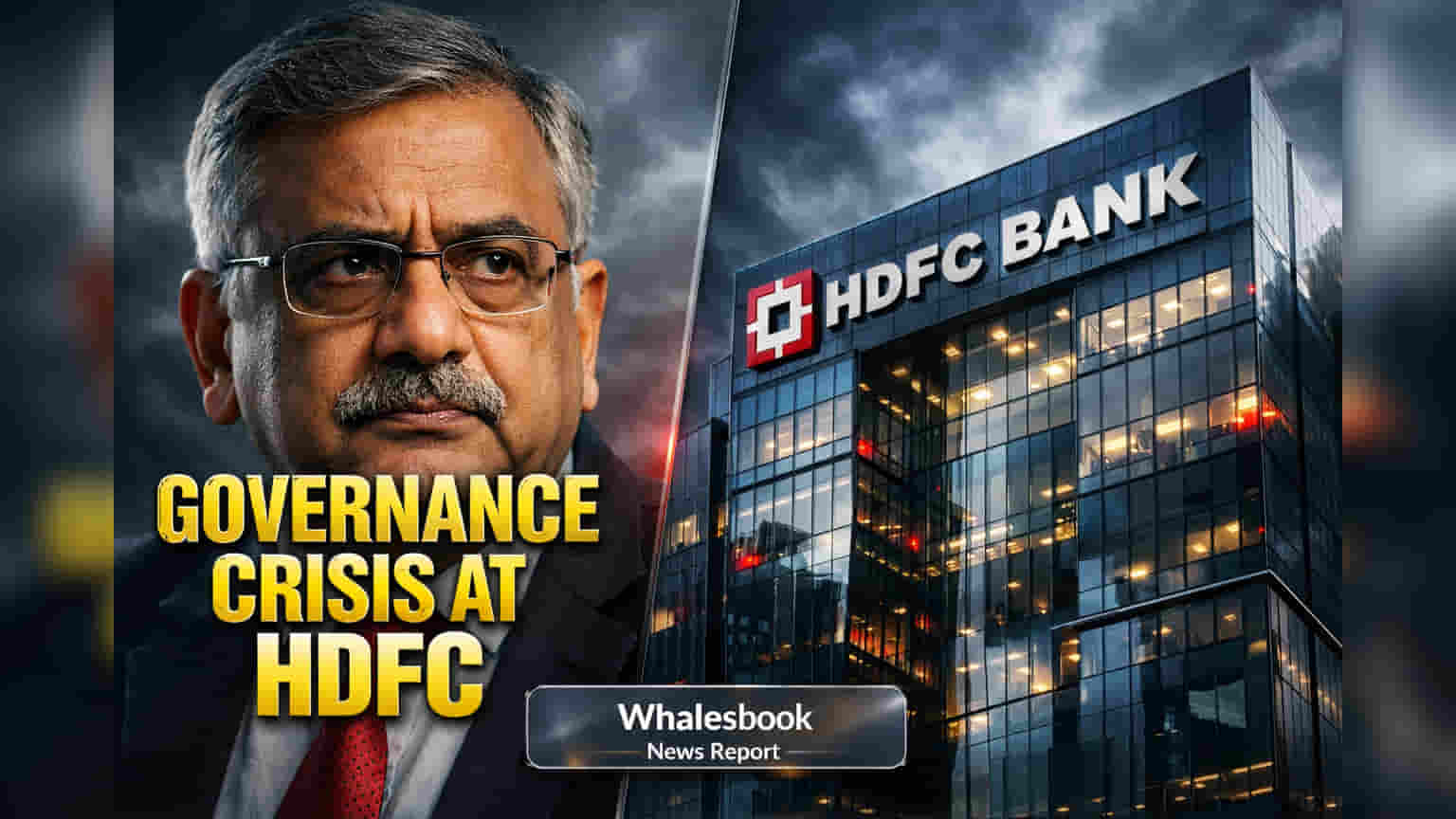
Former Chairman's Departure Signals Deeper Issues
The departure of HDFC Bank's former part-time chairman, Atanu Chakraborty, is raising questions about the bank's governance and ethics. His statement about practices not aligning with his values, especially regarding AT-1 bond sales, shifts focus from operational figures to the bank's integrity.
Chairman Cites Values Clash, Bond Misselling
Chakraborty resigned on March 18, 2026, citing that "certain internal practices" over the last two years did not align with his values. He later criticized the bank's management for dismissing the AT-1 bond misselling to Gulf customers as a "technical issue" instead of a conduct problem. Action was only taken eight years after regulators first flagged concerns. Chakraborty stressed that incentive structures and management oversight must align with depositors' and shareholders' interests, a principle he felt was compromised. He also pointed to the bank's low share price, weak CASA deposits, and high cost-to-income ratio as contributing factors, challenging the bank's approach to risk management and ethics.
Disagreement Over Resignation, RBI's Stance
Chakraborty pushed back against Managing Director Sashidhar Jagdishan's claims that his exit was unrelated to the AT-1 bond actions. He insisted his resignation letter pointed to "larger governance issues." He also downplayed personal differences with Jagdishan or concerns about his reappointment, calling them "overblown." The bank appointed external law firms to review Chakraborty's resignation letter, a move Chakraborty called a mere compliance exercise. Despite these internal reviews and Chakraborty's strong assertions, the Reserve Bank of India (RBI) stated it found "no material concerns" regarding HDFC Bank's conduct or governance, aiming to ease immediate systemic worries.
Stock Slumps Amid Market Worries
The market reaction was sharp, with HDFC Bank's share price dropping significantly. Estimates suggest the bank lost about $21 billion in market value following the announcement. Year-to-date in 2026, the stock has fallen over 24%, significantly underperforming sector peers like ICICI Bank (+7% YTD), Axis Bank (+4% YTD), and State Bank of India (+11% YTD). The broader Nifty Bank index has gained, but HDFC Bank's specific issues have dragged its performance down. Additional market pressures include stricter RBI rules on open foreign exchange positions, introduced on March 25, 2026.
Concerns Over Growth and Margins
Beyond the chairman's resignation, deeper structural issues are surfacing. Analysts highlight slower deposit growth compared to loan expansion, leading to a loan-to-deposit ratio near 100%, straining funding and liquidity. Net interest margins (NIMs) also contracted sequentially in Q1 FY26, though gradual improvement is expected from FY2026 onwards. This has led to mixed analyst sentiment. While some maintain a "Buy" rating due to attractive valuations and strong fundamentals, others have downgraded. Weiss Ratings, for example, lowered HDFC Bank to a "Sell" rating, and the average analyst rating has moved towards "Reduce." Concerns persist about the bank's underperformance, including its stock price and cost-to-income ratio, as noted by Chakraborty.
Analysts Divided Amidst Challenges
Despite governance headwinds and stock underperformance, some market participants remain optimistic. Brokerages like Jefferies maintain a "Buy" rating with a price target of ₹1,240, suggesting significant upside and arguing the recent stock drop has oversold the bank's fundamentals. BofA Securities and Bernstein also hold "Buy" and "Outperform" ratings, respectively, with price targets around ₹1,175 and ₹1,150-1,200. Analysts project earnings growth of approximately 9.57% for the coming year, with earnings expected to grow at 12.1% annually, though revenue is forecast to decline. The bank's market capitalization is around ₹11.26-11.64 trillion as of late March 2026, with a P/E ratio between 14.55x and 15.93x. The future outlook depends on the bank's ability to integrate synergies after its merger, boost deposit mobilization, and importantly, restore investor confidence by showing strong governance and ethics.