

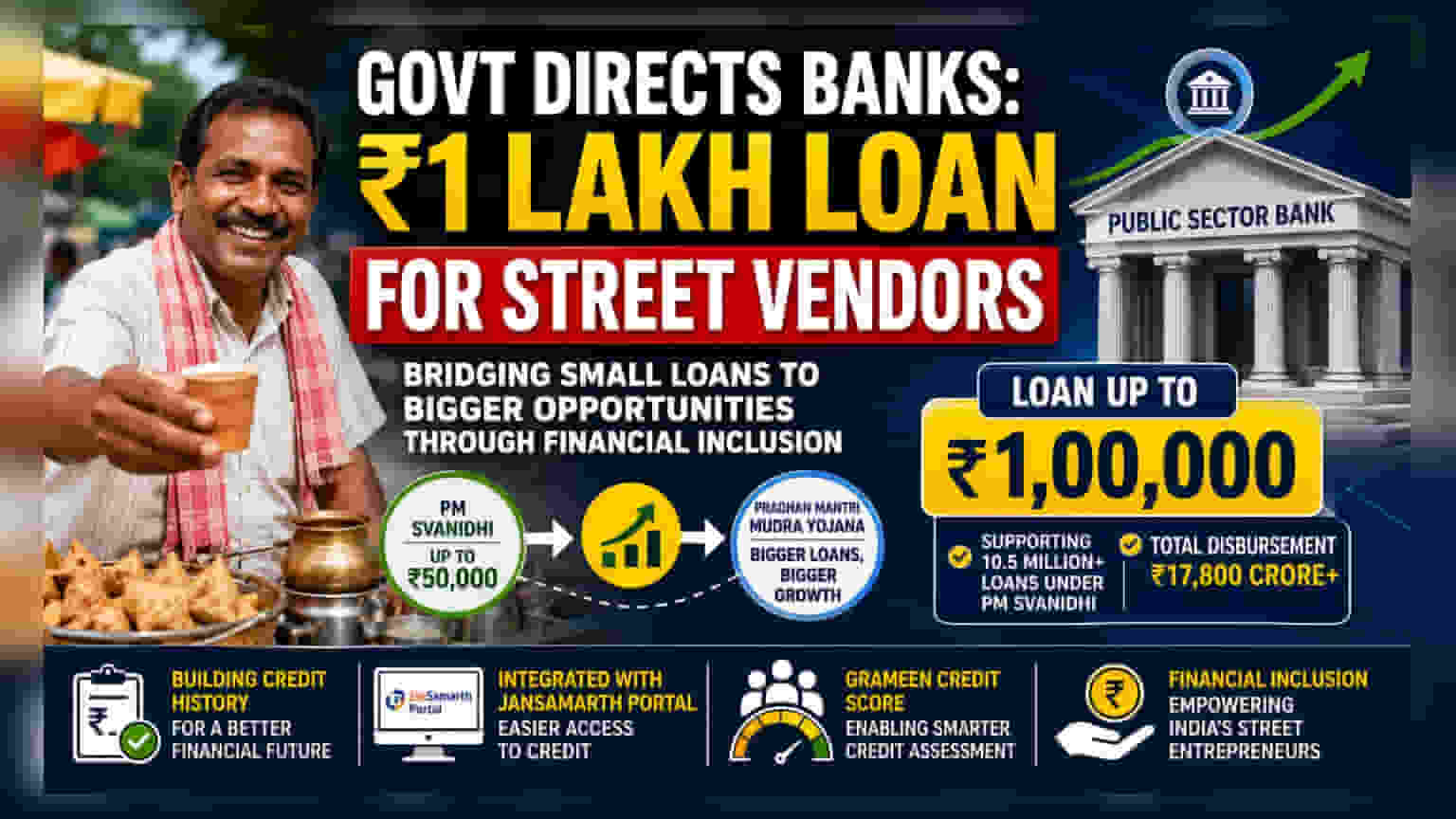
Public sector banks are being asked to introduce ₹1 lakh loan products for street vendors to facilitate their transition to larger Mudra loans. This initiative aims to build credit history for informal sector borrowers using simplified processes. Investors should track how these banks balance growth in micro-lending with the potential risks of maintaining asset quality in this segment.
What Happened
The Indian government has directed public sector banks to design a new loan product offering up to ₹1 lakh to street vendors. This move is designed to act as a bridge, helping small borrowers who have used existing micro-credit schemes like PM SVANidhi to eventually move toward larger, more formal credit under the Pradhan Mantri Mudra Yojana (PMMY).
Since its launch in June 2020, the PM SVANidhi scheme has supported over 10.5 million loans, with a total disbursement of more than ₹17,800 crore. Currently, these loans cap at ₹50,000. The new product aims to create a path for these existing borrowers to scale their businesses by establishing a formal credit track record, making them eligible for larger financial assistance.
Why It Matters For The Business
For public sector banks, this directive is part of a broader push to deepen financial inclusion and capture the large informal sector. By integrating these products with platforms like the JanSamarth Portal and utilizing the Grameen Credit Score, banks are trying to make it easier to evaluate borrowers who may not have traditional income proof.
From a banking perspective, this is a strategic move to create a long-term relationship with small entrepreneurs. If successful, banks can move these vendors from small, short-term loans to more substantial credit products, which can potentially drive retail loan growth.
The Asset Quality Challenge
While the expansion into micro-lending is a growth area for banks, it brings specific risks that investors should understand. Small-ticket loans, especially to street vendors, can be sensitive to economic shocks. Unlike secured lending, where the bank can sell an asset to recover debt, these micro-loans are often unsecured or based on smaller guarantees.
Investors should look for updates in future quarterly reports regarding the asset quality of these portfolios. The key test will be whether banks can keep the levels of bad loans, known as Non-Performing Assets (NPAs), low while scaling up this lending volume. Efficient credit appraisal—or checking if a borrower can repay—is essential to ensuring this initiative adds to profits rather than creating future losses.
What To Watch Next
Investors may monitor the following to understand the impact on individual banks:
Bank Implementation: Look for filings or management commentary from major public sector banks regarding the rollout of these ₹1 lakh loan products.
Portfolio Mix: Check if banks can maintain a healthy balance between high-risk micro-loans and their overall retail portfolio.
Asset Quality Trends: Monitor updates on delinquency rates (how many loans are not repaid on time) in the micro-lending or MSME segments in upcoming financial results.
Credit Scoring Adoption: Observe how effective the integration of the Grameen Credit Score and JanSamarth Portal becomes in automating and simplifying loan approvals.