 Whalesbook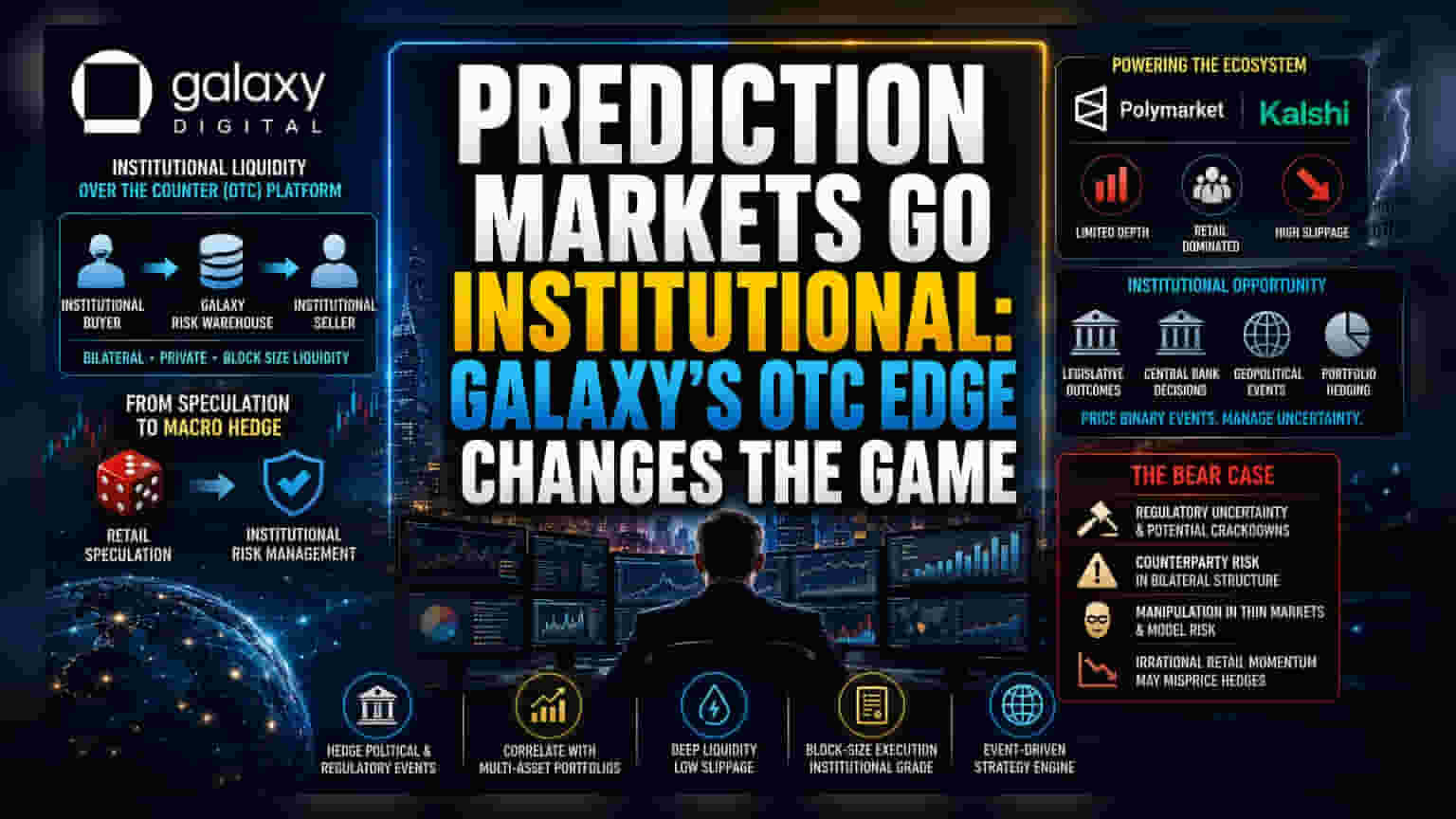


The Shift from Speculation to Macro Hedge
The arrival of Galaxy Digital into the prediction market space represents a structural evolution for the sector. Historically, these platforms functioned as high-volatility environments for retail sentiment tracking. By providing a bilateral, over-the-counter framework, Galaxy is shifting the utility of these instruments from pure speculation toward institutional risk management. This allows asset managers to hedge against binary political and regulatory events, such as legislative shifts or central bank mandates, which were previously difficult to price within traditional portfolio models.
Market Mechanics and Liquidity Challenges
While platforms like Polymarket and Kalshi have gained traction, they suffer from depth issues that preclude large-scale entry. Institutional capital requires deep order books and the ability to execute large blocks without excessive slippage. By warehouse-ing risk, Galaxy is effectively creating a private liquidity pool that mimics the ease of traditional interest rate swap markets. This service allows firms to build multi-asset event strategies, correlating prediction market outcomes with equity or commodity exposures. The ability to source block-size liquidity is the primary differentiator here, separating this offering from the public order books that currently characterize the broader prediction market sector.
The Bear Case: Counterparty and Regulatory Risk
Despite the enthusiasm for deepened liquidity, the institutional adoption of prediction markets faces significant headwinds. First, the regulatory environment for event contracts remains in a state of flux. Any crackdown on the underlying venues utilized for these OTC products could create immediate friction for Galaxy’s clients. Furthermore, the reliance on a bilateral framework introduces heightened counterparty risk compared to clearinghouse-backed instruments. Critics also point to the potential for market manipulation in thinly traded non-sports events, where large-scale institutional bets—even at $10 million—could theoretically skew pricing to serve broader corporate hedging goals rather than objective forecasting. There is also the persistent challenge of 'model risk,' where institutional models rely on prediction markets that may be driven by irrational retail momentum rather than fundamental data, potentially leading to mispriced hedges.
Forward Outlook and Sector Integration
Looking ahead, the focus for institutional players will be on the scalability of these event-driven desks. If Galaxy succeeds in standardizing the reporting and clearing processes for these contracts, other prime brokers are likely to follow, potentially leading to a more bifurcated market. In this scenario, retail participants continue to dominate public platforms, while institutional flows migrate toward private, desk-based trading. The long-term viability of this model hinges on the firm's ability to maintain tight spreads while absorbing volatility during high-stakes political cycles.