 Whalesbook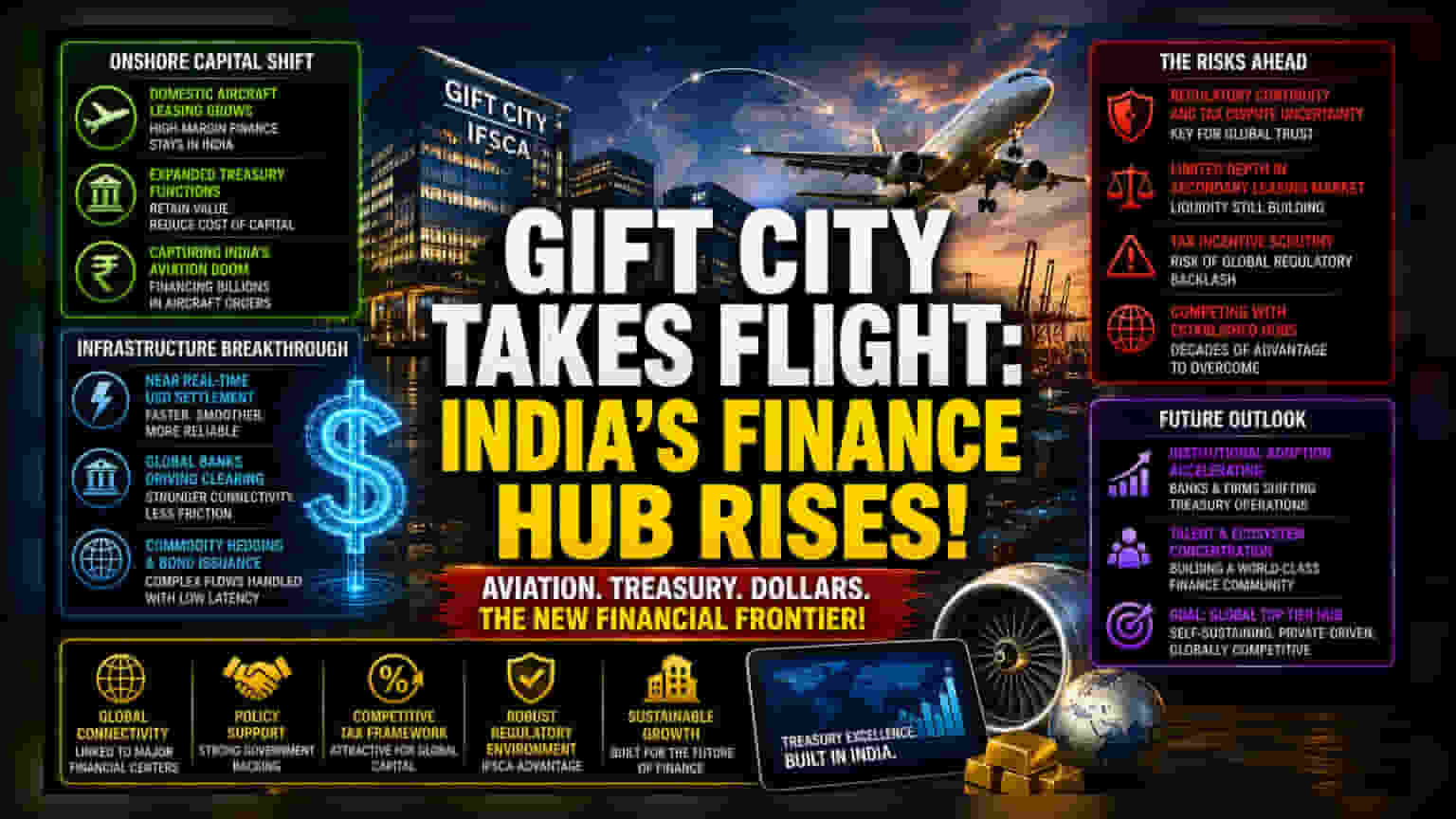


The Onshore Capital Shift
The strategic pivot toward domestic aircraft leasing and expanded treasury functions represents an attempt to repatriate high-margin financial services that have historically gravitated toward tax-efficient, established global jurisdictions. By building a local ecosystem, the International Financial Services Centre (IFSC) is positioning itself to capture the financing flow generated by India's massive aviation order backlog. This is not merely a geographic relocation of business but an effort to lower the cost of capital for Indian carriers by providing a specialized regulatory environment that rivals established offshore centers.
The Infrastructure Bottleneck and Solution
Recent operational improvements in US dollar settlement capabilities are the quiet engine behind this momentum. The implementation of near real-time clearing systems—facilitated by major global banks—addresses the friction that previously forced Indian firms to manage treasury functions in foreign markets. While historical reliance on Singapore or Dublin was driven by liquidity depth, the current trend shows a maturation of the local settlement infrastructure. This is enabling domestic institutions to handle complex cross-border flows, such as commodity hedging and social bond issuance, with significantly lower latency than in previous fiscal cycles.
The Forensic Risk Assessment
Despite the bullish outlook for regional financial dominance, significant structural headwinds remain. Attracting sophisticated, global-scale liquidity is predicated on absolute regulatory continuity and the ability to resolve complex tax disputes without the uncertainty often associated with emerging markets. Unlike established financial centers that benefit from decades of legal precedent and deep, liquid secondary markets for aviation assets, GIFT City is still in the process of building the necessary depth in its secondary leasing market. Furthermore, the success of this initiative is heavily dependent on maintaining competitive tax incentives that do not trigger scrutiny from international regulatory bodies, which could dampen the appeal for large-scale global capital allocators.
Future Outlook and Institutional Adoption
The current trajectory suggests a deliberate move toward institutionalizing the hub as a primary treasury node for India Inc. As local banks increase their participation in the dollar-settlement ecosystem, the concentration of financial talent within the zone will likely increase. However, the true test will be the transition from government-led infrastructure initiatives to a self-sustaining, private-market-driven environment where aviation assets are traded, refinanced, and managed with the same liquidity currently found in established international hubs.