 Whalesbook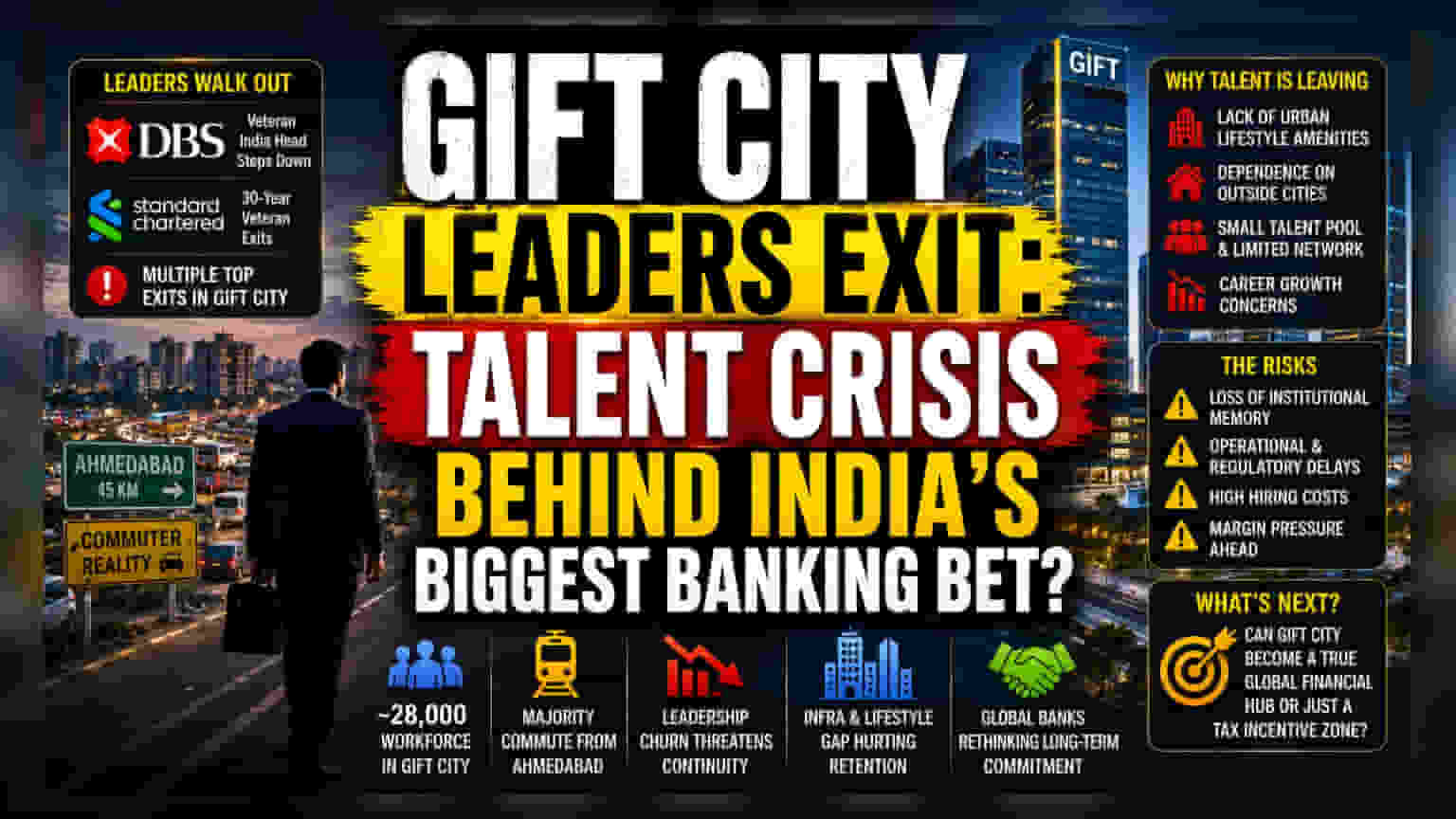


The Leadership Vacuum
The simultaneous departure of veteran banking leads from institutions such as DBS Bank and Standard Chartered Plc marks a period of significant leadership churn within India’s marquee financial special economic zone. The exit of long-tenured executives—some of whom spent decades within their respective banking groups—suggests more than a mere search for higher compensation. It reflects a shift in the internal cost-benefit analysis for elite banking talent operating in a nascent hub that has yet to achieve the maturity of established counterparts like Singapore or Dubai.
Infrastructure as a Regulatory Bottleneck
While the narrative surrounding GIFT City remains focused on aggressive tax incentives and flexible regulatory frameworks, the practical execution of these ambitions is hindered by a mismatch between corporate environment and professional quality-of-life expectations. Data indicates that of the roughly 28,000 personnel employed within the zone, a disproportionate majority reside in surrounding cities like Ahmedabad. This reliance on commuter patterns creates a localized labor elasticity problem. When infrastructure fails to provide the social and entertainment amenities expected by a global professional class, firms face a higher barrier to attracting and retaining the senior-level human capital required to manage high-stakes international banking desks.
The Forensic Risk Perspective
Institutional investors should view this leadership volatility through the lens of operational continuity risk. When a financial center relies on a small pool of specialized talent to navigate complex cross-border regulatory environments, the loss of institutional memory can lead to integration delays. Unlike the established financial centers of Hong Kong or Singapore, where human capital density allows for seamless transition, GIFT City currently lacks this depth. Furthermore, if international lenders like HSBC or Mitsubishi UFJ face similar attrition rates, the cost of talent acquisition and onboarding could eventually compress the margins that initially made the move to the zone attractive. The dependence on external talent pools remains a critical vulnerability.
Future Outlook and Strategic Scaling
Moving forward, the success of GIFT City will depend less on fiscal policy and more on its ability to evolve into a self-sustaining urban environment. Analysts suggest that until the zone can convert its current commuter population into a permanent residential base, it will continue to struggle with high turnover rates among senior leadership. As regulatory authorities look to expand the zone's scope to include more sophisticated derivative trading and asset management activities, the pressure to solve these structural lifestyle constraints will intensify. The market will be monitoring the next set of hiring mandates from these foreign banks to determine if this executive churn is a temporary realignment or a systemic signal of talent migration difficulty.