

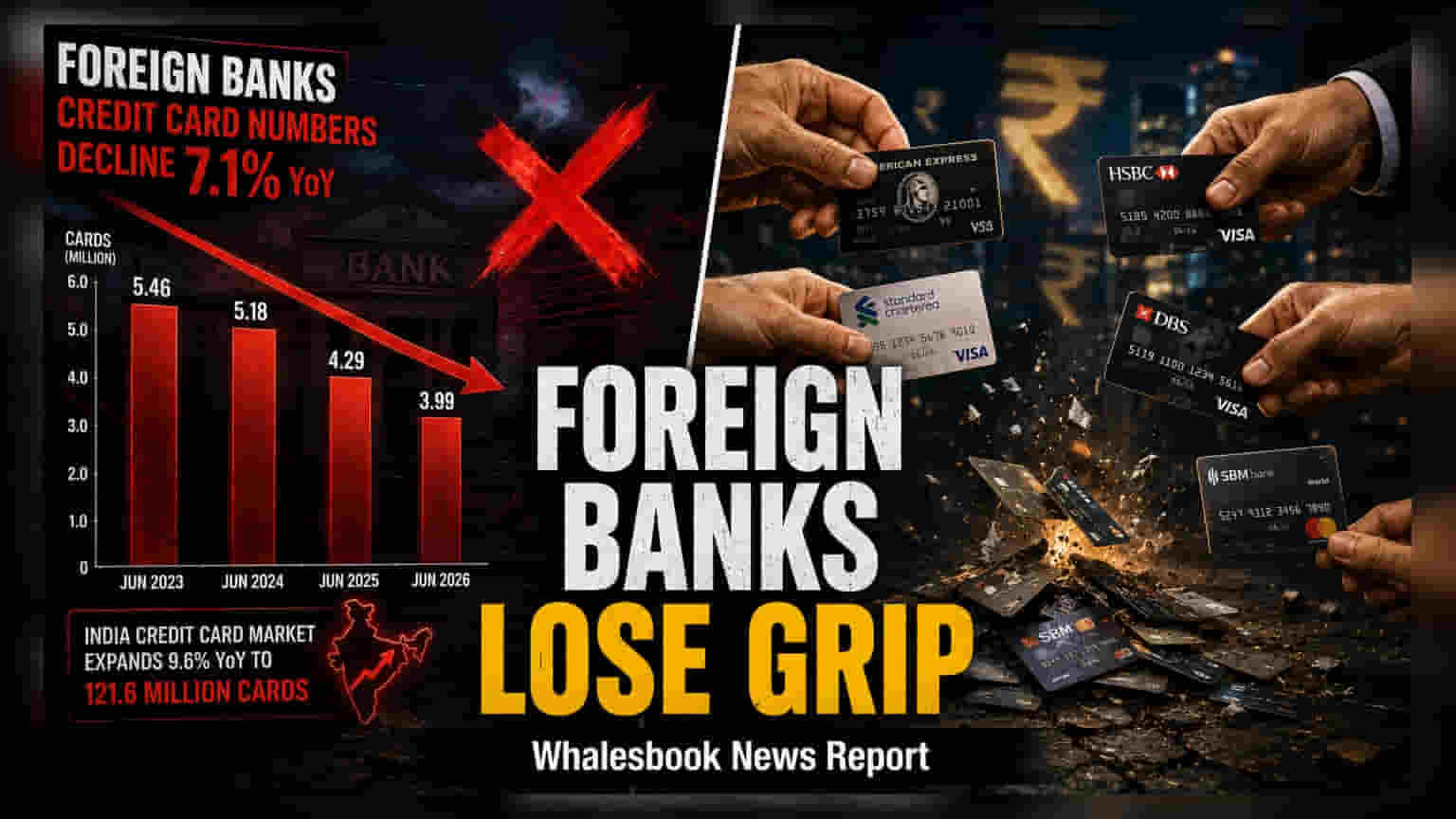
Foreign banks in India saw their combined credit card base drop 7.1% to 3.99 million by June 2026, while the overall market grew 9.6% to 121.6 million. This shift reflects a strategic pivot toward premium customers, increased regulatory compliance hurdles, and portfolio transfers to domestic players.
Foreign financial institutions are reducing their presence in the mass-market credit card segment in India. Data as of June 2026 shows that the combined credit card portfolio of major foreign issuers, including American Express, HSBC India, Standard Chartered Bank, DBS Bank India, and SBM Bank India, contracted by 7.1% year-on-year to 3.99 million cards. This decline occurred despite the broader Indian credit card industry expanding by 9.6%, reaching a total of 121.6 million cards.
This trend is driven by a strategic change in how foreign banks approach the Indian market. Rather than competing for the mass-market volume that domestic lenders are capturing through aggressive digital and cobranded card strategies, foreign banks are increasingly focusing on profitability and high-net-worth, premium customer segments. In many cases, this is not merely a loss of customers but a deliberate effort to trim portfolios that do not align with their current business models.
Strategic portfolio transfers have also played a role in these numbers. For instance, Standard Chartered Bank recently engaged in a transfer of approximately 4.5 lakh credit card accounts to Federal Bank, which significantly impacted the bank's reported card base figures. Consequently, Standard Chartered and DBS Bank India reported some of the sharpest contractions in their portfolios.
Regulatory environment and compliance costs have further influenced this trend. The Reserve Bank of India's regulations regarding the Liberalised Remittance Scheme (LRS), specifically the 180-day fund deployment requirement, have made some offshore banks more cautious about issuing or renewing international credit cards for wealthy resident Indians. These compliance requirements have increased the operational cost of managing certain retail credit products.
Despite the reduction in card numbers, some players are maintaining strong spending activity. American Express, for example, reduced its outstanding cards by 7.5% but reported an increase in card spending of over 16%. This reinforces the strategy of prioritizing high-spending, premium customers who provide better margins even with a smaller total portfolio size. In contrast, domestic lenders continue to leverage their wider distribution networks and retail customer bases to acquire new users in the mass market.
For investors, the key monitorable will be whether foreign banks continue to exit or sell parts of their retail credit businesses to local partners. Additionally, investors may track how these institutions manage the balance between regulatory compliance costs and the profitability of their remaining premium portfolios, as well as whether domestic banks can maintain asset quality while rapidly scaling their own card portfolios.