

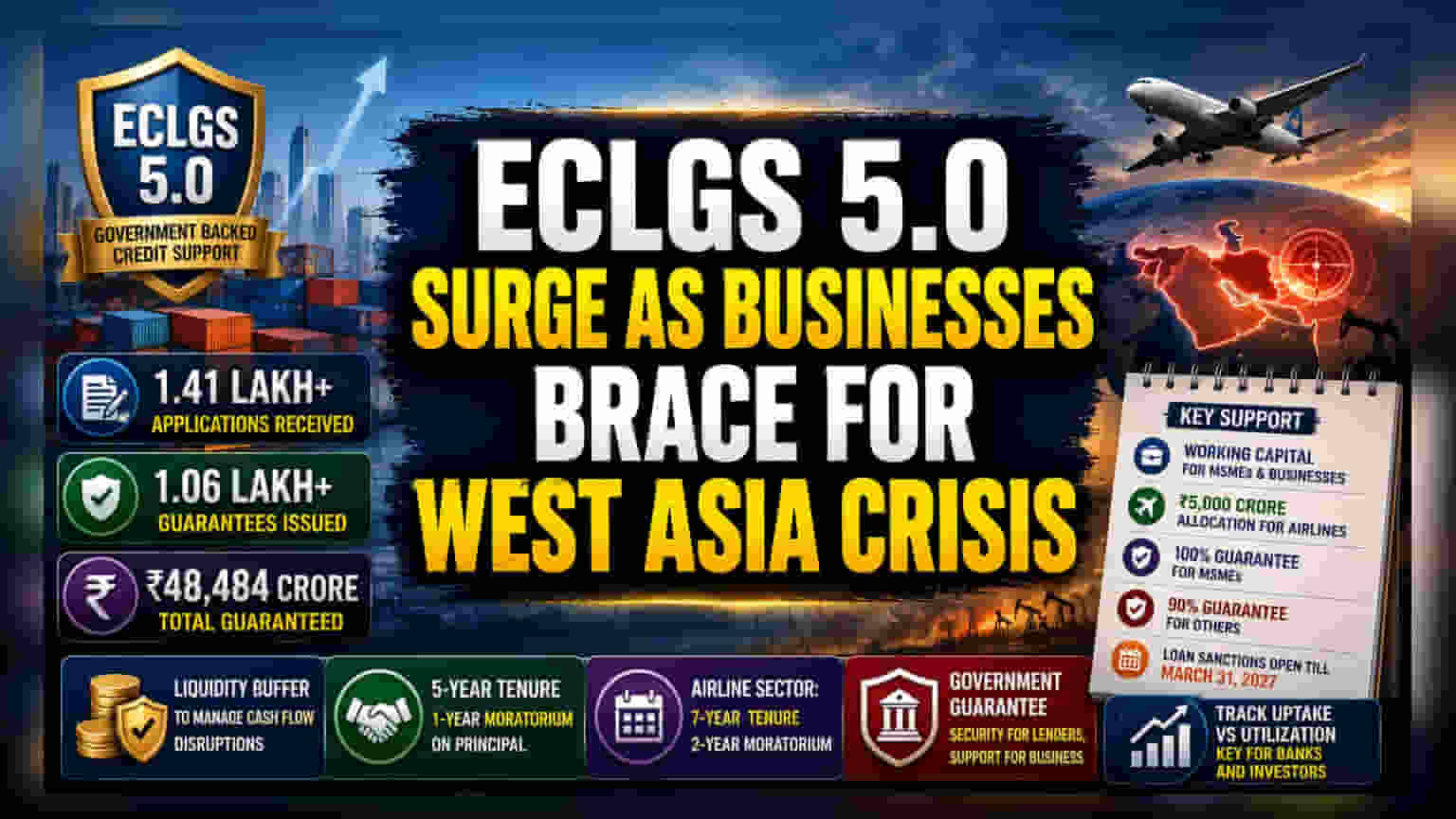
Businesses are flocking to the government's newly launched ECLGS 5.0 scheme to secure a financial safety net amid uncertainties from the West Asia crisis. With a target credit flow of ₹2.55 lakh crore, the facility is being utilized mainly by MSMEs as a precautionary measure. This move underscores the focus on maintaining liquidity for business stability in the current economic environment.
What Happened
Indian businesses are turning to the government's Emergency Credit Line Guarantee Scheme (ECLGS) 5.0 to protect their cash flow against potential disruptions caused by the ongoing West Asia crisis. As of June 2026, the scheme has seen a surge in interest, with the government aiming for a total credit flow of ₹2.55 lakh crore to support eligible borrowers. Recent data shows that over 1.41 lakh applications have already been submitted, with more than 1.06 lakh guarantees issued, totaling nearly ₹48,484 crore in support. The program, which was launched in May 2026, is open for loan sanctions until March 31, 2027.
The Support Mechanism
The ECLGS 5.0 facility is designed to help businesses manage short-term cash flow gaps. Eligible MSMEs and non-MSME businesses can access additional working capital, while a specific allocation of ₹5,000 crore has been earmarked for the airline sector to tackle challenges like rising Aviation Turbine Fuel (ATF) costs and operational volatility. The scheme provides a 100% government guarantee for MSMEs and a 90% guarantee for other eligible categories. Loans generally come with a five-year tenure, including a one-year moratorium on principal payments, while the airline sector may be eligible for a seven-year tenure with a two-year moratorium.
Why Businesses Are Seeking This
The primary reason for the high demand is the need for a 'liquidity buffer.' Many firms are not using these funds for immediate expansion or large projects, but rather as a reserve to ensure they can continue operations if global trade or supply chains face further pressure. MSMEs, in particular, account for nearly 96% of the guarantees issued by number. For these smaller players, having access to guaranteed credit acts as insurance against unforeseen supply chain shocks or increased raw material costs linked to geopolitical tensions.
Financial Risks and Considerations
While the scheme provides a safety net, investors and business owners should note that this is still debt. Even with government guarantees protecting the lenders (banks and financial institutions), the borrowers must eventually repay the principal and interest. The 'precautionary' nature of these loans means that businesses are adding to their debt burden. If the economic environment does not stabilize or if demand remains weak, these companies may face higher interest costs in the future. The structure of the scheme is intended to prevent defaults, but it does not eliminate the fundamental business risks of operating during a volatile period.
What Investors Should Track
The key monitorable for the banking sector is the 'uptake' versus the 'utilization' rate of these credit lines. A high number of sanctioned loans suggests that firms are conservative and worried about the future. Investors should track how much of this credit is actually withdrawn versus how much remains as an unused limit. Furthermore, for the airline sector, performance and liquidity will remain heavily dependent on ATF prices and operational stability. The ultimate success of ECLGS 5.0 will be measured by whether it helps companies sustain their business through the current crisis without leading to a future pile-up of bad loans.