 Whalesbook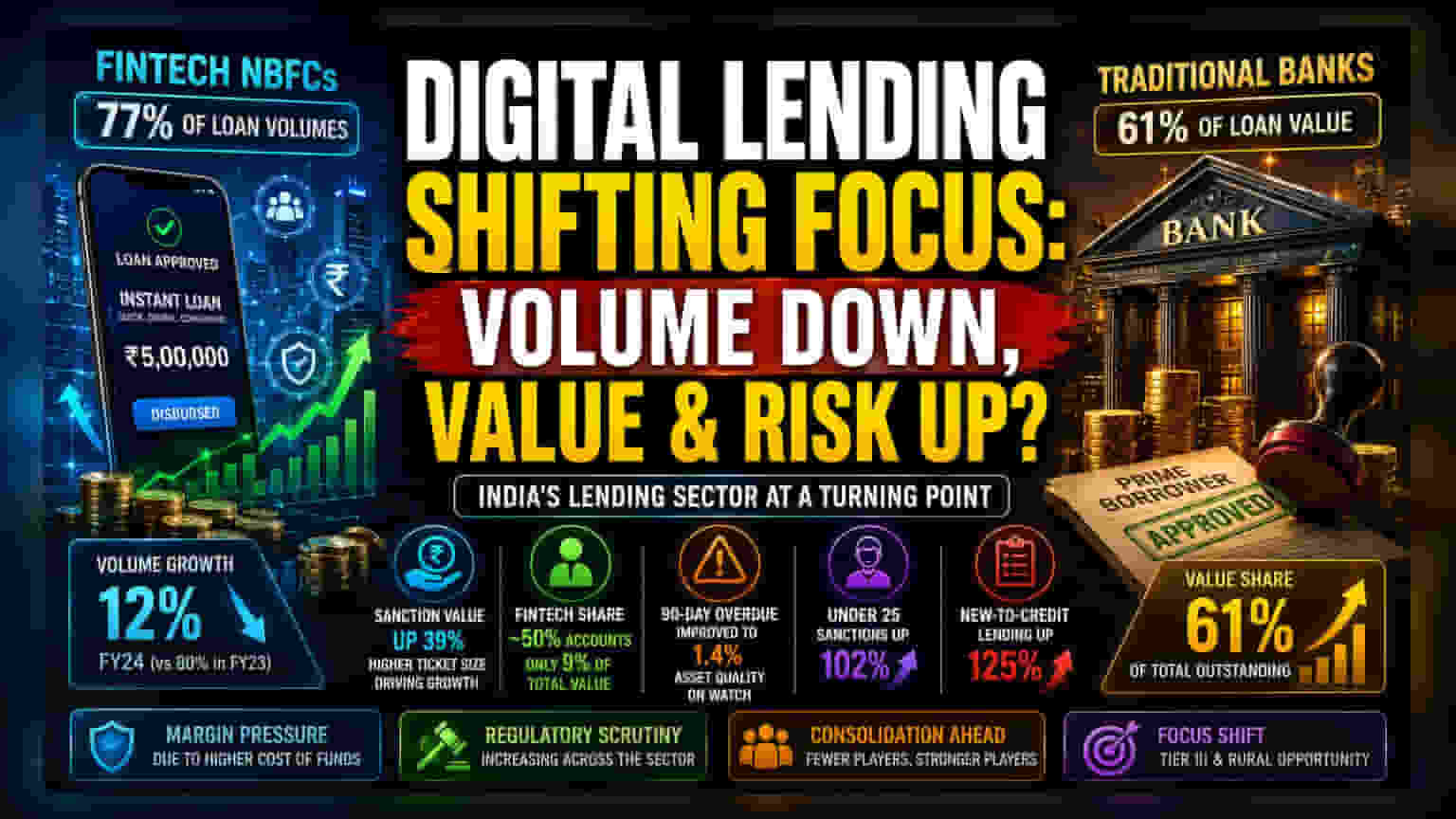


The Shift from Volume to Margin
The digital lending sector in India has reached an inflection point where pure-play acquisition is no longer the primary driver of enterprise value. While fintech non-banking financial companies (NBFCs) continue to command a 77% share of total loan volumes, the internal mechanics of these portfolios are undergoing a forced evolution. The moderation of volume growth to 12%—down from the hyper-growth phase of 80% in FY23—indicates that lenders are moving away from mass-market, high-churn customers. Instead, capital is being reallocated toward higher ticket sizes, as evidenced by a 39% surge in sanction values during the same period. This represents a defensive strategy: processing a single ₹5 lakh loan is operationally more efficient than managing dozens of micro-credits.
Competitive Disparity and Sectoral Risks
The fundamental disconnect between transaction volume and total value remains stark. Fintech players hold nearly half of all active personal loan accounts yet retain only 9% of the industry’s total outstanding value. This highlights the extreme competitive pressure from traditional banks, which maintain a 61% value share. The discrepancy exposes fintechs to potential margin compression if the cost of funding continues to climb. Unlike commercial banks with access to low-cost retail deposits, many digital NBFCs rely on wholesale borrowing, making them highly sensitive to interest rate volatility. As these firms move up the value chain to compete for more 'prime' borrowers, they increasingly cross paths with established banks, setting the stage for a period of fierce competition and likely consolidation.
The Forensic Risk Factor
Regulatory scrutiny remains the primary risk for the digital lending ecosystem. While asset quality reportedly improved with 90-day overdue rates falling to 1.4%, this metric warrants caution. Historically, fintech lenders have utilized aggressive, tech-enabled collection and underwriting models that can mask underlying credit deterioration during early-cycle growth. The rapid 102% increase in sanctions to borrowers under 25, combined with a 125% surge in lending to those with minimal credit history, introduces a layer of systemic risk. Should macroeconomic conditions deteriorate, these cohorts are historically the first to default, potentially forcing a sudden contraction in balance sheets and exposing the limits of automated underwriting algorithms that have not yet been stress-tested through a complete economic cycle.
Future Outlook and Structural Headwinds
Looking ahead, the sector is likely to prioritize 'responsible lending' frameworks to satisfy regulatory mandates, which may suppress top-line growth in the near term. The focus is expected to shift toward deeper penetration in Tier III and rural markets, where the lack of formal credit competition provides better pricing power. However, the structural hurdle remains: transforming these high-volume platforms into sustainable, profit-generating entities while managing the high cost of acquisition and the ongoing necessity for capital adequacy in a maturing regulatory environment.