

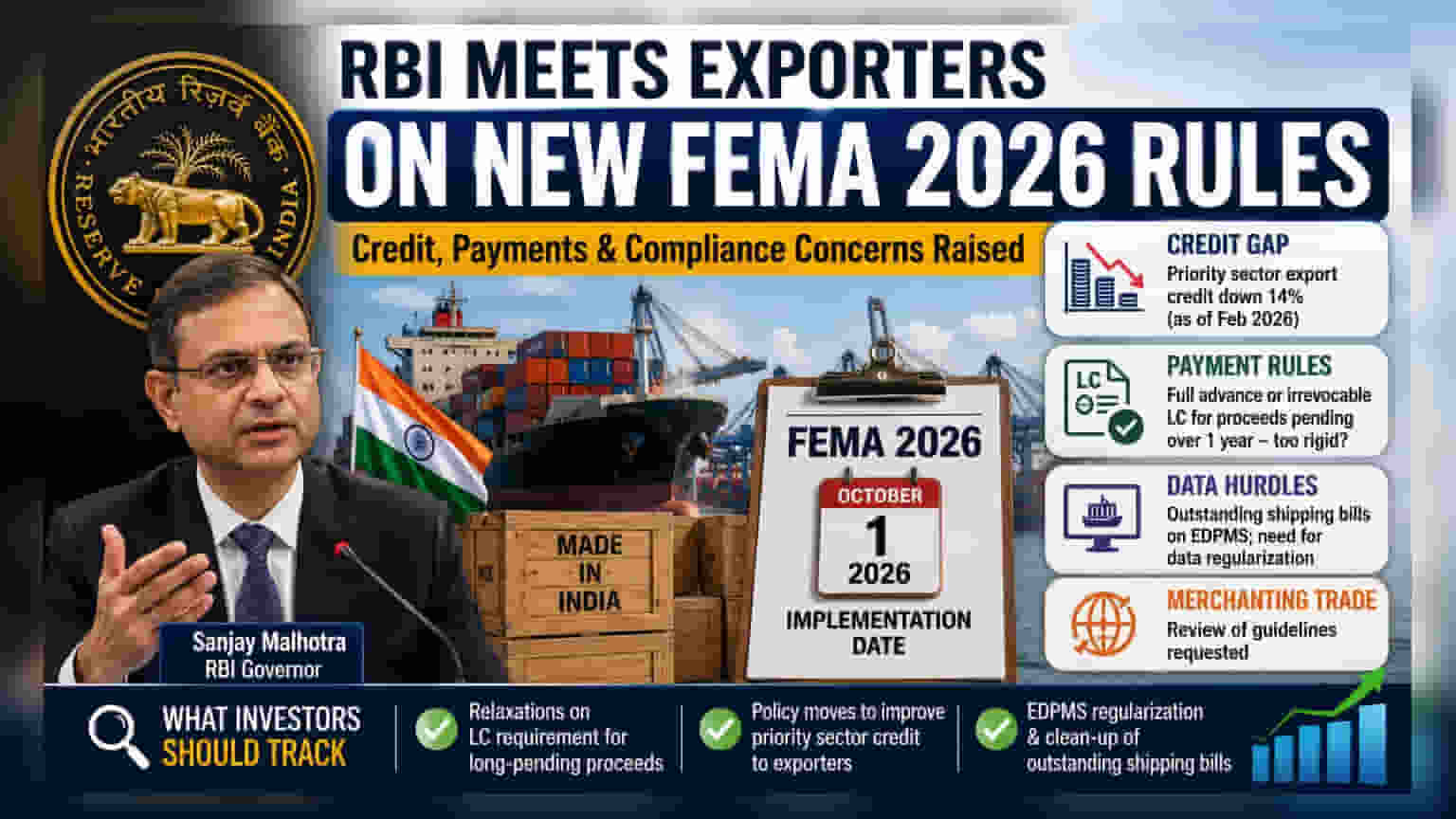
Industry bodies have raised concerns with RBI Governor Sanjay Malhotra regarding new FEMA regulations set for October 2026. Key issues include a decline in priority sector export credit despite rising exports and restrictive payment rules. The central bank has reportedly responded positively to requests for regulatory adjustments.
What Happened
Reserve Bank of India (RBI) Governor Sanjay Malhotra met with representatives from key export organizations, including the Federation of Indian Export Organisations (Fieo) and the Confederation of Indian Industry (CII), on June 25, 2026. The meeting centered on the upcoming Foreign Exchange Management (Export and Import of Goods and Services) Regulations, 2026, which are scheduled to come into force on October 1, 2026. Export industry leaders presented several concerns regarding the new framework, which aims to consolidate trade regulations but has raised alarms about credit accessibility and restrictive payment requirements.
The Credit Gap and Working Capital
One of the most pressing issues highlighted by export bodies is the disparity between export performance and credit flow. While India’s goods and services exports have shown growth, priority sector export credit has reportedly declined by 14% as of February 2026. For investors, this is a critical data point. Export-oriented sectors—such as textiles, gems and jewellery, and engineering—rely heavily on timely pre- and post-shipment credit to manage operations. A continued squeeze on credit can lead to liquidity issues, forcing companies to seek costlier funding, which may put pressure on operating margins in the coming quarters.
Concerns Over New Payment Rules
Industry representatives specifically challenged a provision in the new FEMA 2026 framework that mandates exporters receive full advance payment or an irrevocable Letter of Credit (LC) for export proceeds that remain unrealized for over one year. Export bodies argue that a blanket application of this rule is too rigid, as it could penalize companies for the actions of a single defaulting buyer. They have proposed linking such restrictions specifically to defaulting parties rather than applying them universally. According to industry feedback, the RBI has expressed a willingness to consider these and other suggestions to ensure the new rules do not hinder legitimate trade.
Merchanting Trade and Data Hurdles
Exporters also highlighted difficulties in regularizing trade data on the Electronic Data Processing and Monitoring System (EDPMS). Many shipping bills remain outstanding because banks are hesitant to process them due to perceived commercial risks. Additionally, industry bodies requested a review of guidelines surrounding 'merchanting trade'—transactions where goods move between two countries without entering India. Addressing these procedural bottlenecks is seen as essential for improving the 'ease of doing business' metrics for Indian exporters.
What Investors Should Track Next
Investors with exposure to export-heavy sectors should watch for the RBI’s final operational guidelines before the October 1, 2026, implementation date. The primary monitorables include:
- Whether the RBI provides relaxations on the Letter of Credit requirement for long-pending export proceeds.
- Any policy moves to improve the flow of priority sector credit to exporters.
- The status of EDPMS data regularization, which will affect the clean-up of outstanding shipping bills.
Management commentary from export-focused companies regarding these regulatory changes will provide further insight into potential impacts on cash flow and working capital management.