

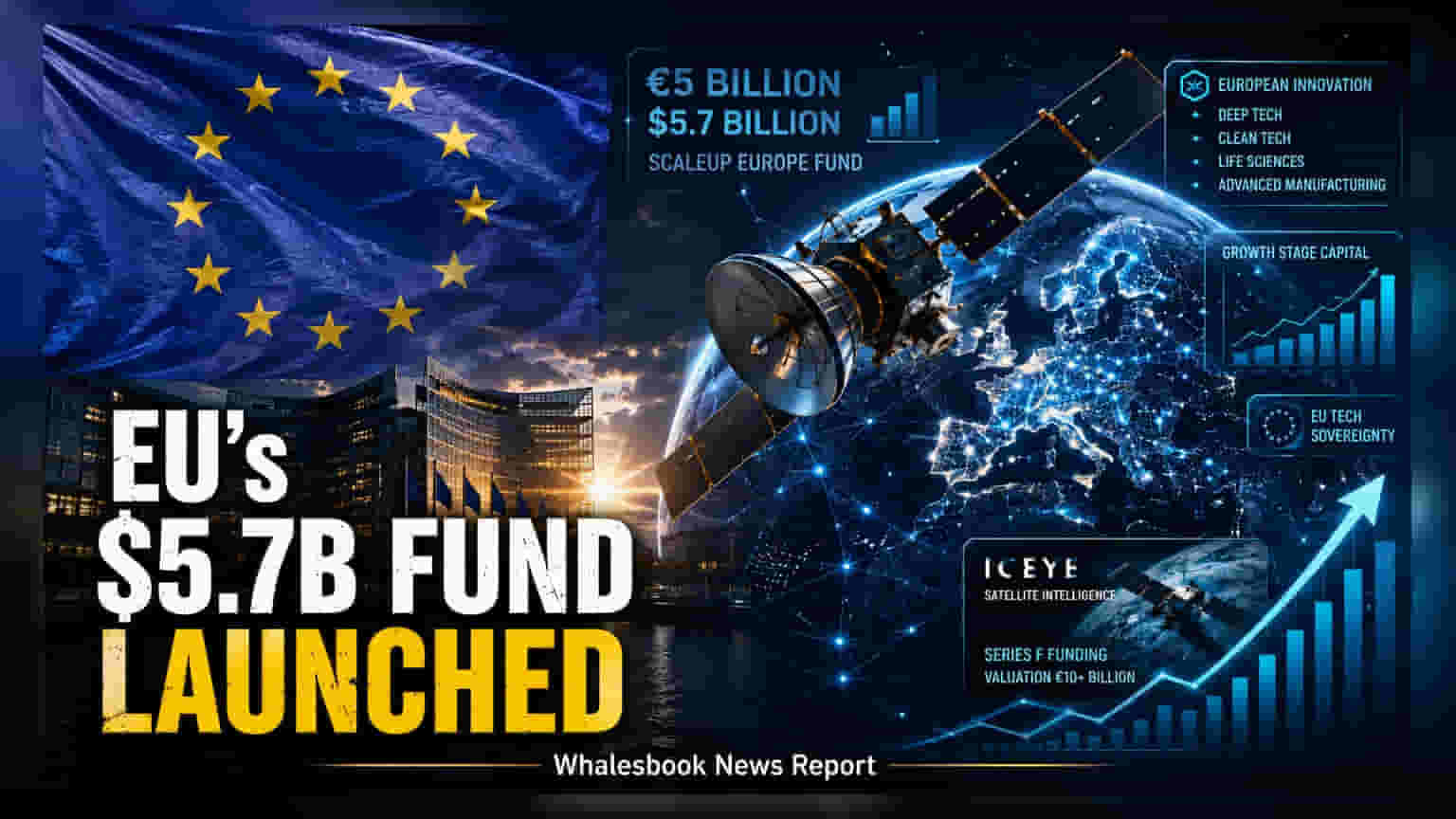
The European Commission has launched the €5 billion (approx. $5.7 billion) Scaleup Europe Fund, marking its first investment by joining the Series F funding round of Finnish satellite firm ICEYE. While ICEYE is a private company and not listed on public exchanges, this major initiative signals a strategic shift in how the EU plans to support late-stage technology companies, offering insights into global trends for deep-tech and space-sector infrastructure.
The European Commission has officially set its new €5 billion (approximately $5.7 billion) investment vehicle, the Scaleup Europe Fund, into motion. In a move to boost the continent's technological sovereignty, the fund made its debut investment by co-leading a portion of the Series F funding for ICEYE, a Finnish company specializing in satellite intelligence. This initiative is managed by the Swedish asset manager EQT and is designed to provide substantial capital to growth-stage companies, helping them scale operations within the European Union.
Understanding the ICEYE Investment
ICEYE is a private firm that builds synthetic aperture radar (SAR) satellite constellations. These satellites can capture high-resolution imagery regardless of lighting conditions or cloud cover, making them valuable for defense, maritime, and disaster management applications. Following its latest funding round, which included the participation of the Scaleup Europe Fund and was originally led by General Atlantic, the company is valued at over €10 billion. It is important for investors to note that ICEYE is not a publicly traded entity, meaning it is not available for investment on the NSE, BSE, or any other public stock exchange. The fund's involvement here highlights the increasing institutional interest in space-tech as a critical infrastructure sector.
Strategic Goals and Fund Management
The Scaleup Europe Fund represents a distinct change from traditional public funding models. By partnering with private institutional investors and utilizing EQT’s management expertise, the European Commission aims to ensure that European deep-tech companies have access to large, late-stage funding pools without needing to look entirely to foreign markets. The fund’s scope is broad, targeting areas such as clean tech, life sciences, and advanced manufacturing, which aligns with the EU’s broader goal of competing globally in strategic technological fields.
Risks and Monitoring for the Sector
While this fund aims to support the growth of European tech, investors following the space-tech and deep-tech sectors should be aware of the specific challenges companies like ICEYE face. A primary concern for firms in this space is revenue concentration. ICEYE, for instance, relies significantly on government and defense-related contracts, which means changes in procurement timelines or policy shifts can impact financial stability.
Additionally, there is significant execution risk involved in the company's ambitious production plans. ICEYE has set goals to scale its satellite manufacturing to 100 units annually by 2028. Successfully meeting these targets is crucial to maintaining its valuation and market position. Furthermore, the global Earth observation market is becoming increasingly competitive, with rapid innovation required to maintain a technological edge. Investors observing these trends can track how effectively such public-private funds can nurture these companies toward sustainable profitability amidst these inherent sector pressures.