

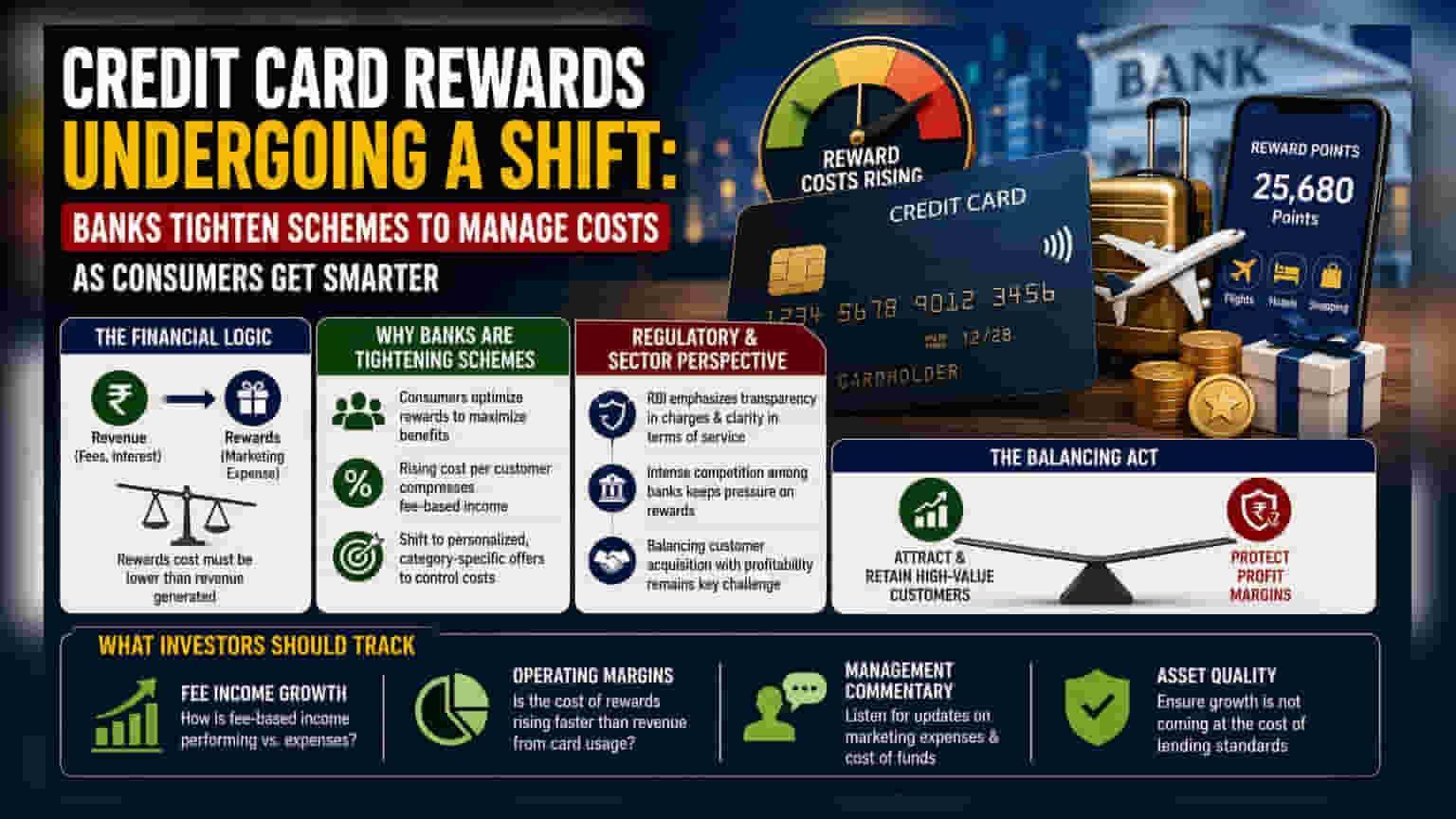
Credit card reward programs are evolving as Indian banks balance customer acquisition with rising costs. While these points drive spending and transaction volumes, higher redemption rates are now pressuring bank margins. Investors should monitor how this shift in loyalty schemes impacts fee income and operational costs for banking stocks.
What Happened
Credit card reward programs in India are undergoing a strategic shift. As consumers become more sophisticated at maximizing points—often shifting from simple cashback to travel miles or high-value redemptions—the cost of these programs for banks has risen. Banks are now increasingly recalibrating their reward structures to manage expenses while still aiming to drive higher transaction volumes. For Indian investors, this trend highlights the delicate balance banks must maintain between attracting high-spending customers and protecting their profit margins.
The Financial Logic of Rewards
For a bank, a credit card is not just a payment tool; it is a revenue-generating product that earns money through merchant fees (the cut taken from stores when a card is used), annual fees, and interest income from users who do not pay their full bills on time. Reward points act as a marketing expense. When a bank offers generous rewards, it is essentially paying to acquire and retain a customer.
However, this model works best when the cost of these rewards is lower than the revenue generated by the cardholder. As consumers optimize their spending to earn more points, the bank’s cost per customer increases. This phenomenon creates a challenge: if the reward payout becomes too high, it can compress the bank's fee-based income, a metric analysts watch closely in quarterly financial results.
Why Banks Are Tightening Schemes
Banks are seeing a maturity in the Indian credit card market. Many consumers now treat reward optimization as a strategic game, which was less common a few years ago. This shift forces banks to move away from “one-size-fits-all” rewards. Instead, they are tailoring programs to encourage spending in specific, higher-margin categories. By moving toward segmented offers, banks aim to reduce the overall cost of rewards while still keeping high-value users engaged.
The Regulatory and Sector Perspective
The Reserve Bank of India (RBI) has kept a close watch on the credit card sector, emphasizing transparency in charges and clarity in terms of service. While regulators are not directly managing reward points, any tightening of industry norms around credit card operations can influence how banks structure these programs. Additionally, as competition in the credit card segment intensifies among private and public sector banks, the pressure to offer attractive rewards remains high, potentially limiting how much banks can scale back these benefits without losing market share.
What Investors Should Track
When reviewing the quarterly performance of major banks and card issuers, investors should look beyond just the growth in the number of cards issued. Important metrics to monitor include:
Fee Income Growth: How is the bank’s fee-based income performing compared to its operational expenses?
Operating Margins: Is the cost of customer acquisition, which includes rewards, rising faster than the revenue generated from card usage?
Management Commentary: Watch for executive remarks on the “cost of funds” and “marketing expenses” related to credit cards.
Asset Quality: While rewards drive volume, ensure that the bank is not sacrificing lending standards just to acquire new cardholders in an attempt to boost transaction counts.