

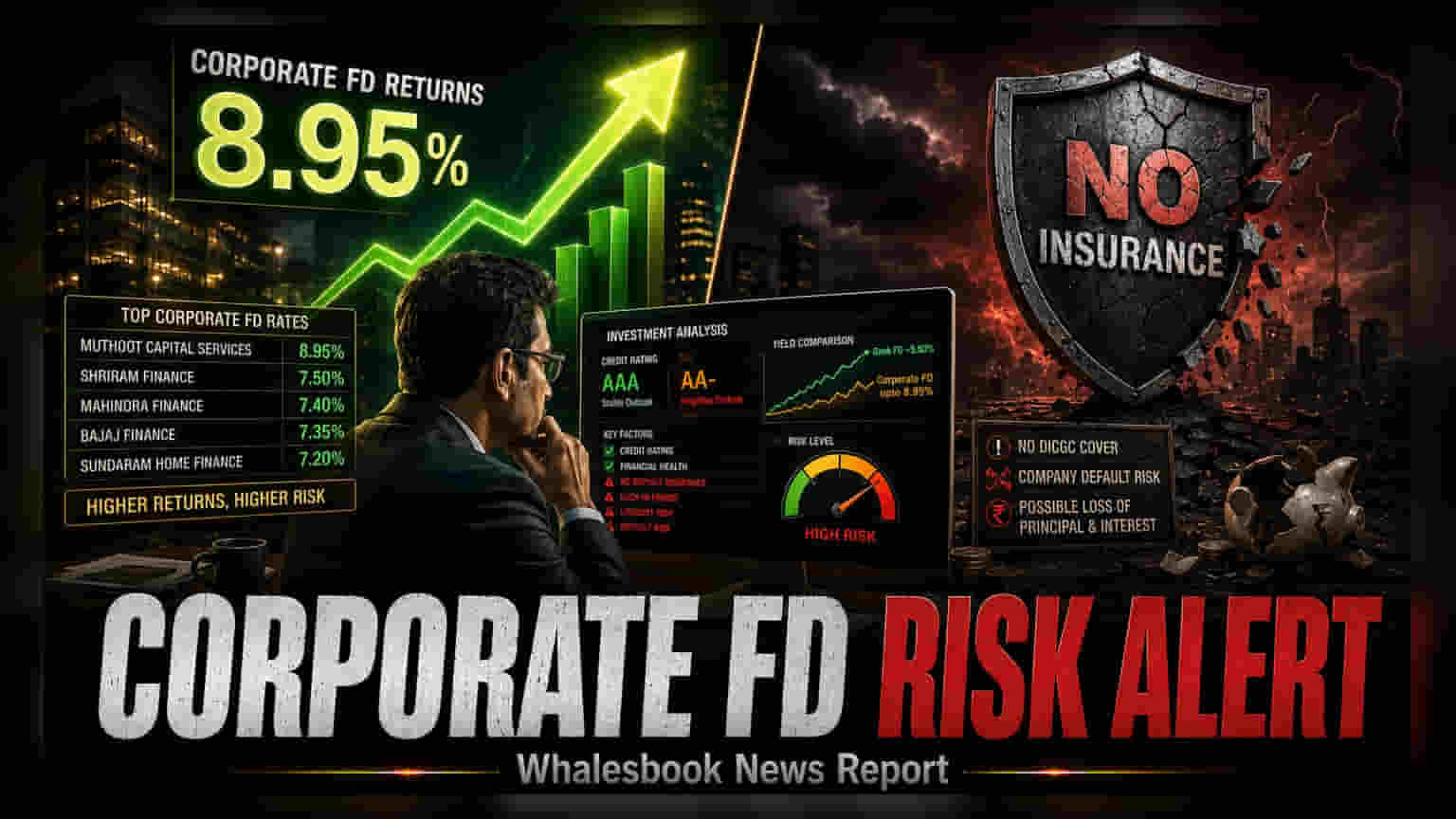
Corporate fixed deposits are currently offering interest rates as high as 8.95%, attracting investors looking for better returns. However, these investments lack the ₹5 lakh DICGC insurance cover available for bank FDs, meaning the credit risk lies entirely with the issuer. Investors should prioritize the company's credit rating and financial stability over headline interest rates.
Corporate fixed deposits (FDs) are currently drawing attention from investors with interest rates reaching up to 8.95%. In a market where standard bank deposits offer lower returns, these yields appear highly attractive. However, it is essential for investors to understand that this higher interest is a form of compensation for the additional risks involved in lending to a private entity rather than a bank.
The most significant difference between a bank FD and a corporate FD is the safety net. Bank deposits are protected by the Deposit Insurance and Credit Guarantee Corporation (DICGC) up to ₹5 lakh per depositor, per bank. Corporate FDs, on the other hand, do not enjoy this protection. If the issuing company faces a liquidity crunch or defaults, there is no government-backed insurance to recover the principal or interest. This makes the issuer's financial strength the only shield for the investor's money.
Understanding the Yield-Risk Trade-off
Recent market data shows a clear divide in the market. Many highly-rated companies, including Shriram Finance, Mahindra Finance, Bajaj Finance, and Sundaram Home Finance, typically offer rates between 7% and 7.5% for three-to-five-year tenures. These firms often maintain high credit ratings, such as AAA, which implies a lower probability of default. In contrast, other issuers are offering up to 8.95% to attract funds. For instance, Muthoot Capital Services, which recently held a CRISIL AA-/Stable rating, has offered rates as high as 8.95% for three-year deposits.
The difference in these interest rates represents the risk premium. Investors are essentially being paid an extra 1% to 1.5% to accept a lower credit rating and the absence of deposit insurance. A rating of AA- is still investment grade, but it carries more risk compared to a AAA-rated instrument.
How to Evaluate Before Investing
Before committing capital to a corporate FD, investors should move beyond the advertised interest rate. The first step is to check the latest credit rating from agencies like CRISIL, ICRA, or CARE. A rating change or a negative outlook from an agency is often the first signal of potential trouble in the company’s financial health or debt-servicing ability.
Liquidity is another critical factor. Corporate FDs often come with strict lock-in periods, and premature withdrawal typically carries a penalty or may not be allowed at all. Unlike bank FDs, which can often be liquidated easily, corporate deposits are less flexible.
For those still keen on this asset class, the most prudent approach is to avoid putting the entire corpus into a single company. Diversifying across multiple issuers, especially those with different rating profiles and business models, can help manage the risk. Investors may also track the company's regular exchange filings, which often disclose information about new debt issuance, such as Non-Convertible Debentures (NCDs), as this can indicate how the company plans to manage its future repayment obligations.