

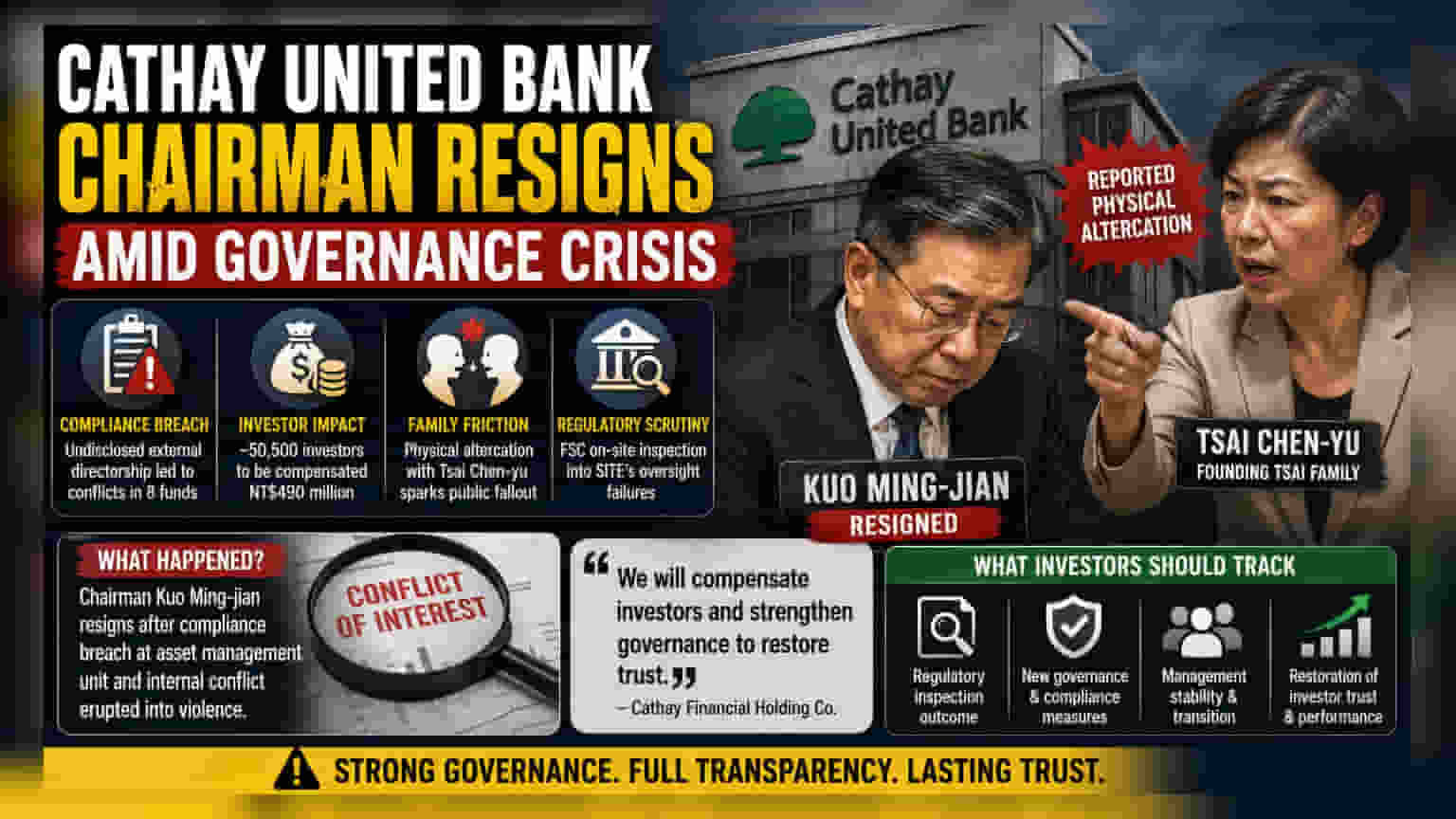
Cathay United Bank Chairman Kuo Ming-jian has resigned following a compliance breach involving his outside board seats. The scandal, which included a dispute with the founding family, has forced the bank's asset management arm to pay NT$490 million to 50,500 investors.
What Happened
Cathay United Bank Chairman Kuo Ming-jian has resigned from his position, stepping down amidst heightened governance concerns and internal conflict. The resignation follows a regulatory compliance breach at the bank's asset management unit, Cathay Securities Investment Trust (SITE), which was linked to Kuo’s external board appointments. The situation was further complicated by reports of a physical altercation between Kuo and Tsai Chen-yu, a member of the founding Tsai family, which drew significant public attention to the bank's internal management practices.
The Compliance Breach and Investor Impact
The core issue stems from a failure to disclose and manage conflicts of interest. An internal review revealed that Kuo held a directorship at Alchip Technologies, a chip company, while simultaneously overseeing the bank's asset management operations. This dual role created conflicts of interest across eight of the firm’s funds, requiring a restatement of the net asset values for those products. To resolve the compliance lapse, Cathay SITE announced plans to compensate approximately 50,500 investors, totaling roughly NT$490 million. For investors, this highlights the risks associated with inadequate disclosure of external roles by key management personnel.
Governance and Family Friction
The resignation was preceded by public criticism from Tsai Chen-yu regarding the number of external board seats Kuo held, raising questions about his time and focus on the bank's operations. The reported physical confrontation between the two at the bank’s headquarters underscored the depth of internal tension. Following these events, Cathay Financial Holding Co. confirmed the resignation, stating that Kuo would relinquish his board positions at the bank, the financial holding entity, and its private equity arm. Interestingly, the company also noted plans to retain Kuo in an advisory capacity, a move that may draw further scrutiny regarding the clean break from the previous governance structure.
Regulatory Oversight
Taiwan's Financial Supervisory Commission has launched an on-site inspection of Cathay SITE to investigate why the subsidiary was not aware of or did not report Kuo's external board role. This regulatory action is a critical factor for investors, as it could lead to further penalties or changes in compliance procedures within the group. The focus will be on whether the bank's internal controls are robust enough to prevent similar conflicts in the future.
What Investors Should Track
Investors and market participants should track the outcome of the ongoing regulatory inspection by the Financial Supervisory Commission. Key monitorables include any additional fines or directives issued to the group, the stability of the management transition, and the effectiveness of the new governance protocols implemented to prevent future conflicts of interest. The company’s ability to move past this reputational hit and restore trust with its investors will be central to its long-term operational stability.