 Whalesbook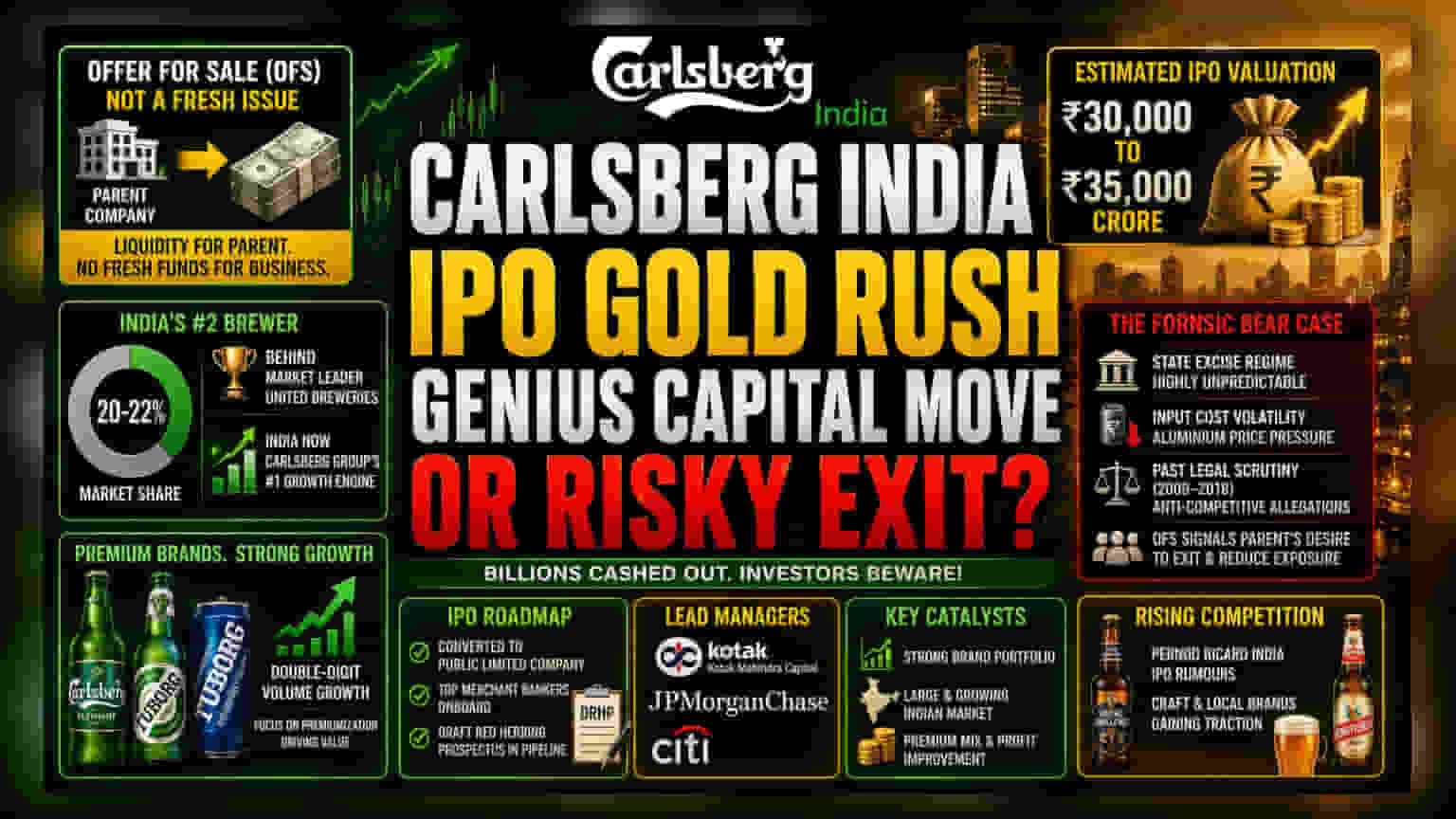


The Valuation Play
Carlsberg’s move to list its Indian subsidiary signifies a calculated shift in capital allocation strategy rather than an operational expansion. By pursuing an Offer for Sale (OFS), the Danish brewer is prioritizing liquidity for its parent company over raising fresh capital for its Indian operations. This mirrors a broader pattern observed among foreign multinationals in India, where parent entities are leveraging the local market's premium valuation multiples—often significantly higher than those found on European exchanges—to repatriate billions in capital.
Market Dynamics and Competitive Benchmarking
As the second-largest brewer in India, Carlsberg holds an approximate 20% to 22% market share, trailing market leader United Breweries. The company has aggressively invested in its local footprint, including a recent ₹1,250 crore capital commitment, to solidify its position as India has overtaken China as the group’s primary growth engine. However, the path to a successful listing is complicated by intense rivalry. While Carlsberg’s premiumization strategy—focusing on brands like Carlsberg Elephant and Tuborg—has delivered double-digit volume growth, it must contend with shifting consumer preferences and the growing dominance of craft segments. Furthermore, the potential IPO timing coincides with similar rumors surrounding Pernod Ricard’s Indian arm, signaling that major global players are increasingly viewing their Indian subsidiaries as standalone assets for financial unlocking.
The Forensic Bear Case
Investors should look past the growth narrative to the structural risks inherent in the Indian alcobev industry. Unlike consumer staples, alcohol manufacturers operate under a restrictive state-level excise regime that can unilaterally alter profitability through price controls and shifting tax structures. The industry is also sensitive to logistical costs, with recent volatility in aluminum prices impacting margins. Furthermore, Carlsberg India carries baggage from historical legal scrutiny regarding alleged anti-competitive practices between 2009 and 2018. While management has recently restructured the board to enhance governance, the reliance on an OFS structure indicates the parent firm is looking to mitigate its exposure to these regulatory and operational headwinds while capitalizing on current market fervor.
Forward Guidance
The company’s move to convert into a public limited entity and the appointment of Kotak Mahindra Capital, JPMorgan, and Citigroup suggests a formal path to a draft red herring prospectus. With an estimated valuation range of ₹30,000 crore to ₹35,000 crore, the deal’s success will depend on whether investors believe the premium multiple is sustainable in an environment of high input costs and regulatory unpredictability.