 Whalesbook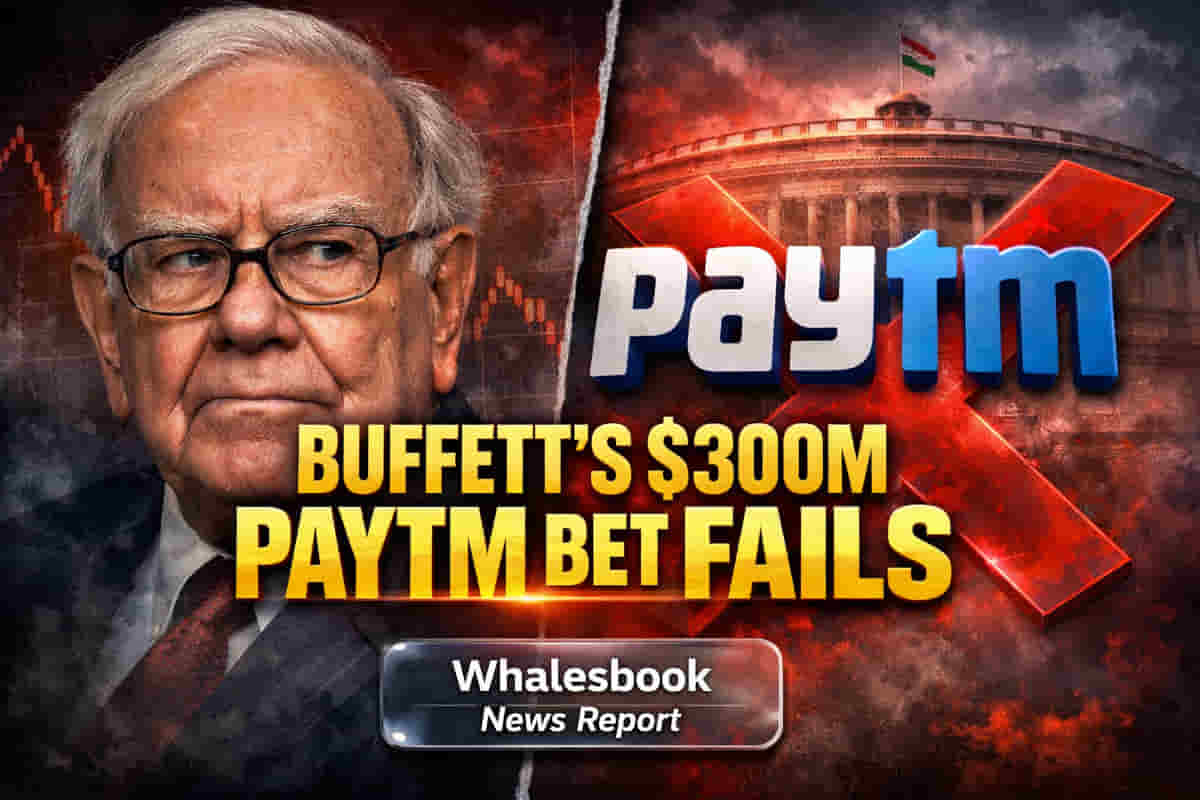


Warren Buffett's impending retirement from Berkshire Hathaway, the conglomerate he has led for over six decades, offers a moment to re-evaluate its investment strategies, particularly its sole foray into India. This significant investment was in the Indian fintech giant Paytm, a venture that ultimately concluded with substantial financial losses for the famed investor's firm.
The Initial Bet on India
Berkshire Hathaway's entry into the Indian market was marked by an investment of approximately $300 million, equivalent to around ₹2,200 crore, made in August 2018. This capital injection secured a 2.6% stake in One97 Communications, the parent entity of Paytm, one of India's leading digital payment and financial services companies. At the time of this investment, Paytm was valued at over $10 billion, but it was not yet a publicly traded entity.
The Unraveling Investment
Paytm eventually made its public market debut in November 2021, more than three years after Berkshire Hathaway's initial investment. The listing proved challenging, with shares opening at a discount to their issue price. Berkshire Hathaway's decision to divest its stake was finalized in 2023, resulting in a reported loss of ₹630 crore for the firm. This exit came after Berkshire Hathaway had already liquidated a portion of its Paytm holdings before the company's Initial Public Offering (IPO). The move out of Paytm within five years stands in contrast to Berkshire Hathaway's typical strategy of holding investments for the long term.
Paytm's Stock Performance and Regulatory Landscape
The stock performance of One97 Communications has been a significant concern since its IPO. The issue price was set at ₹2,150 per share, but it debuted on November 18, 2021, at ₹1,950 and closed its first day of trading at ₹1,359.60. As of December 31, 2025, the stock was trading at ₹1,297, reflecting a decline of nearly 40% from its issue price. Despite this historical underperformance, Paytm's stock has experienced a positive year-to-date return of 31.33%.
Recent developments include regulatory challenges faced by Paytm Payments Bank (PPBL) in early 2024. However, its subsidiary, Paytm Payments Services (PPSL), received a crucial online Payment Aggregator (PA) license from the Reserve Bank of India (RBI) in November 2025. This license is vital for onboarding new online merchants and signifies a step towards resolving earlier compliance issues. Notably, Berkshire Hathaway had already exited its investment before this significant regulatory development.
Impact
The exit of a prominent investor like Berkshire Hathaway, particularly at a loss, can influence investor sentiment towards the Indian fintech sector. While the current year-to-date performance and the PA license offer some positive signals for Paytm, the departure of a major global fund manager might be interpreted by some as a risk indicator for the sector's valuations or future growth prospects. The eventual outcome of Berkshire's investment may serve as a case study for other foreign institutional investors considering similar high-growth, but potentially volatile, emerging market opportunities.
Impact Rating: 6/10
Difficult Terms Explained
- Fintech: Financial technology; companies that use technology to provide financial services.
- Conglomerate: A large company composed of several different businesses in various industries.
- Initial Public Offering (IPO): The first time a private company offers its shares to the public.
- Payment Aggregator (PA): A business that facilitates online payment transactions for merchants by collecting payment information and routing it to the appropriate payment gateway.
- Year-to-date (YTD): The period from the beginning of the current calendar year up to the current date.