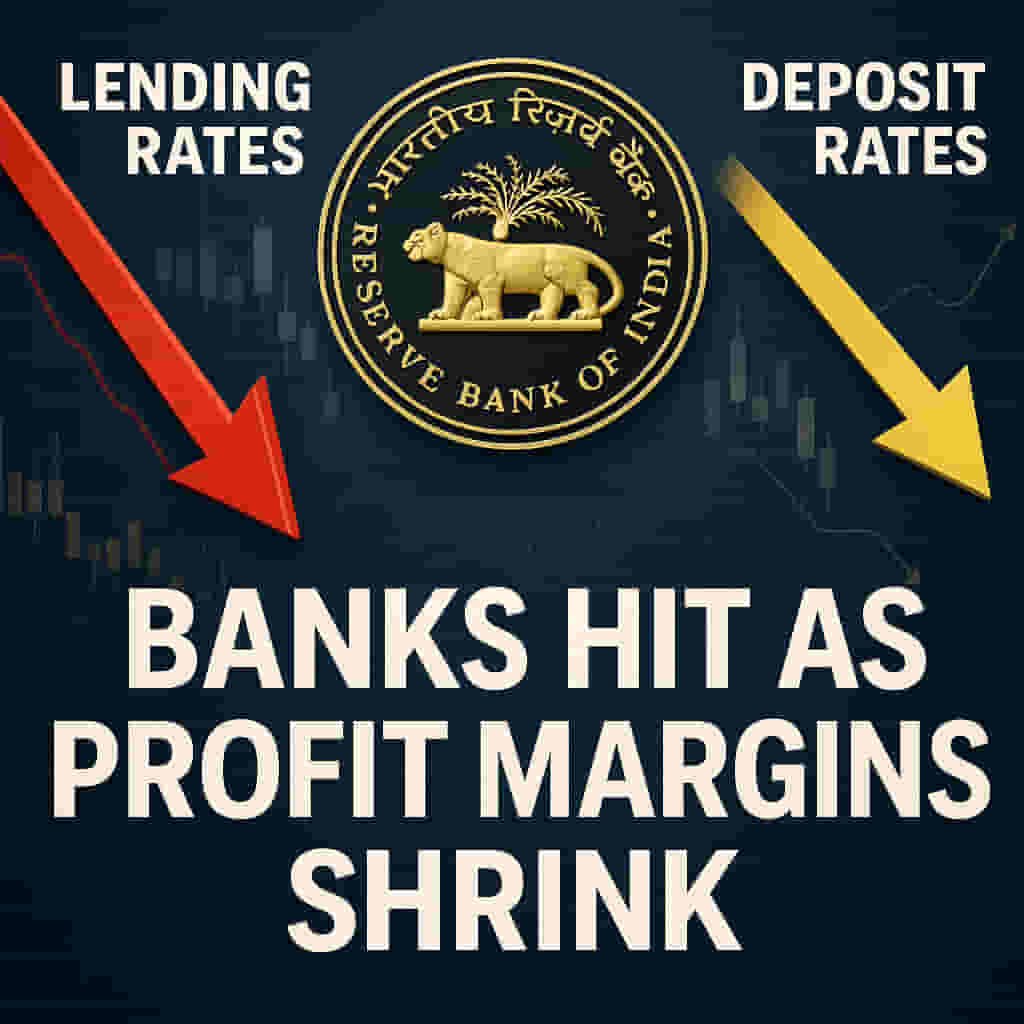
State-owned banks in India have formally raised concerns with the Reserve Bank of India (RBI) regarding a significant imbalance in the transmission of interest rate cuts. They highlight that while lending rates are quickly adjusted downwards, deposit rates are falling at a much slower and more costly pace, leading to a squeeze on their net interest margins.Bankers Voice Concerns to RBIIn a recent meeting ahead of the monetary policy outcome, chiefs of state-owned banks presented their worries to RBI officials.The primary issue discussed was the asymmetry in interest rate adjustments following central bank policy changes.Asymmetry in Rate TransmissionLoans linked to external benchmarks, such as the repo rate, are repriced almost instantly whenever the RBI changes its policy rate.In contrast, deposit rates, especially for existing fixed deposits, are adjusted much more slowly as they mature.One senior bank official noted that banks have passed on 100 basis points (bps) of cuts on the asset side but have been able to reduce deposit rates by only 30 bps, creating a 70-bps spread compression.Impact on Net Interest MarginsThe widening gap between asset yields and liability costs is directly thinning the net interest margins (NIMs) of banks.This situation is described as a "fundamental asymmetry" where a larger portion of loans gets repriced quickly compared to deposits.Banks are struggling to boost deposit growth due to intensified competition for household savings from mutual funds and other financial products.Regulatory and Market FactorsRBI's push for external benchmark-linked loans has made lending portfolios highly sensitive to policy moves, with about 63% of all floating-rate loans linked to external benchmarks.Private sector banks, with approximately 88% of their floating loans tied to external benchmarks, are impacted more than state-owned peers.High runoff factors under the liquidity coverage ratio (LCR) framework can also increase funding costs for banks.Potential Solutions DiscussedEconomists suggest that the RBI could aid transmission by infusing liquidity into the banking system.Bankers have proposed a multi-year "roadmap" for policy rates to guide liability pricing.A reduction in small savings interest rates, which are currently offering higher returns than bank term deposits, is seen as a crucial step to help banks attract deposits.Introducing globally common products like floating-rate deposits, which adjust in line with benchmark rates, is also suggested to enable faster transmission.ImpactThis news directly impacts the profitability and financial health of Indian banks, potentially affecting their ability to lend and offer competitive deposit rates.Investor sentiment towards the banking sector could be affected, influencing stock prices.Difficult Terms ExplainedNet Interest Margin (NIM): The difference between the interest income generated by a bank from its lending activities and the interest it pays out to depositors. It is a key measure of bank profitability.Reserve Bank of India (RBI): India's central bank, responsible for monetary policy, regulation, and supervision of the country's banking system.Repo Rate: The rate at which the RBI lends money to commercial banks. It is a key tool for controlling inflation and influencing credit conditions.Basis Points (bps): A unit of measure used in finance to describe the percentage change in a financial instrument. 100 basis points equal 1 percent.Asset-Liability Management (ALM): The practice of managing a bank's balance sheet to mitigate risks arising from mismatches in assets and liabilities, particularly concerning interest rate and liquidity risks.External Benchmark: A reference interest rate, set by an external body (like the RBI's repo rate), to which a loan or deposit rate is linked.Liquidity Coverage Ratio (LCR): A regulatory standard requiring banks to hold sufficient high-quality liquid assets to cover their total net cash outflows over a 30-day stress period.Runoff Factors: Assumptions used in LCR calculations about the percentage of deposits a lender expects to be withdrawn during liquidity stress.NDTL (Net Demand and Time Liabilities): Total deposits held by a bank, minus funds held in inter-bank deposits and items in the nature of short-term liabilities.
Banks Warn RBI: Rate Cuts Squeezing Profits! Are Your Deposits Next?
BANKINGFINANCE
Overview
Indian state-owned banks have voiced concerns to the Reserve Bank of India (RBI) about declining net interest margins. They report that lending rates are falling much faster than deposit rates following policy rate cuts, creating a significant spread compression. This asymmetry, driven by external benchmark-linked loans versus slower-repricing deposits, is straining bank balance sheets. Bankers are urging the RBI for interventions to improve deposit growth and rebalance transmission.
Disclaimer:This content
is for educational and informational purposes only and does not constitute investment, financial, or
trading advice, nor a recommendation to buy or sell any securities. Readers should consult a
SEBI-registered advisor before making investment decisions, as markets involve risk and past performance
does not guarantee future results. The publisher and authors accept no liability for any losses. Some
content may be AI-generated and may contain errors; accuracy and completeness are not guaranteed. Views
expressed do not reflect the publication’s editorial stance.