 Whalesbook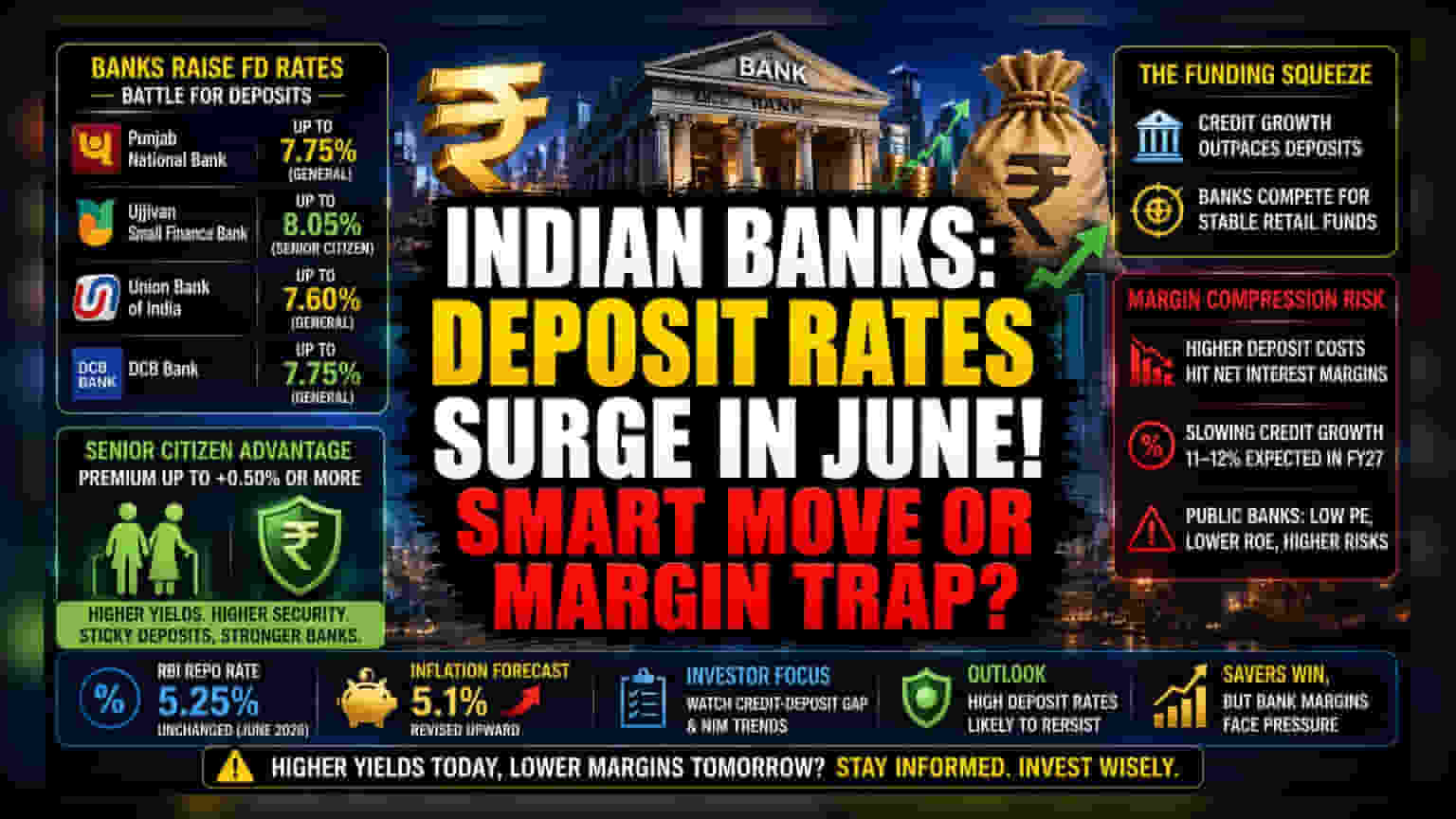


The Funding Squeeze
Indian commercial banks are aggressively raising fixed deposit rates in June 2026, signaling an intensifying battle for retail capital. This trend, led by institutions like Punjab National Bank, Ujjivan Small Finance Bank, Union Bank of India, and DCB Bank, is a defensive reaction to systemic liquidity constraints. While the Reserve Bank of India opted to maintain the repo rate at 5.25% in its June policy meeting, banks are finding themselves compelled to offer higher yields to attract stable long-term deposits, as credit growth continues to outpace deposit mobilization.
The Senior Citizen Yield Play
The most aggressive product positioning is currently focused on the senior citizen demographic. By offering premiums of 50 basis points or more over general public rates, banks are securing high-stickiness capital. Ujjivan Small Finance Bank, for instance, has pushed its offerings to reach the 8.05% threshold for specific tenures. This strategic focus is critical because term deposits, particularly those held by retail savers, serve as a stable buffer against the volatility of wholesale funding markets. However, for the average investor, the dispersion in rates across public and small finance banks highlights a fragmented market where liquidity needs dictate product pricing far more than the central bank's benchmark rate.
Structural Risk and Margin Compression
While rising deposit rates provide immediate relief to savers, they create a deteriorating outlook for bank net interest margins (NIMs). The sector is currently navigating a challenging environment where the transmission of higher funding costs into lending rates is hindered by competitive pressures and a slowing macro-economic backdrop. With system-wide credit growth expected to moderate toward the 11-12% range for the 2026-27 fiscal year, banks with high loan-to-deposit ratios face a difficult choice: accept lower margins or risk losing market share. Public sector giants like Punjab National Bank and Union Bank of India are trading at valuations that suggest the market is already pricing in these margin headwinds, with price-to-earnings ratios hovering in the low single digits. Unlike more nimble private players, these institutions often face the dual burden of lower return on equity and significant contingent liabilities, which could materialize if supply chain disruptions and West Asia geopolitical risks dampen corporate credit quality.
The Forward Outlook
Investors should monitor the credit-deposit gap as a primary indicator of sector health. As the banking industry pivots from the aggressive expansion of 2025 toward a more conservative credit stance, the reliance on high-cost retail deposits will likely increase. Analysts remain cautious about the sustainability of current deposit rates, noting that any further escalation in inflation projections—already revised upward to 5.1%—could force banks to maintain these elevated yields longer than anticipated, putting a structural ceiling on profit growth for the remainder of the year.