

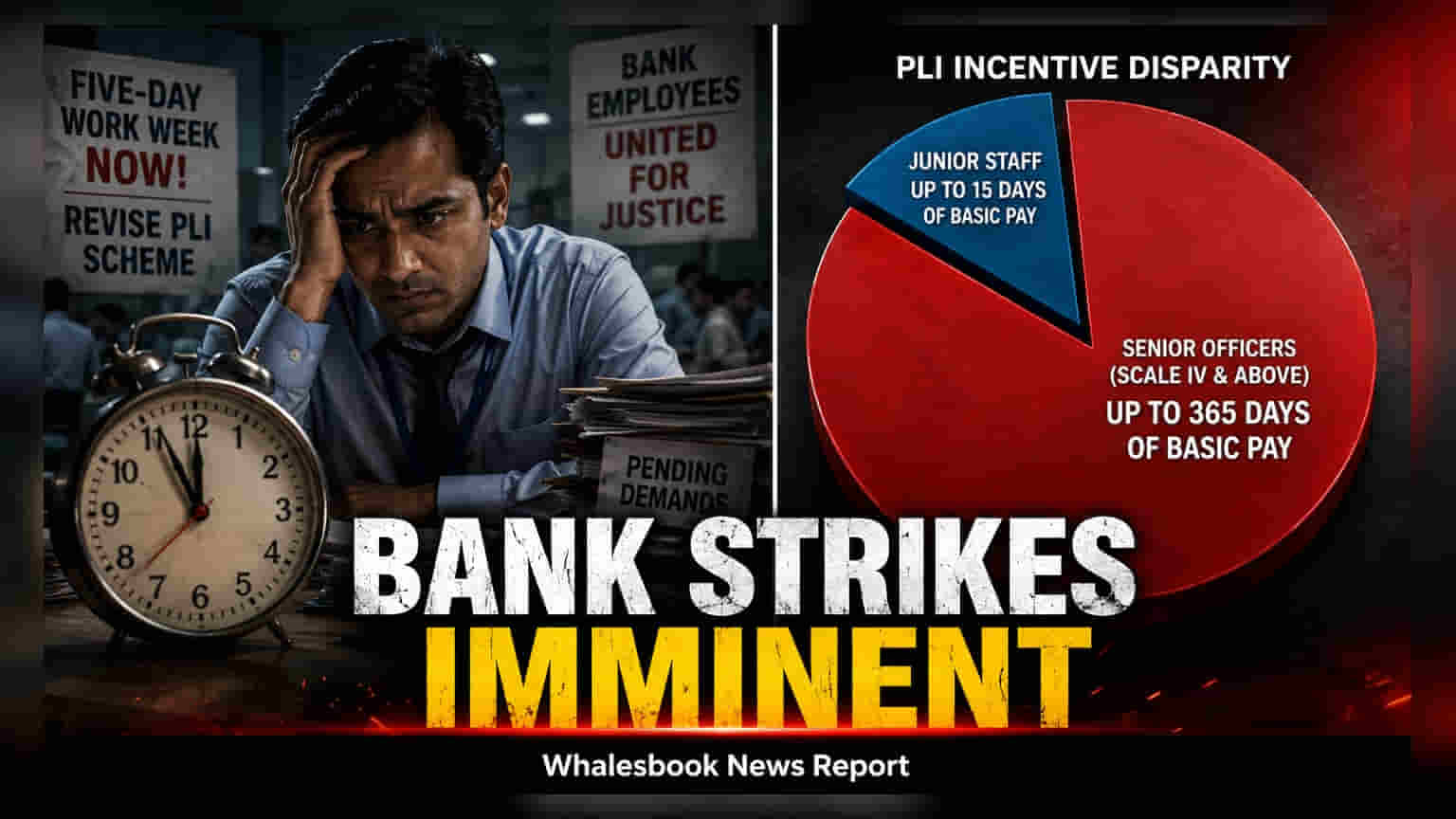
Bank employee unions have announced a series of nationwide strikes starting September 11, 2026, to demand a five-day work week and changes to the performance-linked incentive scheme. Investors may watch for potential operational disruptions in public sector banks, as the ongoing dispute between the unions and the Indian Banks' Association remains unresolved.
The United Forum of Bank Unions (UFBU), representing a coalition of bank employee and officer associations, has declared a series of nationwide strikes. These protests are intended to pressure the government into acting on two long-standing demands: the implementation of a five-day banking work week and a revision of the government’s performance-linked incentive (PLI) scheme.
According to the announced schedule, a one-day all-India strike is set for September 11, 2026. If the demands are not met, the unions have planned a three-day strike from September 28 to September 30. Should the deadlock continue, an indefinite strike is scheduled to begin on October 26, 2026.
The core of the five-day work week dispute relates to the 12th Bipartite Settlement and the 9th Joint Note, which were signed in March 2024. The unions argue that the Indian Banks' Association (IBA) had agreed to this work schedule, but the proposal has been pending government approval for over two years. The unions view this delay as a failure to honor the terms of the settlement.
Additionally, the bank unions are protesting the structure of the recently revised PLI scheme. They contend that the current framework is discriminatory, as it offers significantly higher incentives to senior officers in Scale IV and above compared to junior staff. The unions argue that while most employees are capped at incentives equivalent to 15 days of basic pay and dearness allowance, senior management could receive up to 365 days of basic pay under the new rules. This issue is currently under conciliation proceedings with the Chief Labour Commissioner and is also the subject of litigation in the Delhi High Court. The UFBU has requested that the scheme be paused and renegotiated.
For investors, the primary concern is the potential for operational disruption. Historically, bank strikes have primarily impacted the operations of public sector banks, affecting services such as cheque clearing, cash deposits, and withdrawals at branches. Private sector banks typically remain operational during such events, as their staff are often not part of these specific union coalitions. While these strikes create temporary uncertainty and may influence short-term sentiment, the banking sector’s long-term business performance is generally driven by macro-economic factors like interest rates, credit demand, and asset quality.
The next important monitorable for investors will be any government intervention or negotiation outcome that could avert these strikes. If the strikes proceed as planned, the market will likely track the scale of branch closures and the extent of delay in banking transactions, particularly during the three-day and potential indefinite strike periods.