

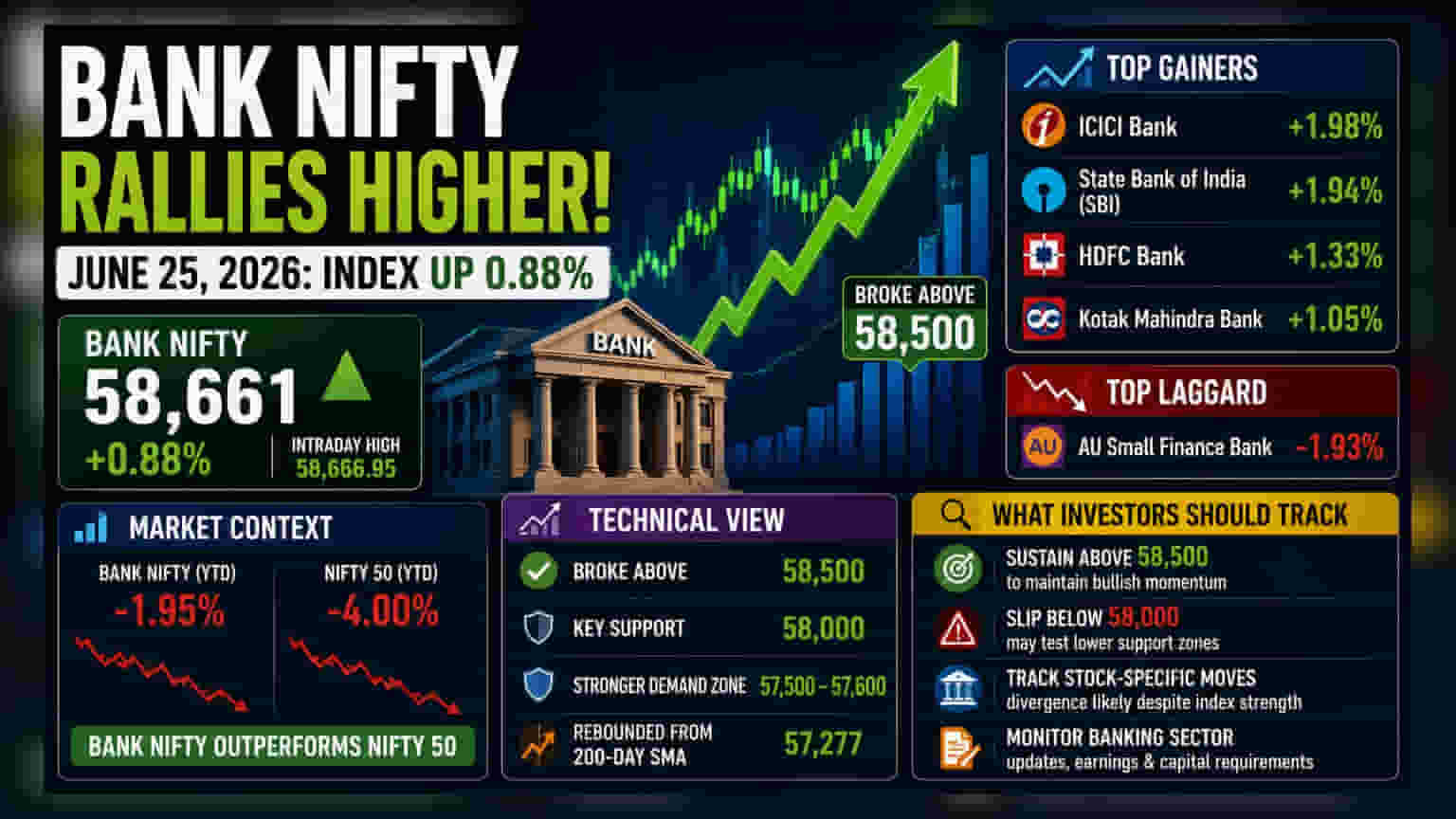
The Bank Nifty index rose nearly 1% to hit an intraday high of 58,666 on June 25, 2026, crossing the key 58,500 resistance level. Gains in major banking stocks like ICICI Bank and SBI drove the index, though AU Small Finance Bank saw a decline. The index remains down 1.95% year-to-date, showing relative strength compared to the broader Nifty 50.
What Happened
The Bank Nifty index moved higher on June 25, 2026, gaining approximately 0.88% to trade at 58,661 during the session. The index reached an intraday high of 58,666.95, successfully breaking above the 58,500 level. This mark has served as a recent technical hurdle, and sustaining positions above this point is often viewed as a signal of improving sentiment among banking stocks.
Sector Leaders and Laggards
The rally was primarily driven by heavyweight private and public sector banks. ICICI Bank and the State Bank of India (SBI) were among the top performers, each registering gains of nearly 2%. HDFC Bank also contributed to the momentum with an increase of over 1.3%, while Kotak Mahindra Bank climbed more than 1%.
In contrast, the sector did not see uniform growth. AU Small Finance Bank bucked the trend, declining by nearly 2% during the trading session, which highlights that stock-specific performance remains a factor for investors even when the broader index moves higher.
Understanding the Market Context
Banking indices often act as a barometer for the broader Indian market due to their high weightage. Year-to-date, the Bank Nifty is down approximately 1.95%. While this indicates a challenging period for the banking sector so far in 2026, it has still outperformed the broader Nifty 50 index, which has declined by about 4% over the same timeframe. This relative performance suggests that while the sector faces headwinds, it is currently holding up better than the wider market.
Technical and Support Levels
The index's recent movement shows an attempt to stabilize above key technical indicators. The rebound from the 200-day simple moving average, which is positioned near 57,277, is considered a point of interest for market observers monitoring the index's long-term trend. For the immediate future, market participants are looking at 58,000 as a key support level. If the index faces downward pressure, a more significant demand zone is identified between 57,500 and 57,600, levels that previously acted as resistance points.
What Investors Should Track
Investors monitoring the banking space should watch for the index's ability to hold the newly cleared 58,500 level. A consistent performance above this mark may be required to sustain the current upward trend. Conversely, if the index slips back below 58,000, it may test the lower support zones. Beyond technical levels, tracking the stock-specific divergence—as seen today with AU Small Finance Bank—will remain important, as banking stocks can often react differently to specific company announcements or capital requirements.