 Whalesbook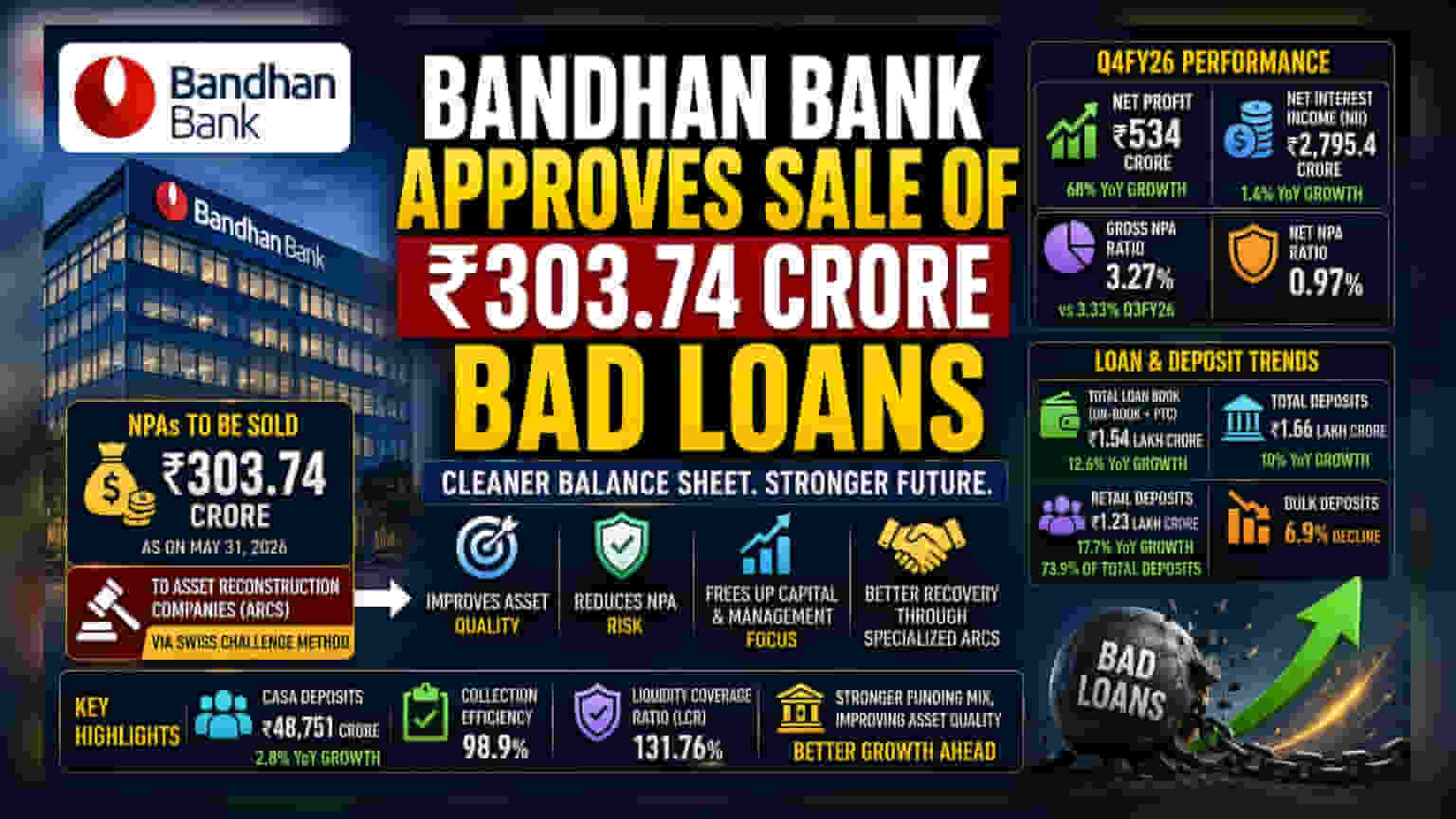


Bandhan Bank plans to sell ₹304 crore of stressed housing loans to Asset Reconstruction Companies using the transparent Swiss Challenge bidding method. This move aims to clean up its balance sheet following a 68% rise in Q4FY26 profit. Investors are tracking this to see how much capital the bank recovers and the impact on future asset quality.
What Happened
Bandhan Bank has received board approval to sell a portion of its non-performing assets (NPAs) from its housing finance division. The bank intends to sell bad loans with a principal outstanding amount of ₹303.74 crore as of May 31, 2026. These specific loans are classified as NPAs, meaning they have been past due for more than 180 days. The bank plans to execute this sale by inviting bids from Asset Reconstruction Companies (ARCs) using the Swiss Challenge method. This process allows the bank to seek competing bids after receiving an initial offer to ensure the best possible price for the stressed assets.
Why This Matters For Investors
For investors, the sale of bad loans is a standard strategy banks use to clean up their balance sheets. When a bank sells an NPA to an ARC, it essentially transfers the risk and the headache of recovery to a specialized entity. While this helps the bank reduce its gross NPA figures and frees up management time, it often involves a financial cost. The bank usually sells these loans at a value lower than what is currently on its books, known as a haircut. Investors will be watching the final price at which these assets are sold, as this will determine the extent of the impact on the bank's profitability and capital.
Financial and Business Context
This decision comes on the back of the bank's Q4FY26 performance, where it reported a net profit of ₹534 crore, a 68% increase compared to the same period last year. While the bottom-line profit saw significant growth, the net interest income (NII)—the difference between interest earned on loans and interest paid on deposits—grew by a more modest 1.4% to ₹2,795.4 crore. The rise in profit despite modest NII growth suggests the importance of other factors, such as lower provisioning or higher non-interest income. Improving asset quality is a key theme for the bank; its gross NPA ratio improved to 3.27% from 3.33% in the previous quarter, and net NPAs were reported at 0.97%.
Loan and Deposit Trends
Bandhan Bank’s broader business metrics showed mixed growth. The loan book, including both on-book and PTC (Pass-Through Certificate) assets, reached ₹1.54 lakh crore by the end of March 2026, representing a 12.6% increase year-on-year. Total deposits grew by 10% to reach ₹1.66 lakh crore. A notable highlight is the growth in retail deposits, which rose 17.7%, now accounting for nearly 74% of the bank's total deposit base. Meanwhile, bulk deposits saw a 6.9% decline, indicating a shift toward a more granular and stable funding mix.
What Investors Should Track
Looking ahead, investors may focus on a few key areas regarding this asset sale. The primary monitorable is the completion timeline and the final recovery value. If the bank can sell these assets at a valuation close to the current book value, it will be viewed positively. Conversely, a large discount could impact immediate earnings. Beyond this, market participants will continue to monitor the trend in CASA (Current Account Savings Account) deposits, which grew 2.8% to ₹48,751 crore, and the bank’s ability to maintain its liquidity coverage ratio of 131.76%. Continued improvement in collection efficiency, which stood at 98.9% in the recent quarter, remains critical for long-term asset quality health.