

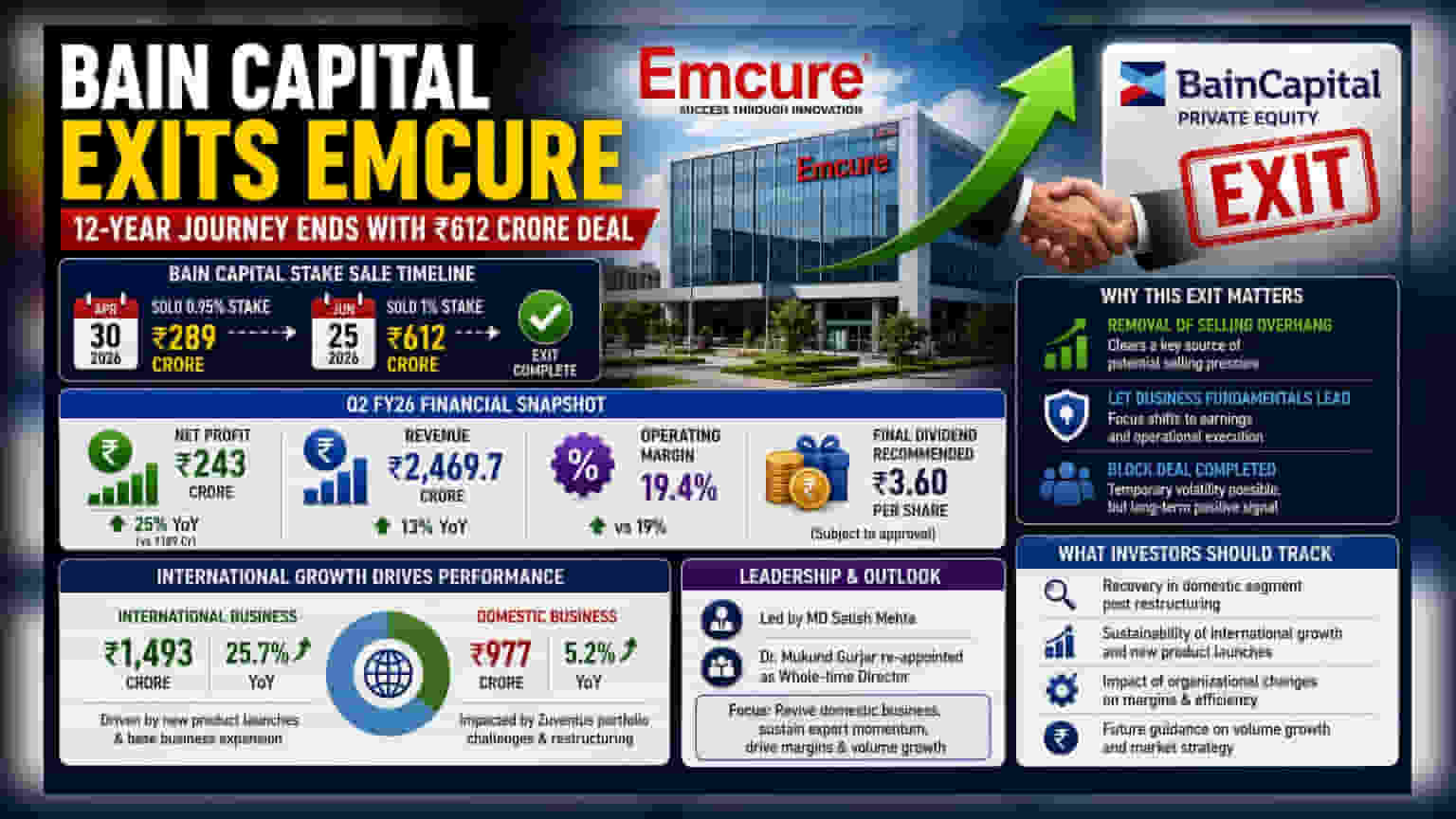
Bain Capital has completed its 12-year investment in Emcure Pharmaceuticals by selling its remaining 1% stake for ₹612 crore through a block deal. The exit follows the company's Q2 results, which reported a 25% profit increase despite slower domestic growth. This move effectively removes the long-term selling pressure from the private equity firm, potentially improving free-float liquidity for public shareholders.
What Happened
Bain Capital, through its affiliate BC Investments IV, has concluded its 12-year association with Emcure Pharmaceuticals. On June 25, 2026, the private equity firm offloaded its final 1% stake in the company via a block deal. The transaction involved approximately 36 lakh shares, fetching a total value of ₹612 crore. This follows an earlier partial sale on April 30, 2026, where the firm sold a 0.95% stake for ₹289 crore, signaling a phased exit process that has now reached its completion.
Financial Performance Snapshot
The exit coincides with the release of Emcure’s second-quarter financial results. The company reported a 25% year-on-year rise in net profit, climbing to ₹243 crore from ₹189 crore in the same quarter last year. Revenue growth was solid at 13%, reaching ₹2,469.7 crore. Operating margins also showed a modest improvement, reaching 19.4% compared to 19% previously. Additionally, the company’s board has recommended a final dividend of ₹3.60 per share, subject to shareholder approval.
Why The Exit Matters For Investors
For public investors, the completion of a long-term private equity exit is often viewed as the removal of a 'selling overhang.' Large institutional investors like Bain Capital often hold significant stakes, and their potential to sell shares can exert pressure on the stock price. With the entire stake now divested, that specific source of potential selling pressure is removed. While large block deals can sometimes lead to temporary price volatility as the shares are absorbed by the market, the completion of the exit typically clears the way for the stock to be driven by fundamental business performance rather than technical selling pressure.
International Versus Domestic Performance
A closer look at the company’s growth drivers reveals a clear divide. The international business has become the primary engine of growth, with sales surging 25.7% to ₹1,493 crore, driven by new product launches and base business expansion. In contrast, the domestic market performance was more muted, with growth at 5.2% to ₹977 crore. The company has explicitly attributed this softer domestic performance to challenges within its Zuventus portfolio and ongoing organizational restructuring efforts. Investors may find this contrast important, as the company’s ability to stabilize its domestic business while maintaining export momentum will be a key factor in future earnings.
What Investors Should Track
Going forward, the focus will likely shift from ownership changes to operational execution. The key monitorable for shareholders is whether the management, led by Managing Director Satish Mehta, can successfully address the sluggishness in the domestic segment. Following the recent re-appointments of key leadership, including Dr. Mukund Gurjar as Whole-time Director, the market will likely look for updates on the organizational restructuring and its impact on domestic margins and volume growth. The ability to maintain international growth while reviving the domestic business will remain the primary metric for long-term valuation assessment.