

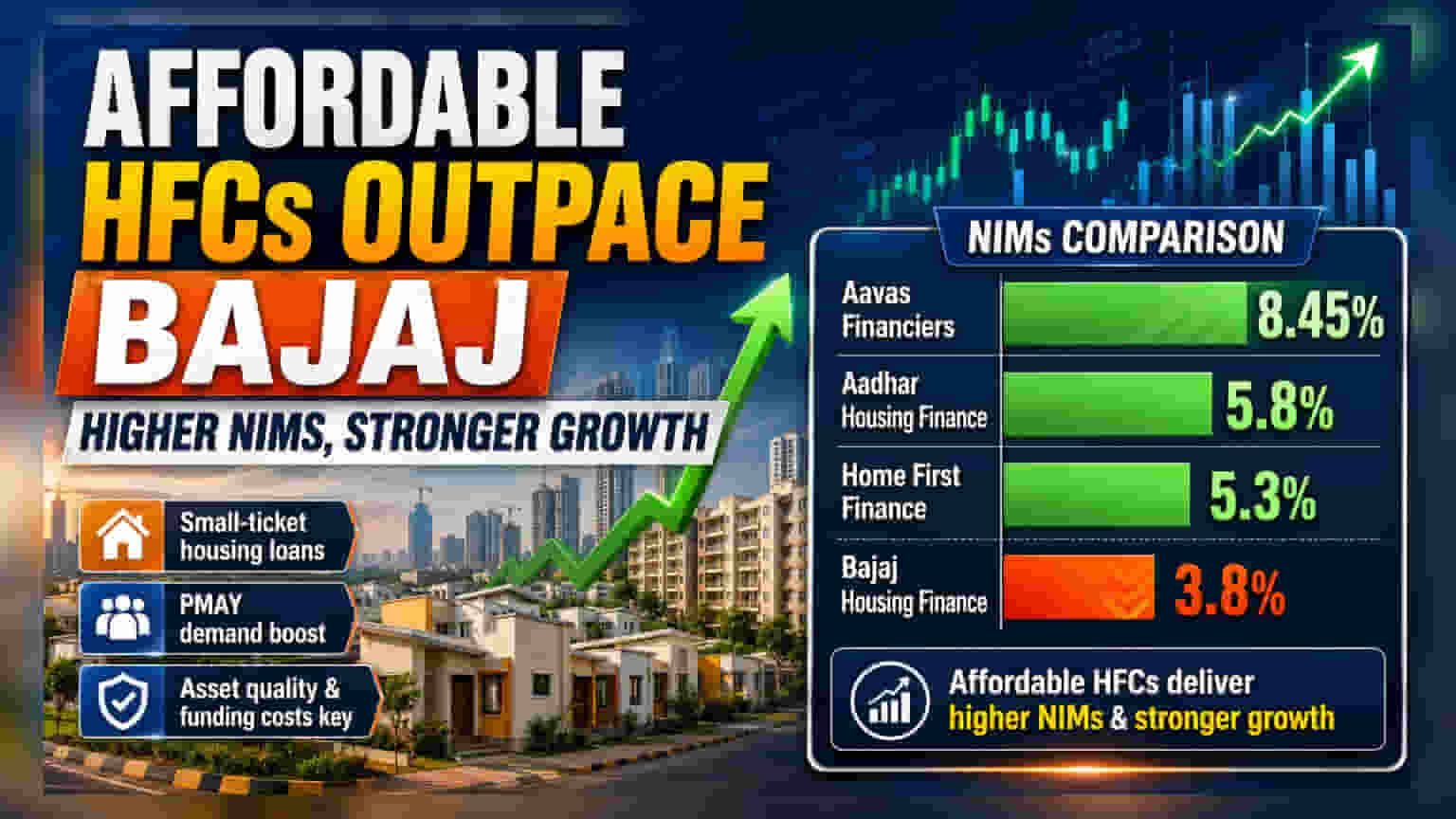
Smaller affordable housing finance firms like Aavas, Aadhar, and Home First are posting higher net interest margins than Bajaj Housing Finance. While these firms benefit from government housing schemes and high-yield, small-ticket loans, they operate with a different risk profile. Investors should understand that higher margins often come with the challenge of lending to lower-income, informal-sector borrowers compared to the prime segment.
What Happened
In the quarter ending March 2026, smaller affordable housing finance companies recorded significantly higher net interest margins (NIMs) compared to large-cap player Bajaj Housing Finance. While Bajaj Housing Finance reported a NIM of 3.8%, smaller peers such as Aavas Financiers (8.45%), Aadhar Housing Finance (5.8%), and Home First Finance (5.3%) posted much higher figures. This trend highlights a stark difference in how these companies approach the housing finance market and the types of borrowers they serve.
The Margin And Growth Story
The superior margins for affordable housing financiers are largely driven by their target customer base. These companies focus on small-ticket loans, typically ranging between ₹10 lakh and ₹12 lakh. By catering to the economically weaker sections and self-employed individuals, they can charge higher interest rates, which directly boosts their NIMs.
Aavas Financiers reported an 18.3% jump in net profit to ₹181.7 crore, supported by a diverse loan mix. Similarly, Aadhar Housing Finance saw net profit grow 27% to ₹310.9 crore, with disbursements rising over 20%. Home First Finance showed the strongest profit growth among the three, climbing 43.3% to ₹149.4 crore. These companies are also benefiting from the government's Pradhan Mantri Awas Yojana, which continues to drive demand for low-cost housing.
Why The Risk Profile Differs
For investors, it is important to distinguish between "prime" housing finance and "affordable" housing finance. Bajaj Housing Finance generally targets prime borrowers with higher credit scores and formal income proofs, which usually leads to lower credit costs but lower interest margins.
In contrast, affordable housing lenders work with borrowers who often lack formal income documentation and may work in the informal economy. While this allows for higher interest charges, it creates a unique risk: the sensitivity of these borrowers to economic stress is higher. Consequently, the ability of these smaller firms to maintain asset quality and manage collections becomes as critical as their growth numbers.
Valuation Perspective
Despite the different business models and risk profiles, market valuations for these companies are relatively clustered. As of the recent quarter, Aavas Financiers traded at a price-to-book (P/B) ratio of 3.1x, Aadhar Housing Finance at 3.0x, and Home First Finance at 2.9x. Bajaj Housing Finance, which operates in a lower-risk, lower-margin segment, is valued at 3.2x. This indicates that the market currently assigns a similar valuation multiple to these firms, weighing the high-growth, high-margin potential of affordable housing against the safety and scale of prime mortgage lenders.
What Investors Should Track
The key monitorable for investors is whether these companies can sustain their NIMs as competition in the affordable housing segment increases. Investors may track asset quality reports in future quarters to see how well these lenders manage their loan portfolios during economic cycles. Additionally, funding costs—the interest rate at which these companies borrow money to lend—will be crucial. A shift in interest rates could affect the borrowing costs for these firms, potentially putting pressure on the margins that currently define their performance.