

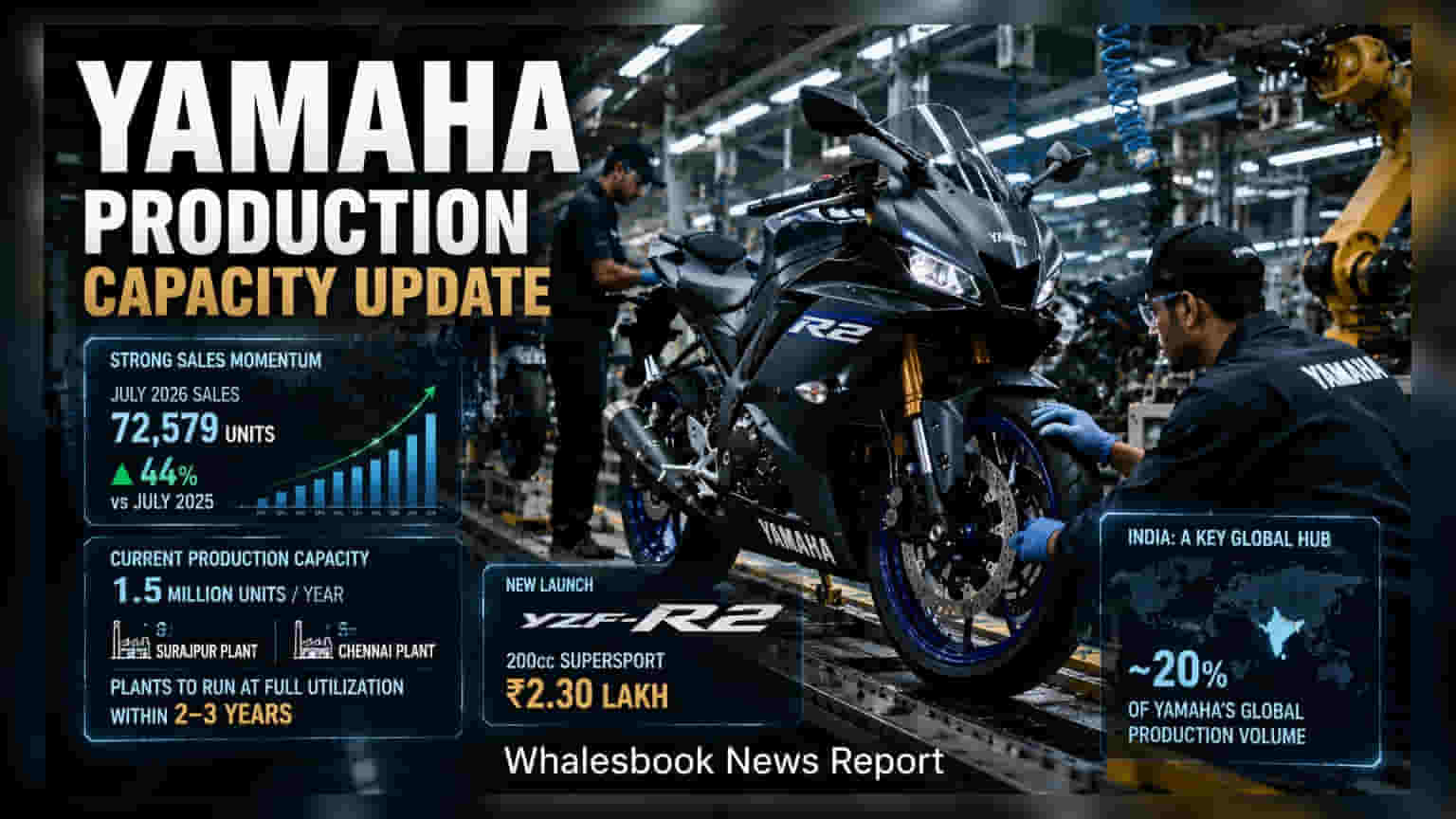
Yamaha Motor India is preparing to increase production capacity as demand for premium motorcycles accelerates. The company, which recently launched the 200cc YZF-R2, plans to optimize its existing plants in Surajpur and Chennai to handle rising domestic and export demand. While the Indian entity is a private, unlisted company, this expansion underscores the shifting trend toward higher-performance bikes in the Indian two-wheeler market.
Strategic Production Focus
Yamaha Motor India is preparing to ramp up its manufacturing output to meet the surging demand for premium motorcycles. The company currently has an annual production capacity of 1.5 million units across its facilities in Surajpur and Chennai. Executives have indicated that, given the current sales momentum, these plants are expected to reach full utilization within the next two to three years. To manage this, management is prioritizing operational efficiency and upgrades to existing lines rather than immediate investment in new, separate factory sites.
Market Shift and New Launches
This production strategy follows a period of robust growth. The company reported 72,579 unit sales in July 2026, representing a 44% increase compared to the same month in the previous year. A major driver of this growth is the rapid move by Indian consumers toward premium, higher-displacement motorcycles. To capitalize on this, Yamaha recently introduced the YZF-R2, a 200cc supersport motorcycle priced at ₹2.30 lakh, designed to capture a larger share of the performance segment.
It is important for investors to note that India Yamaha Motor Private Limited is a private, unlisted subsidiary of Japan’s Yamaha Motor Co., Ltd. While shares of the Indian entity are not available for public trading, its strategic moves provide important context for the domestic two-wheeler sector. The shift toward higher-value products is a trend that is also being actively pursued by listed competitors such as Bajaj Auto, TVS Motor, and Hero MotoCorp.
Sector Context and Risks
Yamaha’s focus on the Indian market as a global manufacturing hub—accounting for approximately 20% of its global production volume—highlights the country's growing importance in the automotive supply chain. However, the path ahead is not without challenges. The industry remains sensitive to fluctuations in the prices of raw materials, particularly aluminum and petroleum-derived components, which can impact profit margins.
Furthermore, the automotive sector faces constant pressure from evolving global regulations concerning internal combustion engines and potential shifts in international trade tariffs. For stakeholders in the broader two-wheeler industry, the key monitoring points will be whether Yamaha can successfully increase production volume without incurring massive new spending and how other established players respond to the intensifying competition in the premium motorcycle category.