 Whalesbook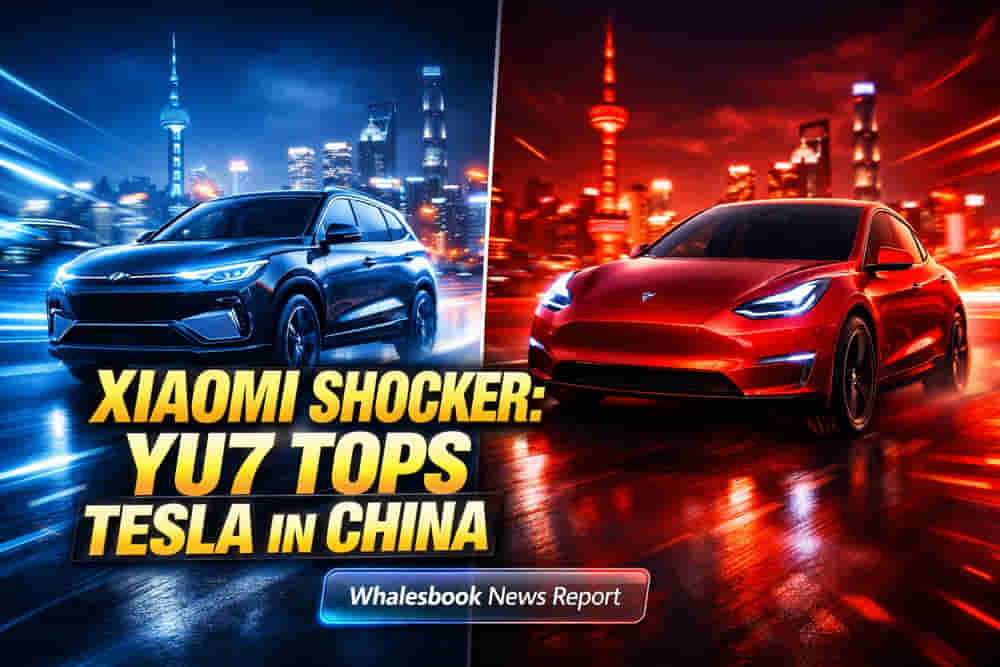
Xiaomi's YU7 Claims January Sales Crown
Xiaomi's YU7 SUV captured the top spot in China's vehicle sales for January 2026, a notable achievement that saw it outsell Tesla's Model Y. The YU7 sold 37,869 units, more than double the 16,845 domestic retail units of the Model Y. This performance pushed the Model Y down to 20th place overall and seventh among new energy vehicles (NEVs) for the month. Despite January typically being a slower sales month, the YU7 demonstrated robust momentum, climbing the rankings consistently since its launch in June 2025. This sales victory for Xiaomi comes as the broader Chinese NEV market faced headwinds, recording its first year-on-year decline in two years, impacted by new purchase tax policies and the expiration of trade-in subsidies.
Shifting EV Dynamics and Competitive Pressures
The January figures reveal a dynamic shift in China's highly competitive EV market. While Tesla's domestic sales in China declined by 45% year-over-year to 18,485 units, its Shanghai factory significantly ramped up exports, shipping 50,644 vehicles abroad. This export-heavy strategy means that 73% of Giga Shanghai's January output was destined for overseas markets, a stark increase from previous years, suggesting a strategic pivot away from solely focusing on domestic demand. Tesla's overall market share in China's NEV segment fell to 3.1% in January 2026.
Meanwhile, other domestic players like Geely saw strong performance, with its Boyue L and Geome Xingyuan models ranking second and third in overall sales for January. BYD, the dominant force in China's auto industry in 2025 with over 3 million vehicles sold, had only one model, the Fang Cheng Bao Ti7, in the top 20 rankings for January, also prioritizing exports. Xiaomi's total EV deliveries for January reached 39,002 units, with the YU7 accounting for over 97% of this volume. The company aims to deliver 550,000 EVs in 2026.
The Bear Case: Sustainability and Valuation Concerns
While Xiaomi's YU7 victory is a notable monthly achievement, it occurs within a context of a contracting domestic market and Tesla's strategic international focus. Tesla's reliance on exports from its Shanghai plant, while boosting wholesale numbers, highlights a potential softening of domestic consumer appetite or a strategic reallocation of resources to balance global demand. The sharp year-over-year decline in Tesla's Chinese retail sales and its shrinking market share raise concerns about its long-term competitive position against increasingly capable domestic rivals.
Xiaomi's own product cycle presents potential volatility; the SU7 sedan's sales have declined significantly as a refreshed model approaches. Furthermore, both companies face scrutiny over their valuations. Tesla's trailing P/E ratio hovers around an extremely high 360-398, suggesting that immense future growth is already priced into its stock, making it vulnerable to any deviations from optimistic forecasts. Xiaomi, while trading at a more moderate P/E of approximately 19-21, still requires sustained earnings growth to justify its valuation.
Outlook Amidst Market Shifts
The January 2026 sales data from China reflects a maturing and increasingly competitive EV market. Xiaomi's YU7 success is a testament to its rapid market penetration, but the sustainability of this performance will be tested against ongoing macroeconomic factors and the strategic adjustments of global players like Tesla. The overall contraction in the Chinese NEV market in January, the first in two years, signals a more challenging environment ahead, demanding resilience and adaptability from all automakers operating within this crucial automotive hub.