
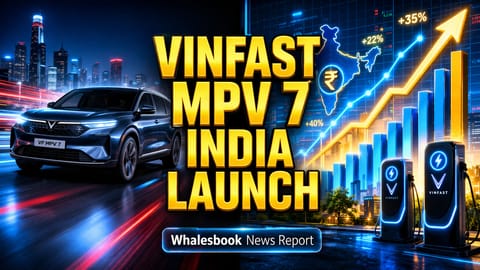
VinFast Launches VF MPV 7 in India
VinFast is entering India's growing family EV market with the VF MPV 7, aiming to capture a substantial share in one of the world's fastest-growing auto economies. This launch builds on its existing presence with the VF 6 and VF 7 SUVs, targeting demand for practical electric multi-purpose vehicles.
VF MPV 7 Details and Pricing
VinFast has opened bookings for its VF MPV 7, a seven-seater electric MPV, in India, with prices expected between ₹19 lakh and ₹24 lakh. This follows the September 2025 launch of its VF 6 and VF 7 electric SUVs, which have collectively sold over 1,000 units by early 2026. The VF MPV 7 is 4,740 mm long with a 2,840 mm wheelbase. It features a 60.13 kWh battery offering over 500 km of range and can fast charge from 10% to 70% in about 30 minutes. CEO Tapan Ghosh said the vehicle aims to "set benchmarks in its segment and provide a practical alternative to conventional vehicles for larger households," supporting VinFast's goal of expanding electric mobility in India.
Competition in the Indian EV Market
VinFast's VF 6 and VF 7 are already competing in India between ₹16.5 lakh and ₹26.8 lakh against rivals like Tata Motors and BYD. In late 2025, VinFast reported selling 291 units in November, exceeding Tesla's 48 units that month, partly due to competitive pricing and local production. The VF MPV 7 enters a segment poised for more competition, with Maruti Suzuki expected to launch its electric MPV (codenamed YMC) in late 2026. Other potential competitors include Kia's Carens Clavis EV and Mahindra's XEV 9S. VinFast's target price range of ₹19-24 lakh places it directly against these rivals, aiming to balance value with its current offerings, which have seen price adjustments after initial offers.
India's EV Ecosystem and Policy
India's EV market is expanding rapidly, with projections of 10-15% penetration by 2030, but faces significant challenges. Consumer interest in sustainability is strong, but sales depend heavily on affordability, performance, and charging availability. Government incentives like the PM E-DRIVE scheme are being adjusted, with reduced subsidies. Building charging infrastructure is ongoing, with costs varying widely for public stations. VinFast plans to expand its showroom network to 75 outlets by the end of 2026, aiming to reach customers beyond major cities, which is vital for widespread EV adoption.
VinFast's Financial Struggles
VinFast's global expansion, including its Indian investment, is supported by significant funding pledges totaling $17 billion from founder Pham Nhat Vuong and parent Vingroup by November 2024. Despite this, the company reports substantial losses, with a net loss of nearly $4 billion last year, and its break-even point is now projected beyond 2027. Financial indicators show liquidity issues, with a current ratio of 0.51 and a debt-to-equity ratio of -0.52. VinFast has shifted focus from the U.S. and Europe to emerging markets like India, Indonesia, and the Philippines. While local assembly in Tamil Nadu aids competitive pricing, the company has faced product quality issues and recalls in the past. Its aggressive pricing and features that previously boosted sales are challenged by rising costs and competition, putting pressure on profit margins.
Future Outlook in India
VinFast seeks to gain market share by offering value-priced EVs. However, its long-term success depends on managing fierce competition, rising operational costs, and achieving profitability from its extensive global investment. Analysts anticipate gross profit break-even could occur between 2027 and 2028. VinFast's ability to sustain operations, adapt products for India, and balance premium features with affordability will be key to its future in the Indian market.