

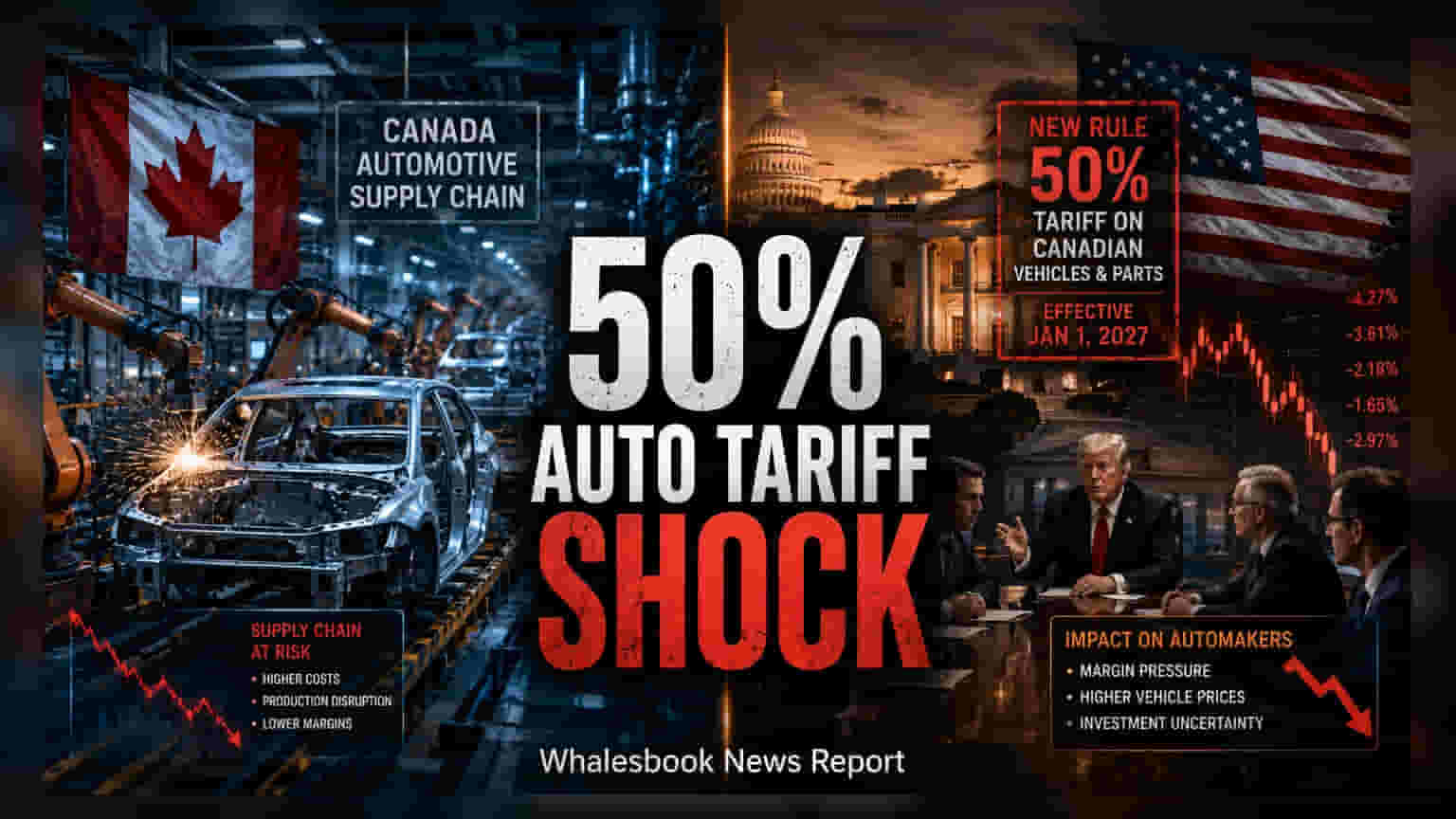
President Donald Trump has announced a 50% tariff on Canadian vehicles and auto parts starting January 1, 2027. This decision follows failed trade talks and creates a major supply chain crisis for global automakers like Ford, GM, and Toyota. In response, Canada plans retaliatory measures on U.S. goods, which may significantly pressure profit margins and increase production costs across the North American auto sector.
President Donald Trump has ordered a 50% tariff on vehicles and auto parts imported from Canada, with the new rule set to begin on January 1, 2027. This decision follows the sudden collapse of trade negotiations between the two nations, marking a significant escalation in North American trade tensions. For global automakers, this move is a major hurdle because the industry relies on deeply connected supply chains where parts and vehicles frequently cross the U.S.-Canada border.
Major manufacturers such as General Motors, Ford, Stellantis, Toyota, and Honda are among the most exposed to this change. These companies often produce high-volume vehicles, such as the Chevrolet Silverado, Toyota RAV4, Honda CR-V, and Chrysler Pacifica, using a mix of plants and components from both countries. Under the new rules, the cost of moving these vehicles and parts across the border will rise sharply, making current production models much more expensive to maintain.
The situation is creating a two-way trade conflict. Canada has announced its own plans to apply retaliatory tariffs of up to 50% on approximately $20 billion worth of U.S. goods, including steel, dairy, and agricultural machinery, starting September 8, 2026. This reciprocal action adds a layer of uncertainty for U.S. companies that export products to Canada, potentially affecting a wider range of businesses beyond just the automotive sector.
For investors, the primary concern is the potential for sharp margin compression. Automakers now face a difficult choice: they must either absorb the high cost of the tariffs, which would lower their profits, or attempt to move production entirely into the U.S., which requires massive amounts of money spent on expansion and takes considerable time to achieve. If companies choose to pass these higher costs on to customers, it could lead to higher vehicle prices, potentially slowing down sales volume.
The most important updates to follow over the coming months are whether a diplomatic solution is reached before the January 1 deadline and how individual automakers alter their production strategies to cope with the new trade reality. Investors should closely track official company announcements, specifically any comments regarding supply chain shifts and updates to their financial guidance for the coming year.