

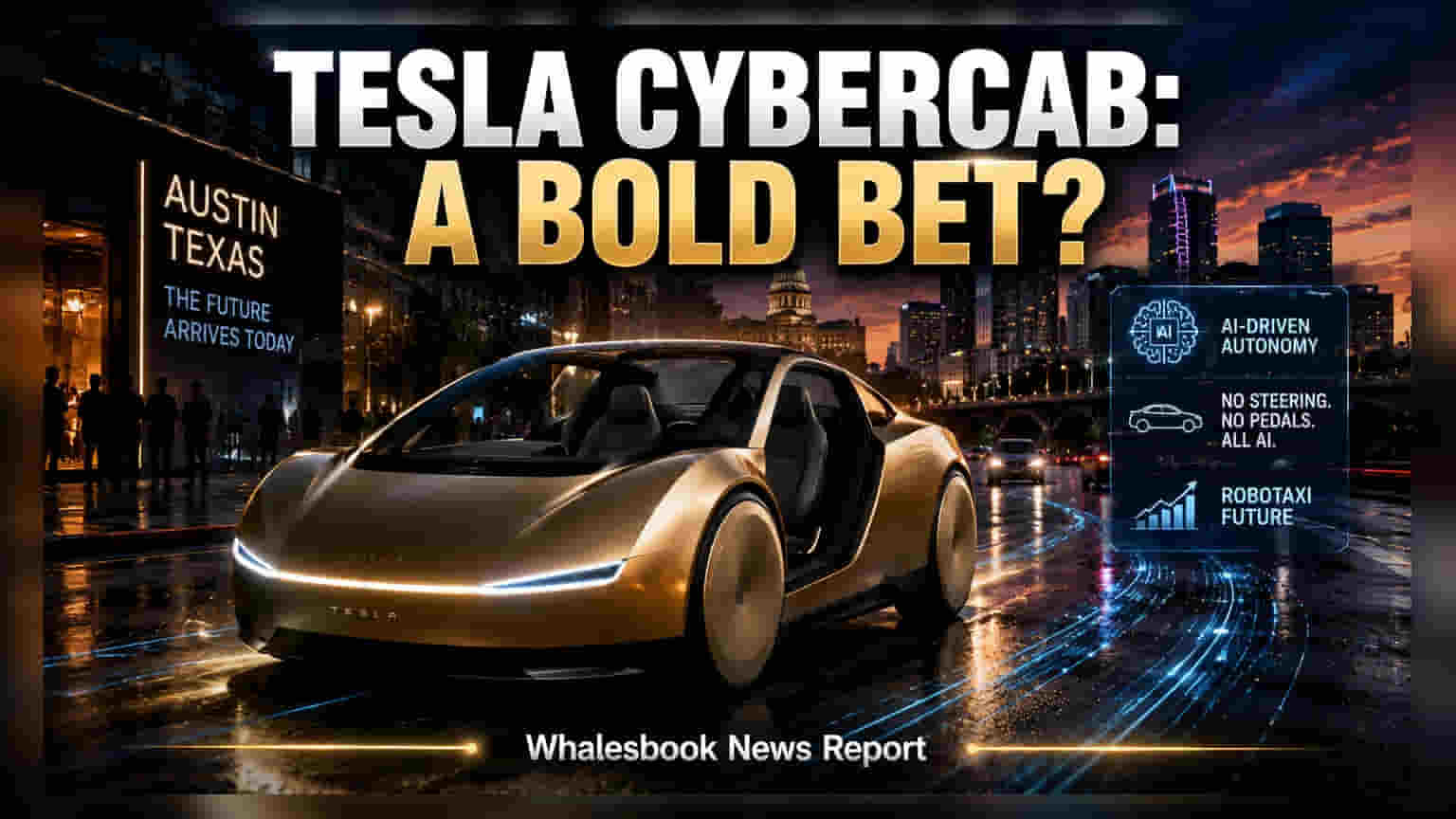
Tesla is debuting its purpose-built Cybercab in Austin, Texas, signaling a critical move from electric vehicle manufacturing to autonomous robotics. While the stock has rallied 7% ahead of the event, the company faces pressure from shrinking profit margins and intense competition. Investors are now looking for clear plans on commercial deployment to justify the company's long-term valuation.
Tesla is hosting an invite-only event in Austin, Texas, today to showcase its long-awaited 'Cybercab.' This two-seater, pedal-less, and steering wheel-less vehicle represents the company's attempt to transition from a traditional electric vehicle manufacturer to a leader in AI-driven robotics. The launch comes as Tesla aims to move beyond its current driver-assistance technology and prove that it can successfully deploy a fully autonomous transport network.
The market has reacted with anticipation, with Tesla's stock rallying approximately 7% in the days leading up to the event. Despite this recent gain, the share price remains about 18% lower for the year so far, reflecting investor caution amidst a shifting business model. The success of the Cybercab is viewed by many as a make-or-break moment for the company's strategy, as future growth expectations for Tesla are heavily pinned on its ability to dominate the autonomous taxi market.
From a financial perspective, the company is at a sensitive juncture. Tesla’s second-quarter 2026 earnings report highlighted significant pressure on profitability, with the operating margin falling to 1.4%. Furthermore, the company has been spending more cash on research and development for AI and robotics projects than it is currently generating from its core automotive sales, leading to negative free cash flow. This financial reality makes the commercial viability of the Cybercab critical, as the company needs to demonstrate that these heavy investments can eventually lead to sustainable profit growth.
While Tesla has begun manufacturing the Cybercab and has reportedly registered about 45 units for testing, moving from controlled demonstrations to a real-world commercial network presents major hurdles. The company faces stiff competition from established players like Waymo, which have already gained experience in running autonomous fleets. Additionally, Tesla must clear significant regulatory and safety requirements to operate vehicles without human drivers. Any high-profile incident or failure to provide a credible, near-term plan for scaling the fleet could lead to renewed volatility in the stock price.
For investors, the immediate focus will not just be on the vehicle's design or features, but on the company's strategy for commercial deployment. The market will be watching for details on how quickly Tesla intends to expand its fleet, how it plans to navigate the complex regulatory environment for unsupervised driving, and whether the business can improve its profit margins. The outcome of the Austin rollout serves as a key indicator of whether Tesla can successfully evolve into an AI-focused firm or if it will remain primarily an electric vehicle producer under intense price competition.