

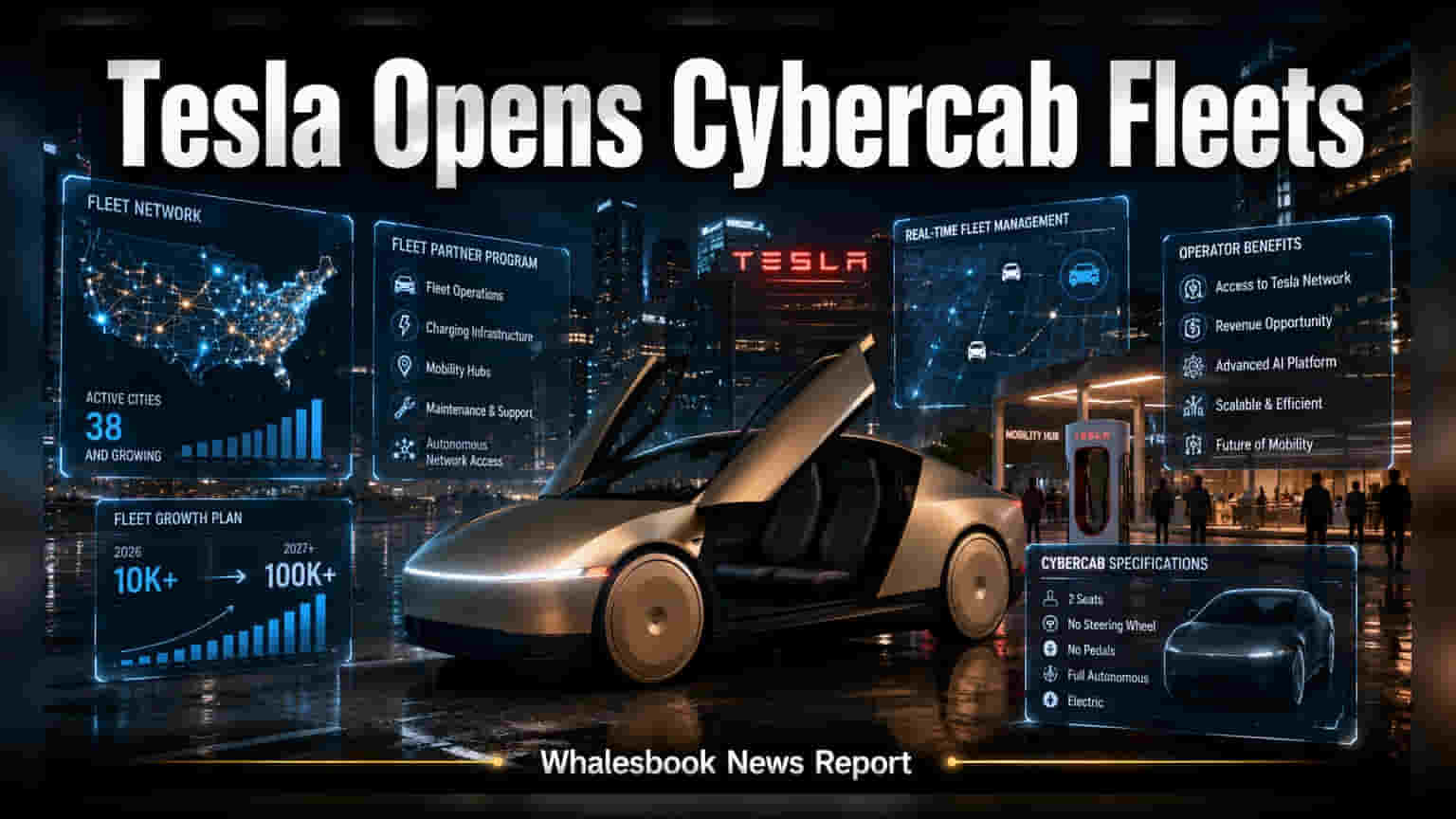
Tesla has launched an interest form for external businesses to manage its Cybercab robotaxi fleets, marking a major shift in its autonomous strategy. Investors responded positively to the announcement, sending the stock up 6.35% to $379.67. The move aims to accelerate market expansion by moving beyond the company's previous in-house operating model.
Tesla has officially invited third-party operators to join its Cybercab robotaxi network, marking a significant strategic pivot for the electric vehicle manufacturer. On September 3, 2026, the company launched an interest form on its website, encouraging businesses to partner with Tesla to manage fleets, develop charging infrastructure, and set up mobility hubs for its autonomous vehicles.
This move represents a departure from Tesla's earlier strategy, which focused on an in-house, controlled model where the company would manage the entire robotaxi ecosystem alone. By opening the network to external operators, Tesla is attempting to address the operational challenges of scaling its autonomous service. This approach mirrors the business models used by established competitors in the ride-sharing space, who often partner with third-party fleet managers to handle maintenance, local logistics, and charging requirements.
Market participants reacted positively to the update and the accompanying launch event in Austin, Texas. Shares of Tesla (TSLA) rose by 6.35% during the September 3, 2026, trading session, closing at $379.67. For investors, the price movement reflects optimism that the company is successfully shifting toward a more sustainable and scalable business structure for its autonomous division.
While the expansion plan seeks to increase the footprint of the Cybercab, which is a two-seat vehicle designed without steering wheels or pedals, the company faces distinct challenges. A primary monitorable for investors is the regulatory hurdle. Although the company has secured some permits for testing, vehicles without manual controls face strict safety and legal scrutiny in many jurisdictions. Tesla must ensure it can navigate these diverse regulatory environments to operate its robotaxi fleet at scale.
Execution risk also remains a key factor. Tesla is transitioning from building vehicles for individual consumers to creating a specialized fleet for autonomous transit. The success of this model will depend on the company's ability to manufacture these purpose-built vehicles efficiently and the willingness of third-party partners to invest in the required infrastructure. Furthermore, as Tesla enters the robotaxi market, it will compete directly with well-funded, established autonomous driving companies that have already gained experience through partnerships with local fleet operators.
Indian investors tracking Tesla should note that the company is not listed on the NSE or BSE. However, developments in the global autonomous sector often influence the technology and mobility indices that impact related stocks. Moving forward, the key factor for investors to track will be the progress in fleet manufacturing and the company's ability to secure reliable third-party partnerships, which will determine if this new model can generate consistent revenue.