

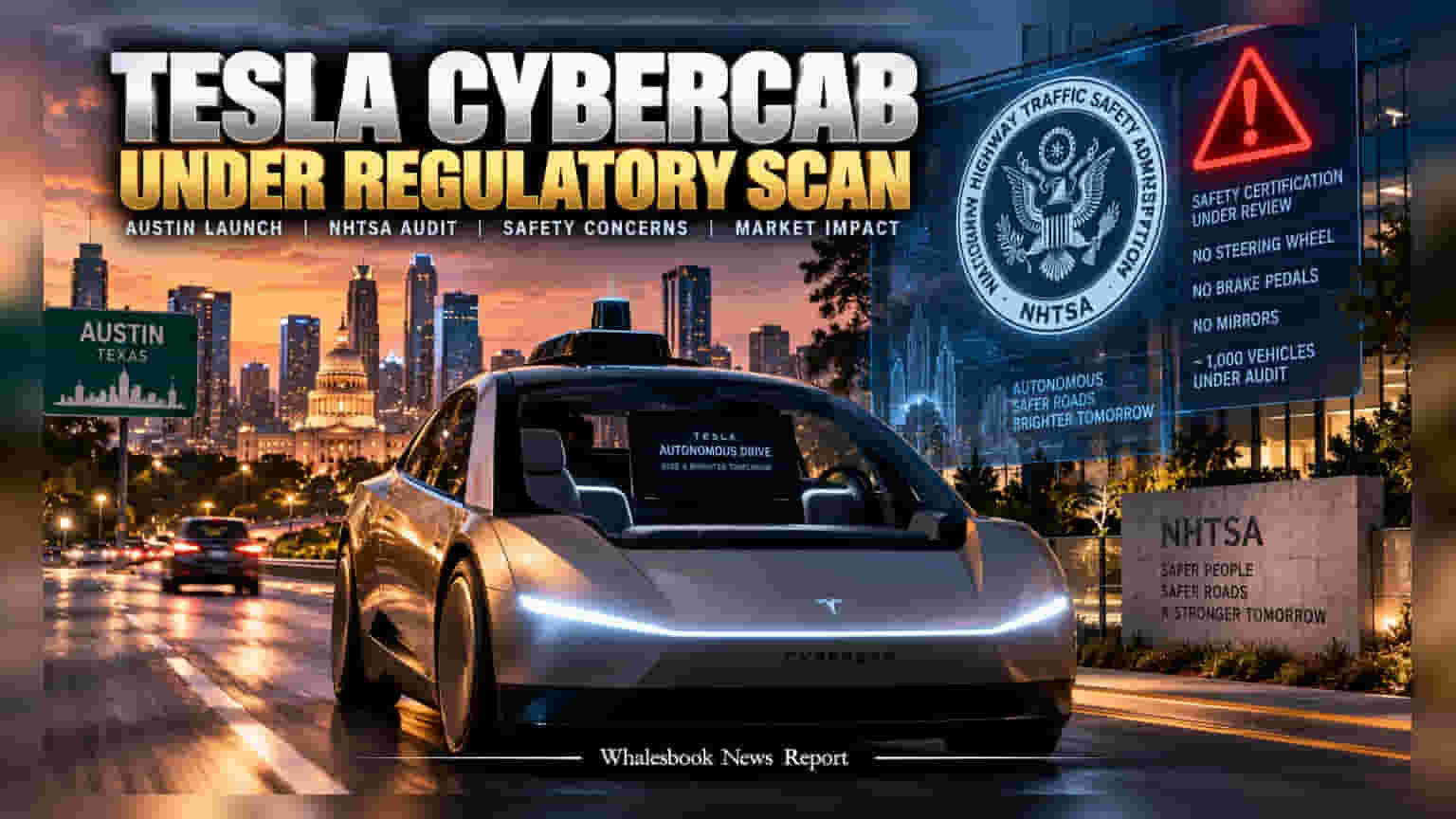
Tesla’s new Cybercab faces a federal investigation by the NHTSA just days after its Austin launch. The probe examines whether 1,000 steering-wheel-free vehicles meet safety standards. This regulatory uncertainty, combined with investor disappointment over the launch’s lack of detail, led to a 5.9% drop in Tesla’s stock price on September 4. The news highlights challenges for the company as it tries to scale its autonomous taxi business.
Tesla’s push into robotaxis has encountered a significant regulatory hurdle shortly after starting its limited service in Austin, Texas. On September 3, 2026, the National Highway Traffic Safety Administration (NHTSA) opened an audit query into Tesla’s autonomous driving strategy. The federal agency is investigating the safety certification of approximately 1,000 Tesla vehicles. These cars are unique because they lack traditional manual controls, such as steering wheels, brake pedals, and mirrors. While Tesla self-certified these units as meeting safety requirements, the NHTSA is checking whether this process fully aligns with federal safety standards.
The news has tempered investor excitement following the vehicle's unveiling. Market analysts noted that the reveal event lacked clear details on production scale, deployment timelines, and service rollouts. This lack of clarity, compounded by the new regulatory investigation, caused Tesla’s share price to decline by 5.92% on September 4, 2026.
The regulatory scrutiny arrives at a sensitive time for the company's financials. Tesla reported operating margins of 1.4% in the second quarter of 2026, indicating that the company is already under pressure to manage costs while investing heavily in research and new technology. Because the company’s valuation is closely tied to its future in robotics and artificial intelligence, any delay in the Cybercab program could affect its ability to generate returns on these high expenses. The company faces the challenge of proving that its end-to-end AI systems can meet the strict safety criteria required for mass-market autonomy.
While rivals like Waymo continue to operate their own autonomous fleets, Tesla is trying a different approach by removing traditional vehicle controls. The core conflict is between Tesla’s rapid innovation cycle and federal safety expectations. For shareholders, the risk is that the NHTSA may require changes to the vehicle design or the certification process, which could force a delay in wider commercial deployment. Investors will monitor official reports from the NHTSA to see if the current Austin service can continue as planned or if the regulator will impose stricter requirements on the fleet.