

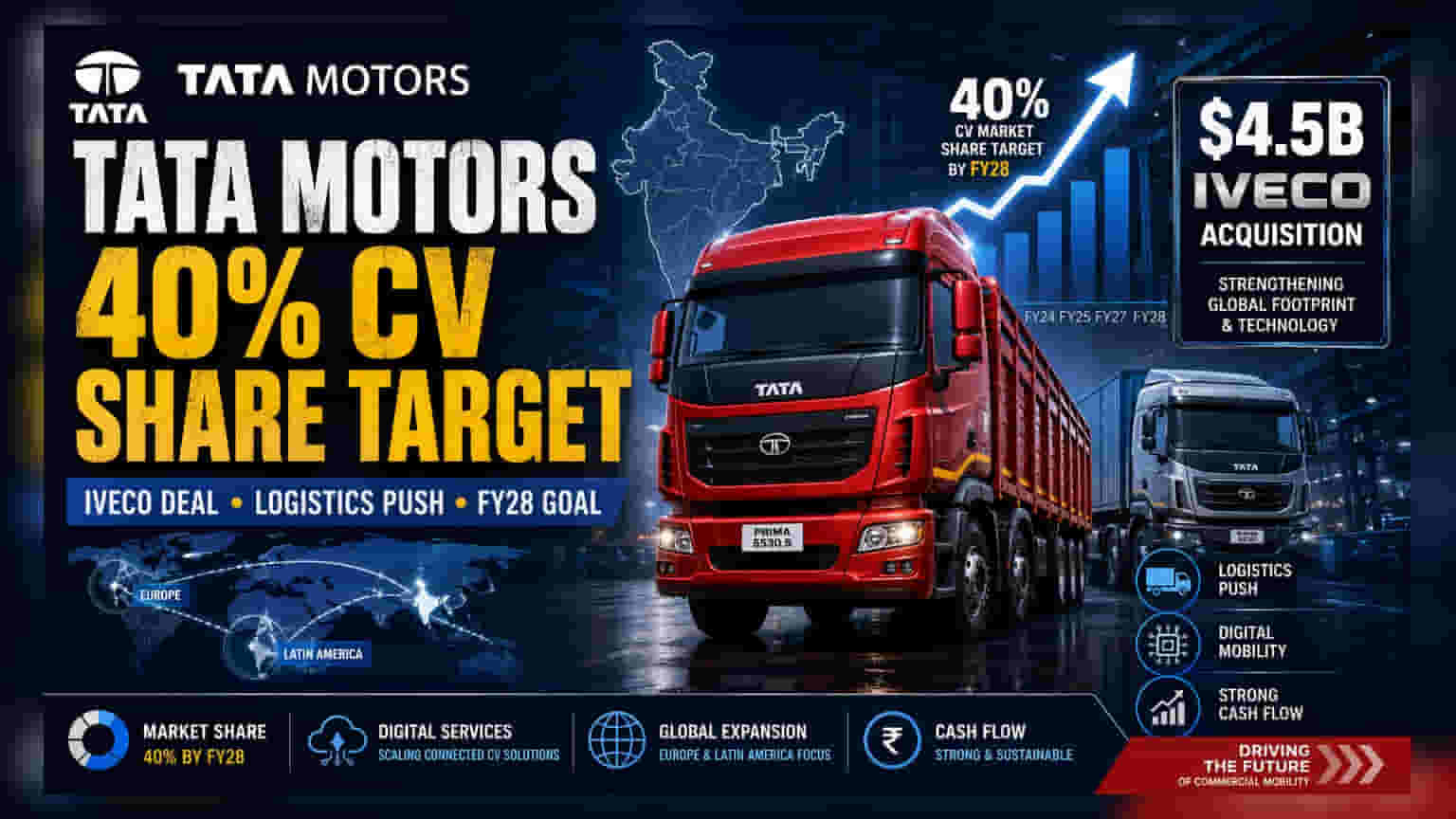
Tata Motors has announced an ambitious goal to capture 40% of India's commercial vehicle market by fiscal year 2028. To support this, the company is focusing on global growth, digital services, and a proposed $4.5 billion acquisition of Italy's Iveco. Investors are watching how this strategy helps reduce dependence on traditional, cyclical truck sales.
What Happened
Tata Motors has set a bold target to secure a 40% market share in India's commercial vehicle (CV) segment by fiscal year 2028. This plan comes alongside a broader strategy to transform the company from a traditional truck manufacturer into a comprehensive logistics and mobility platform. A centerpiece of this global ambition is the proposed $4.5 billion acquisition of Italian truck maker Iveco, which the company aims to complete by the second quarter of the 2027 fiscal year, pending regulatory approvals. By combining its domestic strength with Iveco's established footprint in Europe and Latin America, Tata Motors intends to access new technologies and global markets.
The Shift to Non-Cyclical Growth
The commercial vehicle industry is historically known for being "cyclical," meaning demand rises and falls sharply based on the health of the broader economy. To reduce this volatility, Tata Motors is diversifying its revenue. Recent reports indicate that the company is expanding its focus on digital platforms, mobility services, and international operations. While these non-core areas currently account for a smaller portion of total revenue, they are growing at a double-digit pace, helping to stabilize the company's financial profile even when truck sales face pressure from commodity price fluctuations or economic slowdowns.
Competition and Demand Context
The Indian commercial vehicle market remains highly competitive, with players like Ashok Leyland, Mahindra, and others actively vying for market share. Tata Motors has recently maintained its focus on pricing discipline and product mix—prioritizing high-margin heavy commercial vehicles over volume-at-any-cost. Additionally, the company has announced a price increase of up to 2.5% across its commercial vehicle portfolio effective July 1, 2026, to manage rising input costs. Despite short-term challenges like diesel price volatility and geopolitical concerns, the long-term outlook remains supported by India's infrastructure development and rising freight demand.
Financial and Operational Health
Tata Motors has reported strong financial performance for fiscal year 2026, characterized by record cash flows and improved profitability. The company has focused on reducing debt, aiming for a cleaner balance sheet as it pursues its ambitious growth targets. Unlike the past where high debt was a concern, the current focus on free cash flow generation is aimed at providing the company with the financial flexibility to fund its expansion plans without over-relying on external borrowing.
What Investors Should Track
For investors, the immediate monitorables include the regulatory progress and finalization of the Iveco acquisition, as large cross-border deals often face integration challenges such as cultural differences, management alignment, and regulatory hurdles. Additionally, tracking the market share data in the coming quarters will be critical to see if the 40% target remains on track. Finally, monitor management commentary on how the new digital and services businesses are contributing to profit margins, as this will be the key test of whether the company can successfully lower its cyclical risks.